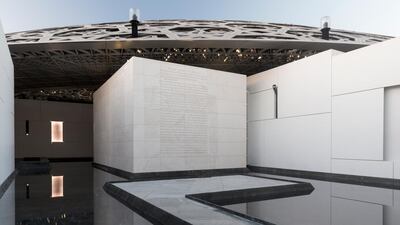

Louvre Abu Dhabi opened its doors to the public three years ago today. Since then, it has welcomed millions of visitors from around the world. From the start, the museum's approach has been cross-cultural, in an endeavour to encompass everyone within its home of Abu Dhabi.
In the past three years, Louvre Abu Dhabi has presented significant artefacts and works of art from around the world and across the region, including Auguste Rodin's The Thinker sculpture and the world's oldest natural pearl at about 8,000 years old, which was found in the capital last year.
Much like other museums globally, Louvre Abu Dhabi had to close its doors from March to June because of the Covid-19 pandemic. However, it kept up its activities online, from the release of the cinematic podcast We Are Not Alone, featuring the voice of famed architect Jean Nouvel, the man behind the museum's dome, to the launch of its digital archive, which will house its permanent collection in the coming months. Its latest commission, a short film titled The Pulse of Time, will be released today.
"The achievements of Louvre Abu Dhabi in three short years have made a remarkable impact on the emirate’s cultural scene. Looking back at the past year, I am particularly proud of the way we have adapted to the changing environment, bringing Louvre Abu Dhabi into the homes of millions of people through creative and educational digital initiatives that reflect the museum’s vision to showcase humanity’s cross-cultural connections throughout time," said Mohamed Al Mubarak, Chairman of the Department of Culture and Tourism - Abu Dhabi in a statement.
On its anniversary, the museum has also announced new acquisitions to its permanent collection including a number of artefacts such as a third century statue from Mesopotamia titled Sumerian Statue of a Female Worshipper, which will go on display alongside a statue from Egypt titled Statue of a Kneeling Man (circa 4th to 7th century), in addition to an 11th century Jain sculpture titled Standing Jina from India. Other acquisitions announced include The Adoration of the Magi (circa 1523) by Flemish artist Pieter Coecke van Aelst, Saint-Joseph by Spanish painter Jusepe de Ribera, a series by an anonymous artist titled Eight Paintings of Foreign Dignitaries from 18th century China, and Belorussian-French artist Marc Chagall's Between Darkness and Night (1938-43).
Louvre Abu Dhabi, along with NYU Abu Dhabi, will also host an online symposium on the future of museums from Monday, November 16 to Wednesday, November 18, tackling issues such as the pandemic and representation within arts and cultural institutions.
Here, we take a look at some key pieces from the museum’s collection:
-
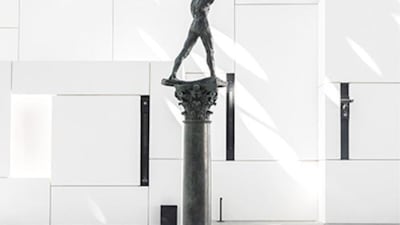
‘The Walking Man, On a Column’ is a sculpture of a man devoid of head and arms. The sculpture, by Auguste Rodin, was part of the world’s fair in Paris in 1900, where the artist had an exhibition of his work. Today, the piece sits under Louvre Abu Dhabi’s dome. DCT Abu Dhabi / Thierry Olivier -

Osman Hamdi Bey’s 1878 painting ‘Young Emir Studying’ depicts a young man reading a manuscript. While the character and the setting look very specific, the story behind the painting reveals that it is an imaginary scene created by the artist. DCT Abu Dhabi / Agence PhotoF -

The funeral set of princess Henuttawy, the daughter of a pharaoh, is an exceptional set of nested sarcophagi and a cartonnage case, both of which have her name and titles repeated on them. Although the identity of the pharaoh remains unknown, it is certain that it belonged to the royal families of the 22nd Dynasty (945-715 BCE). DCT Abu Dhabi / Thierry Ollivier -

‘A Collar of the Order of the Golden Fleece’ goes back to the 16th century and was worn by the knights loyal to Philip the Good, the Duke of Burgundy, as a pledge of obedience. This particular collar belonged to Adrien de Croy, one of the faithful counsellors of Charles V, Holy Roman Emperor and Duke of Burgundy, who bestowed it on him in 1519. DCT Abu Dhabi / Thierry Ollivier -

This is one of a series of nine pieces ‘(Untitled I-IX)’ by American painter Cy Twombly, from 2008. Painted in white on blue, the canvas depicts an almost abstract form of musical expression that has blurred the lines between drawing and writing. DCT Abu Dhabi / Agence PhotoF / Cy Twombly Foundation



