Taysir Batniji’s brother, Mayssara, had borrowed the artist's sketchpad on the day he was killed in Palestine. The sibling drew an image of a soldier shooting a gun, and hours later he was shot by a sniper. It was 1987, and the First Intifada was under way.
The memory of that drawing and the indentations it left on the page would come back to Batniji decades later, when he created his work To My Brother in 2012.
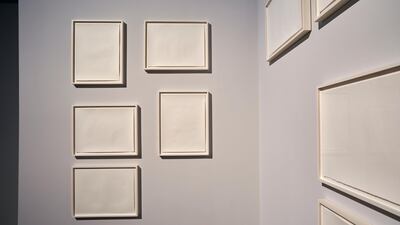
The piece comprises a series of 60 inkless drawings, or, more accurately, carvings onto white paper that resemble sculptural reliefs. The visuals are based on family photographs taken during Mayssara's wedding, which took place two years before his death.
At first glance, the framed works in the room appear blank. Viewers must step closer to see the traces. There are joyful scenes of guests dancing, family members embracing, and the bride and groom together.
To My Brother now fills one of Jameel Arts Centre's new group of Artist's Rooms, where it will be on view in Dubai until January 2021.
Batniji's other range of works also deal with erasure, remnants of memory and presence. For example, his watercolour paintings Traces mimic the glue residue of tape placed on posters or pictures.
Born in Gaza, the artist moved abroad in 1993 and now lives in Paris, France. His work, though informed by Palestinian identity, goes beyond the politics and digs into the personal.
“I choose always to take things from another point, to evoke things in a very subjective way based first on my experience as a Palestinian, as a person, and it will reflect collective issues anyway," he explains. "In one way or another, your life overlaps with the collective story.”
It is also his way of taking on Palestinian identity. “I want to escape this image of victimhood. For many, the Palestinian is seen as a victim or, for others, a terrorist. Both cases are not productive. You are not seen as a normal human,” he says. “As Palestinians, we are human beings like others in the world. We have dreams. We have questions. We have other issues too.”
Batniji's brother was 25 years old when he was killed, and those responsible for his death have not been identified. "There is no justice for Palestinians. Every day, Palestinians are killed," he says, citing the death of Eyad Hallaq, an autistic man who was shot by Israeli forces outside of his special needs school in May.
Batniji links the Palestinian struggle with the longstanding fight against racism in America, seeing both groups involved as navigating and surviving systems of oppression.
I hope with this new movement, Black Lives Matter, and what is happening in the US will bring change in this sense
“I hope with this new movement, Black Lives Matter, and what is happening in the US will bring change in this sense. The world is now compensating the killers more than the victims, but I hope this will change,” he says.
In the US, protests have been raging for weeks after the tragic death of George Floyd. “What is happening in the US, we as Palestinians support strongly. We all have to stand against racism,” Batniji says.
In creating To My Brother, the artist wants to compel people towards awareness and reflection. To compose his drawings, the artist traced the prints of film negatives, engraving the lines and curves with a dry pen on paper. "I want people to be involved in the work, to look at it. The viewer is obliged to move, to get closer, to see both sides and see the light to see something," he says.
Even then, one never really sees the full picture. In this way, the work transcends politics, speaking instead of the emptiness of grief, but also its incomprehensibility. We can sense its depth, but our attempts to express it feel incomplete, inadequate. Like the engravings, loss is not always visible, but it lingers just beneath the surface.
Other Artist’s Rooms
In another Artist's Room at the centre, Lawrence Abu Hamdan's This Whole Time There Were No Land Mines barrages the senses with a deafening sound and video installation.
On two rows of screens, mobile phone footage of skirmishes from a 2011 incident in the Golan Heights, Syria play on a loop. The conflict took place in the “shouting valley”, a contested piece of land annexed by Israel in 1967 where family members often yell messages to each other at the border. On the day depicted in Abu Hamdan’s work, 150 Palestinian protestors were able to cross the border into the occupied territory.
The final Artist's Room features Larissa Sansour's In Vitro, a black-and-white science-fiction film initially presented at last year's Venice Biennale, where it was shown at the Danish Pavilion. Set in post-apocalyptic Bethlehem, the film centres on two female scientists a generation apart. Both live in a bunker with an orchard of heirloom seeds collected as part of a plan to someday replant them in the ground above.
Dunia, the founder of the orchard, speaks to her successor, Alia, who has never been above ground. Their powerful and moving dialogue speaks of loss, memory and exile pertinent to the occupation in Palestine.
In an interview with The National last year, Sansour spoke about her distinctive use of the science-fiction genre. "It came out of a need … [to defy] expectations of a Middle Eastern artist and a woman," she said. "Working with sci-fi is quite liberating, because I work with difficult issues … I like to contextualise these dialogues in a framework that is not really expected."
The haunting film shot in monochrome considers the remaking of a national identity inflicted with generational trauma and loss.
Jameel Arts Centre’s Artist’s Rooms will run until January 2021

School counsellors on mental well-being
Schools counsellors in Abu Dhabi have put a number of provisions in place to help support pupils returning to the classroom next week.
Many children will resume in-person lessons for the first time in 10 months and parents previously raised concerns about the long-term effects of distance learning.
Schools leaders and counsellors said extra support will be offered to anyone that needs it. Additionally, heads of years will be on hand to offer advice or coping mechanisms to ease any concerns.
“Anxiety this time round has really spiralled, more so than from the first lockdown at the beginning of the pandemic,” said Priya Mitchell, counsellor at The British School Al Khubairat in Abu Dhabi.
“Some have got used to being at home don’t want to go back, while others are desperate to get back.
“We have seen an increase in depressive symptoms, especially with older pupils, and self-harm is starting younger.
“It is worrying and has taught us how important it is that we prioritise mental well-being.”
Ms Mitchell said she was liaising more with heads of year so they can support and offer advice to pupils if the demand is there.
The school will also carry out mental well-being checks so they can pick up on any behavioural patterns and put interventions in place to help pupils.
At Raha International School, the well-being team has provided parents with assessment surveys to see how they can support students at home to transition back to school.
“They have created a Well-being Resource Bank that parents have access to on information on various domains of mental health for students and families,” a team member said.
“Our pastoral team have been working with students to help ease the transition and reduce anxiety that [pupils] may experience after some have been nearly a year off campus.
"Special secondary tutorial classes have also focused on preparing students for their return; going over new guidelines, expectations and daily schedules.”
Quick pearls of wisdom
Focus on gratitude: And do so deeply, he says. “Think of one to three things a day that you’re grateful for. It needs to be specific, too, don’t just say ‘air.’ Really think about it. If you’re grateful for, say, what your parents have done for you, that will motivate you to do more for the world.”
Know how to fight: Shetty married his wife, Radhi, three years ago (he met her in a meditation class before he went off and became a monk). He says they’ve had to learn to respect each other’s “fighting styles” – he’s a talk it-out-immediately person, while she needs space to think. “When you’re having an argument, remember, it’s not you against each other. It’s both of you against the problem. When you win, they lose. If you’re on a team you have to win together.”
UAE currency: the story behind the money in your pockets
Surianah's top five jazz artists
Billie Holliday: for the burn and also the way she told stories.
Thelonius Monk: for his earnestness.
Duke Ellington: for his edge and spirituality.
Louis Armstrong: his legacy is undeniable. He is considered as one of the most revolutionary and influential musicians.
Terence Blanchard: very political - a lot of jazz musicians are making protest music right now.
UAE currency: the story behind the money in your pockets
Results
5pm: Maiden (PA) Dh80,000 (Turf) 1,200m, Winner: ES Rubban, Antonio Fresu (jockey), Ibrahim Aseel (trainer)
5.30pm: Handicap (PA) Dh85,000 (T) 1,200m, Winner: Al Mobher, Sczcepan Mazur, Ibrahim Al Hadhrami
6pm: Handicap (PA) Dh80,000 (T) 2,200m, Winner: Jabalini, Tadhg O’Shea, Ibrahim Al Hadhrami
6.30pm: Wathba Stallions Cup (PA) Dh70,000 (T) 2,200m, Winner: AF Abahe, Tadgh O’Shea, Ernst Oertel
7pm: Handicap (PA) Dh85,000 (T) 1,600m, Winner: AF Makerah, Tadhg O’Shea, Ernst Oertel
7.30pm: Maiden (TB) Dh80,000 (T) 1,600m, Winner: Law Of Peace, Tadhg O’Shea, Satish Seemar
Real estate tokenisation project
Dubai launched the pilot phase of its real estate tokenisation project last month.
The initiative focuses on converting real estate assets into digital tokens recorded on blockchain technology and helps in streamlining the process of buying, selling and investing, the Dubai Land Department said.
Dubai’s real estate tokenisation market is projected to reach Dh60 billion ($16.33 billion) by 2033, representing 7 per cent of the emirate’s total property transactions, according to the DLD.
Profile of Foodics
Founders: Ahmad AlZaini and Mosab AlOthmani
Based: Riyadh
Sector: Software
Employees: 150
Amount raised: $8m through seed and Series A - Series B raise ongoing
Funders: Raed Advanced Investment Co, Al-Riyadh Al Walid Investment Co, 500 Falcons, SWM Investment, AlShoaibah SPV, Faith Capital, Technology Investments Co, Savour Holding, Future Resources, Derayah Custody Co.
More from Rashmee Roshan Lall
yallacompare profile
Date of launch: 2014
Founder: Jon Richards, founder and chief executive; Samer Chebab, co-founder and chief operating officer, and Jonathan Rawlings, co-founder and chief financial officer
Based: Media City, Dubai
Sector: Financial services
Size: 120 employees
Investors: 2014: $500,000 in a seed round led by Mulverhill Associates; 2015: $3m in Series A funding led by STC Ventures (managed by Iris Capital), Wamda and Dubai Silicon Oasis Authority; 2019: $8m in Series B funding with the same investors as Series A along with Precinct Partners, Saned and Argo Ventures (the VC arm of multinational insurer Argo Group)
Test series fixtures
(All matches start at 2pm UAE)
1st Test Lord's, London from Thursday to Monday
2nd Test Nottingham from July 14-18
3rd Test The Oval, London from July 27-31
4th Test Manchester from August 4-8
Groom and Two Brides
Director: Elie Samaan
Starring: Abdullah Boushehri, Laila Abdallah, Lulwa Almulla
Rating: 3/5
UAE currency: the story behind the money in your pockets
MATCH INFO
Manchester United 1 (Fernandes pen 2') Tottenham Hotspur 6 (Ndombele 4', Son 7' & 37' Kane (30' & pen 79, Aurier 51')
Man of the match Son Heung-min (Tottenham)
