


The 12th Berlin Biennale for Contemporary Art is facing criticism for its inclusion of an exhibition based on the 2004 Abu Ghraib prison scandal in Baghdad.
Sajjad Abbas, Layth Kareem and Raed Mutar — three Iraqi artists taking part in this year’s event — have protested against their work being displayed at the Hamburger Bahnhof, alongside French artist Jean-Jacques Lebel’s installation Poison Soluble, without their consent.
Lebel’s installation, which was being presented in an adjacent space separated by a curtain, and which includes a trigger warning, centres on the torture of inmates at the Abu Ghraib prison.
Graphic photographs of prisoners being abused by US military personnel in Abu Ghraib during the US-led invasion of Iraq in 2003 were leaked to the media in 2004. The images depict prisoners, who had been tortured and abused, forced into humiliating poses for the amusement of the US military personnel.
These images form the foundation of Lebel’s installation. He has combined enlarged versions of the colour photographs with black and white images of Iraqi towns bombed by the US Air Force.
“The aim of this project is to provoke the viewer to meditate on the consequences of colonialism,” Lebel said in his artist’s statement on the Berlin Biennale website.

However, artist and curator Rijin Sahakian has written an open letter in which she addresses the issues pertaining to displaying Lebel’s installation alongside the work of Iraqi artists exploring themes of violence.
Sahakian's letter points out how this Biennale was said to be centred on decolonial engagement, offering repair as a form of agency and a starting point for critical conversation, in order to "find ways together to care for the now”.
“Yet the Biennale made the decision to commodify photos of unlawfully imprisoned and brutalised Iraqi bodies under occupation, displaying them without the consent of the victims and without any input from the Biennale’s participating Iraqi artists, whose work was adjacently installed without their knowledge,” she states in the letter, which has been signed by nearly 400 people.
Abbas, Kareem and Mutar’s exhibits, which include mediums such as painting, video and public installation, explore facets of their real experiences, as Iraqis, of violence as a result of war and occupation.
In 2013, Abbas scaled the "Turkish Building" in Baghdad and painted the words “I can see you” underneath an enlarged photograph of his eye. The building, and Abbas’s eye, faced the Green Zone, home to the US-led coalition forces during the invasion and occupation of Iraq.
While Abbas’s work was taken down, it left a lasting impression. Six years later, I Can See You was resurrected on the same building during the 2019 youth-led Iraqi uprising.
Abbas’s I Can See You installation is interrupted by Lebel’s exhibition. While it can be separately accessed, visitors to the Hamburger Bahnhof museum do in some instances have to walk through the images of the tortured Abu Ghraib prisoners in order to complete their experience of Abbas's work.
After a month of negotiations, Abbas was able to move his banner and video to another venue, the Akademie der Kunste Pariser Platz.
Mutar’s work, Untitled (2012), an oil on canvas painting, is a self-portrait depicting the artist in a surgical mask while being fed fluids by another figure. The work is a reflection of his bond with two friends, also painters, with whom he shared a studio during his time at the University of Baghdad's College of Fine Arts.
The image, while symbolic and melancholic, is also a sensitive and intimate portrayal of Iraqi men, unarmed and averse to acts of violence.
Mutar’s painting has also now been moved to the KW Institute for Contemporary Art.

Kareem’s 2014 video The City Limits is an exploration of the psychological landscape of Iraq, overshadowed by the looming threat of random violence and death.
The video depicts Kareem’s friends and family gathering in a junkyard that was the site of violence in 2006 in Baghdad. There, isolated in abandoned cars, they experience through images and video, the everyday emotional and physical terror and violence of Baghdad.
As part of Biennale’s public programme, Kareem and Sahakian were in discussion on stage when the topic of his video work in relation to Lebel’s installation was explored. Kareem revealed that he had family who were imprisoned at Abu Ghraib and that as victims they hadn’t given permission for their images to be used.
“I can’t accept this,” he said.

Moments later, Kader Attia, lead curator of the biennale, took to the stage to add context as to why Lebel’s installation was included in the exhibition. He cited that the images should be viewed as a means for political change to take place.
Attia and the Berlin Biennale artistic team responded to Sahakian with their own letter, apologising and making changes to how and where the images are being displayed.
“We did not anticipate the hurt caused by the juxtaposition of the works, and this is maybe where the misunderstanding of our intentions comes from. We do not deny our accountability.”
The response also detailed a defence for the inclusion of Lebel’s installation.
“What the presence of the work Poison Soluble wants to incite is a provocative prompt to confront the violence of American colonialism and imperialism across the world (not only in Iraq) that continues through the cultural industries, and its dominion over the imaginary, the media, and of course physical occupation.”
However, the Berlin Biennale didn't address Sahakian’s comments on the impact curatorial decisions could have on Iraqi artists’ autonomy, and how their work is framed on the international art scene.
“The outcome of all of this is a familiar sadness," she states in her letter. "Must Iraqi artists ask, when they are included in exhibitions, if the curatorial premise demands that there be torture victims nearby?”
Sahakian, along with Abbas, Kareem and Mutar, have released a joint statement addressing the Berlin Biennale artistic teams’ response to their open letter.
“The works we shared with this biennale were made in Baghdad in the aftermath of, and in resistance to, US-led wars and invasion. We have a right to contest the curatorial actions of the biennale without it being described as a fight,'” the statement read.
“This is a tired way of painting Iraqis as unable to engage in liberal humanist values and has been used by the coalition to deflect blame for the war’s massacres and failures.”
The statement also explained that Lebel’s exhibition exploits, fetishises and repeats the violence that occurred to the victims of Abu Ghraib, creating artwork from their experience without their consultation while framing it as "work for justice".
“As Iraqis, we know all too well when those who insist on their own authority have no intention of taking accountability for their actions.”
The statement concluded with the artists making the decision to withdraw from the Berlin Biennale.
“We have withdrawn from the Berlin Biennale and appreciate the nearly 400 who have added their signatures in solidarity.”
Sahakian confirmed to The National that they have notified the Berlin Biennale of their decision and “are hoping to have the work (of the artists) taken down as soon as possible.”
Venice Biennale 2022's 'The Milk of Dreams' — in pictures
-
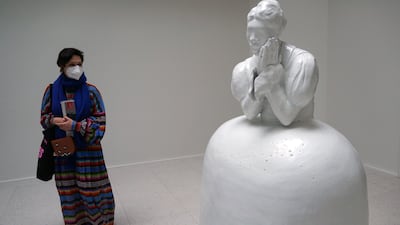
The sculpture 'Anonymous' is part of the Sovereignty exhibition at the Venice Art Biennale, featuring works by US artist Simone Leigh at the US pavilion. Leigh was awarded the Golden Lion for the best presentation. EPA -
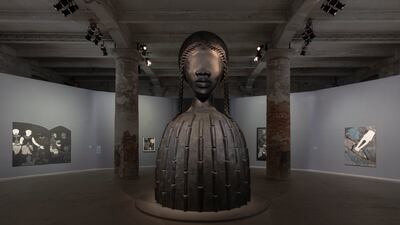
Simone Leigh's sculpture of an eyeless African-American woman, surrounded by Cuban artist Belkis Ayon's prints of a secret Afro-Cuban society in the main exhibition The Milk of Dreams. Photo: Roberto Marossi -
Francis Alys’ 'The Name of the Game' at the Belgian pavilion. Photo: Roberto Ruiz -
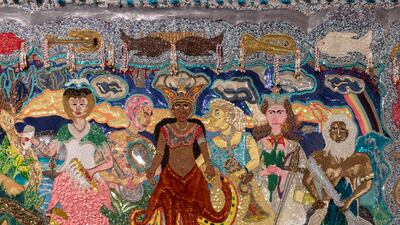
Textiles, and their evocations of craft and slow, painstaking labour, were an important theme, as was spirituality. Both came together in Myrlande Constant's Voodoo flags. Photo: Roberto Marossi -
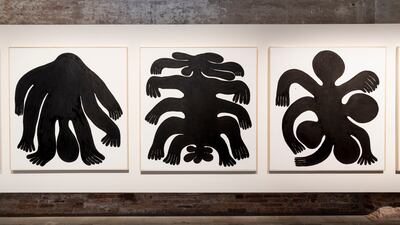
Brazilian artist Solange Pessoa paints creatures on the verge of transformation in 'Sonhiferas, I, 2020', on view in the Arsenale. Photo: Roberto Marossi -
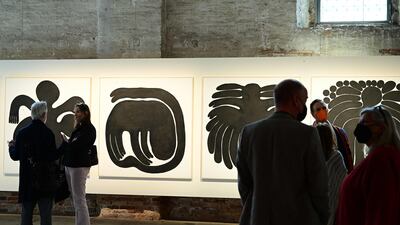
Visitors take in Pessoa's work. EPA -
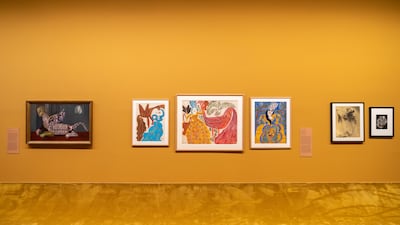
The Milk of Dreams had several 'capsule' shows. One of the best explored the work of female surrealists, or women whose work can be considered in line with Surrealism, such as the Algerian artist Baya Mahieddine. Photo: Marco Cappelletti -
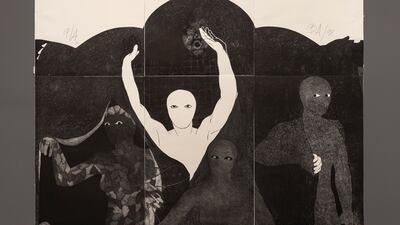
Belkis Ayon's prints document the secret Afro-Cuban society known as Abakua. Photo: Roberto Marossi -

Cecilia Alemani, the Italian curator of the 59th Venice Art Biennale. AFP -
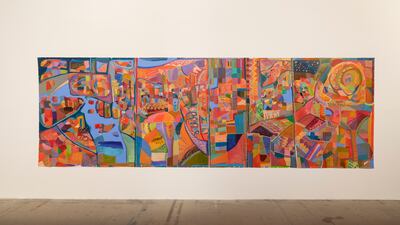
The Milk of Dreams is notable for its wide geographical representation. In the Arsenale, the late US artist Ficre Ghebreyesus shows memories of his youth in Asmara, Eritrea. Photo: Roberto Marossi -
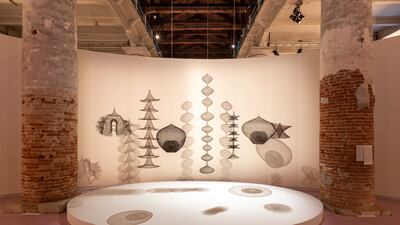
In the section focused on organic forms, this installation by Ruth Asawa is called 'A Leaf a Gourd a Shell a Net a Bag a Sling a Sack a Bottle a Pot a Box a Container'. Photo: Roberto Marossi -
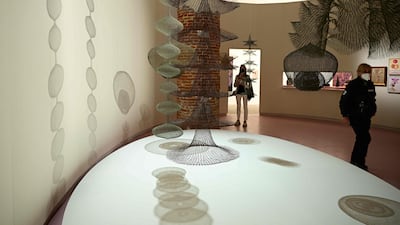
Visitors at Asawa's installation. AFP -
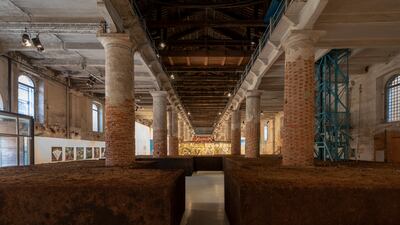
Delcy Morelos' 'Earthly Paradise, 2022', fills the cavernous Arsenale with packed, redolent earth. Photo: Roberto Marossi -

Monira Al Qadiri's drill bits, 'Orbital, 2022', resemble a trio of sci-fi temples. Photo: Roberto Marossi -
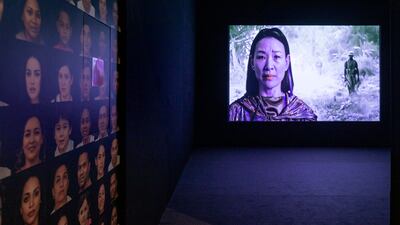
A video and collage by Lynn Hershman Leeson, who connects digital culture to new modes of identity. Cyborgs and digital art are a major sub-theme of the Venice Art Biennale. Photo: Roberto Marossi -
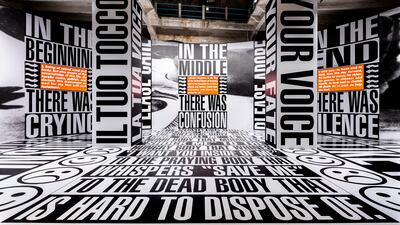
Veteran New York artist Barbara Kruger has been given a whole room to fill with her cutting proclamations on politics and social responsibilities. Photo: Roberto Marossi -
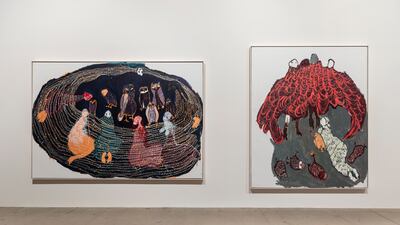
Portia Zvavahera creates oil-based stencils on linen, in invocations of animals and subjects. Photo: Roberto Marossi -
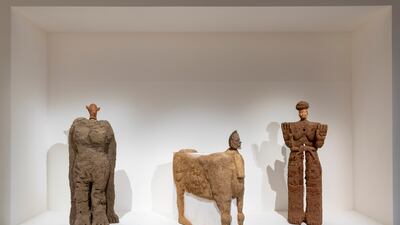
Lebanese artist Ali Cherri's 'Titans, 2022', resemble gods made from the earth itself. Photo: Roberto Marossi -
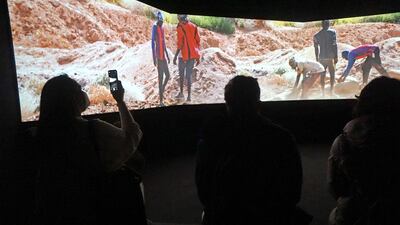
Visitors look at the 'Untitled' installation by Lebanese artist Ali Cherri. EPA



