


The death of Tarek Al-Ghoussein has caused shock and mourning across the UAE and Arab art worlds this week, after the Abu Dhabi-based artist was found unresponsive in New York on Saturday morning.
Al-Ghoussein worked rigorously, and steadily as a photographer, often on large-scale, encyclopaedic projects. He was also an educator and mentor to a generation of young artists at the American University of Sharjah and since 2013 at New York University Abu Dhabi.
Despite his stature within the UAE art world, he maintained a humility and openness that made him not only an important figure, but also a beloved one.
He was born in 1962 in Kuwait to parents of Palestinian origin. His father was a diplomat and he grew up in various locations around the world, including the US, Morocco and Japan. Al-Ghoussein earned his bachelor of fine arts degree in photography from New York University in 1985 and then a masters in photography from the University of New Mexico in 1989. He worked as a photojournalist after graduating, later transitioning into art photography.
-
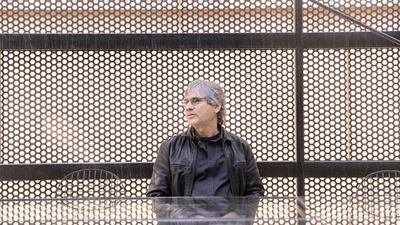
Kuwaiti-Palestinian artist Tarek Al-Ghoussein, who has died at the age of 60 in New York, in Abu Dhabi's Warehouse 421 in November 2018. Reem Mohammed / The National -
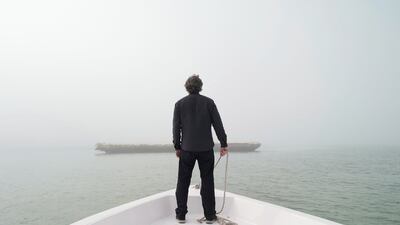
Abu Dhabi Archipelago (Hami Roha Gassar), 2016. Photo: Tarek Al-Ghoussein -
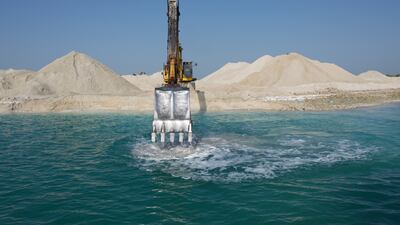
Tarek Al-Ghoussein's Abu Dhabi Archipelago – Island Making (2015), shown at the MEI Art Gallery in Washington. Photo: MEI Gallery -
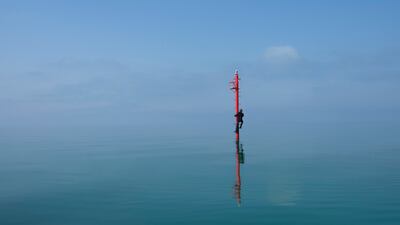
Tarek Al-Ghoussein, Abu Dhabi Archipelago, (Marawah), 2015. Photo: Tarek Al-Ghoussein -
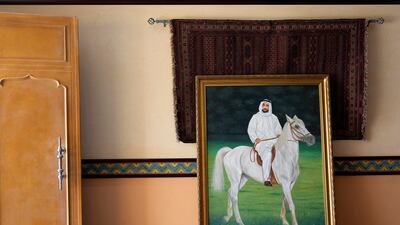
Abu Dhabi Archipelago (Abu Dhabi), 2018. Photo: Tarek Al-Ghoussein -
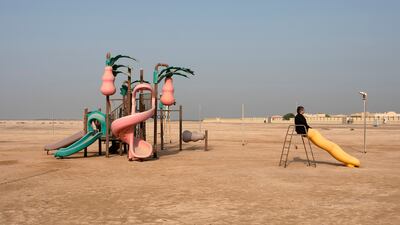
Abu Dhabi Archipelago, (Ramhan), 2015. Photo: Tarek Al-Ghoussein -

Tarek Al-Ghoussein's 'Odysseus' series featured in a 2021 exhibition, 'Between the Sky and the Earth: Contemporary Art from the UAE', in Washington DC. Photo: Tarek Al-Ghoussein -
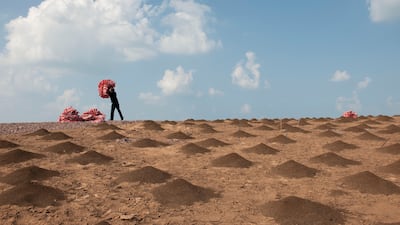
Tarek Al Ghoussein, '(In)Beautification-No.2581' (2012). Photo: courtesy the artist and The Third Line, Dubai -
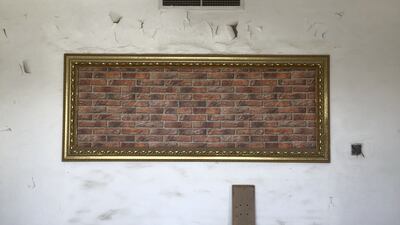
Tarek Al-Ghoussein, Al Sawaber 5003_2015-2017_Digital print_21 x 28 cm. Photo: courtesy the artist and The Third Line -

Untitled 4, 2009, From the D II series, Inkjet Print. Photo: courtesy the artist and The Third Line and Taymour Grahne Gallery, New York -
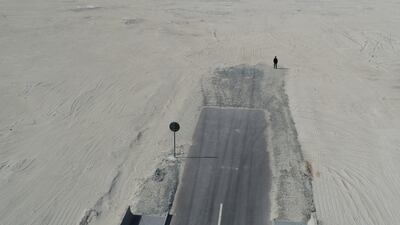
Tarek Al-Ghoussein photographed Abu Dhabi's islands for his Odysseus project. This is Abu Dhabi Archipelago (Al Alia) – the first photograph he shot in five months due to the Covid pandemic. Photo: Tarek Al-Ghoussein -

Tarek Al-Ghoussein said this is one of his favourite images from his series K Files 735, 2013, which was shown at the Kuwait Pavilion at the Venice Biennale in 2013. Photo: courtesy the artist and The Third Line -
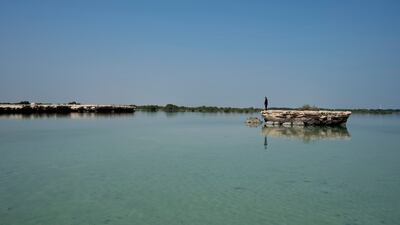
Tarek Al-Ghoussein, Abu Dhabi Archipelago (Gassar 2). Photo: Tarek Al-Ghoussein -
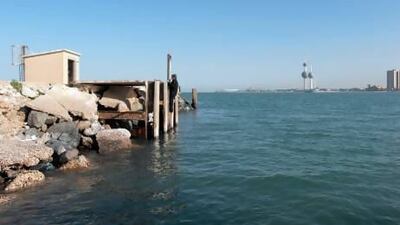
Tarek Al-Ghoussein's K Files consists of eight photographs he shot himself inside the stock market, a dilapidated palace, a football field, an old school and beside Kuwait's first oil well with the famous water towers spiking the horizon in the distance. Photo: courtesy the artist and The Third Line -
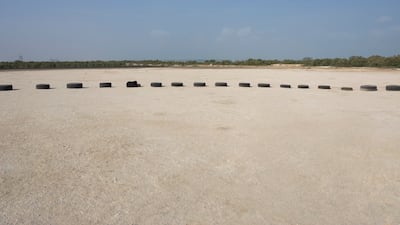
Abu Dhabi Archipelago (Al Habel Al Abyad). Photo: Tarek Al-Ghoussein -
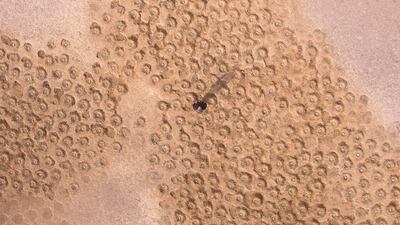
Tarek Al-Ghoussein's "Abu Dhabi Archipelago (Salaha Gassar)", part of his Odysseus project to document Abu Dhabi's 215 islands. Here he stands amid nesting cormorants. Photo: Tarek Al-Ghoussein


The artistic work that developed from the 1990s and early 2000s was often concerned with the media image of the young Arab man, which was at the time under intense scrutiny. His series Self-Portrait (2003-05) tackled the stereotype of Arabs as terrorists, showing himself posing in a keffiyeh in front of airfields and buildings. The threat he sought to counteract was more than notional. While shooting one image, for which he looks over the Dead Sea towards Palestine, he was apprehended by the Jordanian police, and held for 22 hours.
He also explored his Palestinian identity. In B-series (2005-06), he documented a series of walls and barriers, a series that began in reference to the wall in Palestine. And in War Room (2004), shown at the Sharjah Biennial in 2005, he documented the media’s representation of the US invasion of Kuwait, relating to cinematic or other pop cultural depictions of conflict.

But by the 2010s, Al-Ghoussein left this field of inquiry, feeling that his work was too narrowly reduced to identity politics. In retrospect, Al-Ghoussein’s early works already exhibit the hallmarks of what becomes his sustained project, though this seems to have been ignored at the time: the investigation of place and his role within it.
Throughout his career, his stark, large-format images pictured scenes of desolation, entropy and change, as if they are a field of interconnections in which he navigates an uncertain role. Journeys, too, were vital: Al-Ghoussein was ever on the move, documenting new backdrops and himself within them.
Again, these landscapes did not conform to images of Middle East destruction: the sites he photographed were as often ones of construction. The In(Beautification) series, shot in 2011, shows Abu Dhabi's Saadiyat Island on the brink of transformation, as foundations were being laid for what would become the site's suburban landscape today. The natural world assumes an active role, with sand assembling itself into tidy mounds, newly planted trees forming stripes across the landscape, and a watchful blue sky glowering above.
In 2015, Al-Ghoussein began photographing Al Sawaber, a modernist complex in Kuwait. It had been built in 1981 to provide social housing for Kuwaiti families, but had become decrepit and in the late 2010s was earmarked for demolition. Al-Ghoussein’s photographs alternate between the architectural elements of the complex, with its rounded entrances and sleek, shaded corridors. They also capture the unruly, individual details of each family’s home, their lives legible in the items they left behind: footballs, vases, books, bags and prayer mats.
Al Sawaber was home to many different nationalities, a complexity that Al-Ghoussein’s comprehensive, roving approach underscores. He became, he said, almost obsessed with the place, seeking to photograph as many of the abandoned apartments as he could.

His last work, the unfinished project Odysseus, also strives for completion. He set out to document all of Abu Dhabi’s 214 islands. The goal committed him to an almost performative task. (In a 2008 interview with The National, he called his work “performance photography.”) Behind the series' stark, beautiful photographs is a field of social negotiations: discussions with authorities, boats trips planned out to different islands, and attempts to leverage any wasta, or influence — which he constantly denied he had — to finish his project.
Al-Ghoussein had been working on Odysseus since 2015, persevering through the Covid-19 pandemic, and had captured about 160 islands by the end of his life (the exact number remains unclear). The images reveal the scale of the vast Abu Dhabi archipelago, and attain that seemingly impossible task of communicating the perceptual feel of the place: the gusty wind, visible in the dunes of sand or tears in abandoned posters; the dust that blankets dilapidated playgrounds; the heat visible by the sheer absence of vegetation.
-
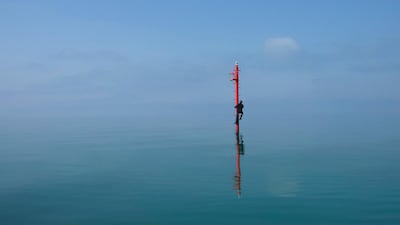
'Abu Dhabi Archipelago, (Marawah)' by Tarek Al-Ghoussein. All images courtesy the artist and The Third Line, Dubai -
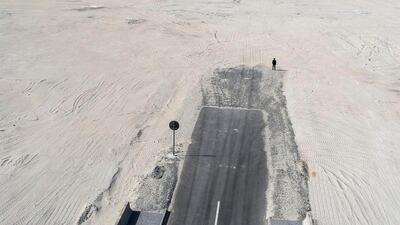
'Abu Dhabi Archipelago (Ras Gharab 2)' by Tarek Al-Ghoussein -
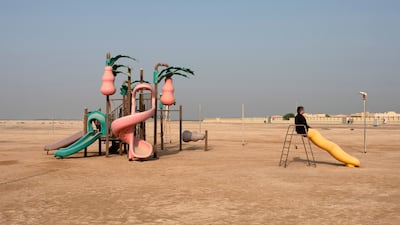
'Abu Dhabi Archipelago, (Ramhan)' by Tarek Al-Ghoussein -
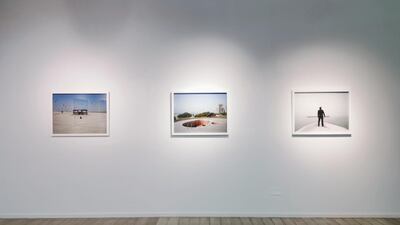
View of Tarek Al-Ghoussein's 'Odysseus' at The Third Line -
'Abu Dhabi Archipelago (Al Habel Al Abyad)' by Tarek Al-Ghoussein -
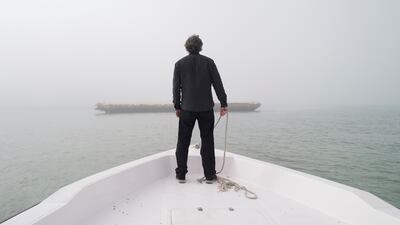
'Abu Dhabi Archipelago, (Hami Rohah Gassar)' by Tarek Al-Ghoussein -
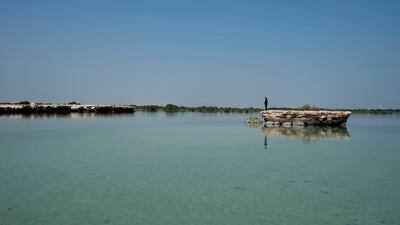
'Abu Dhabi Archipelago (Gassar 2)' by Tarek Al-Ghoussein


The artist appears in many of them, like Odysseus surveying the islands as he makes his way home. When he first presented the project, at Warehouse421, the title appeared clearly to refer to the Sisyphean task of visiting all the islands, some of which were restricted by the government and others which were simply privately owned and impossible to visit. But the title also suggests more poignant: the idea of the home that Odysseus searches for.
Al-Ghoussein’s death came as a surprise: he had just turned 60 and was in good health. He had recently been appointed head of the new MFA programme at NYUAD, solidifying his work as a teacher.
“His importance was not just in the ecosystem in the culture world, but he was also very prominent as an educator,” says Sunny Rahbar, his gallerist at the Third Line, who began representing him in 2008. "He was a hard worker. If he wasn’t shooting, he was teaching.”
Many of his students are now themselves well-established artists, such as Lamya Gargash, who represented the UAE at the Venice Biennale in 2009.
He was also an informal support, both within in and beyond the parameters of the UAE art world. The Kuwaiti-Palestinian photojournalist Laura Boushnak notes his influence on her work; Sueraya Shaheen, the editor of photography magazine Tribe, recalls him as a passionate advocate. He was a loyal friend of the painter Mohammed Al Mazrouei, and spoke with pride of the curator Munira Al Sayegh's different projects.

Rahbar says he was constantly sending her portfolios of young artists to see, in case she was interested in putting them in shows. He was always at the end of a Zoom link, or Botim call, turning every small query into a collaboration.
Al-Ghoussein had a long list of accolades, such as the many biennials and shows he appeared in, or the prestigious museum collections that own his work. These include the Guggenheim, the Smithsonian, the Victoria & Albert, the British Museum, Abu Dhabi Music and Arts Foundation, the Barjeel Art Foundation and the Sharjah Art Foundation.
But the strongest testament to his character is likely the expressions of mourning throughout the art community. He held his students up to high standards — for many, higher standards than other teachers had challenged them with — and he maintained the same for himself.

