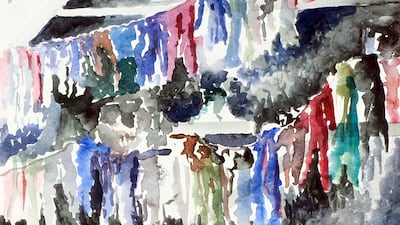
The flat December light is setting into Washington, but the MEI Art Gallery has shut out the winter gloom with artworks that trill in bright blues, baby pinks, candy yellows and, soft, almost touchable greens.
Between the Sky and the Earth: Contemporary Art from the UAE opened on the UAE’s National Day on December 2, and is nominally an exhibition presenting 12 artists from the country to an audience in the US less familiar with the art scene in the Emirates.
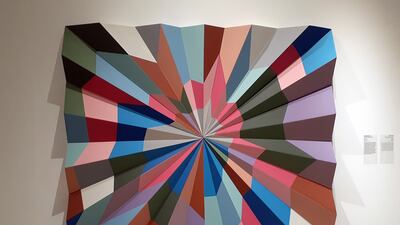
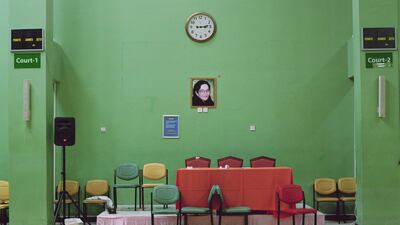
But at the heart of it is a celebration of colour, pure and simple: Mohamed Ahmed Ibrahim’s fantastically painted creature-like sculptures, in stripes and designs of bright blues, greens and pinks; a 3D star-like wooden sculpture, painted as if tie-dyed in mauves, purples, oranges and blues by, Ebtisam Abdulaziz (Focal Illusion, 2019); or an interior of the Indian Club in Abu Dhabi suffused in mossy, faded green in Lamya Gargash’s photograph The Court, The Indian Club (2014).
And the wide blue UAE sky crosses all the works, from Tarek Al-Ghoussein’s Odysseus (2016–ongoing) series, his attempt to photograph all of Abu Dhabi’s islands, to Augustine Paredes’ Sunset at the Mina Zayed Parking Lot (2021), with its stripe of dusky blue: “Let us go then, you and I / When the evening is spread out against the sky,” as TS Eliot – not Paredes, though he publishes poetry too – once wrote.
The sky was, in fact, curator Munira Al Sayegh’s inspiration for the show.
“Between the sun and the sky is an idea of possibility, the idea of growth,” she says. “It is very relevant to what the UAE feels like for us, the active generation in the arts, and that quickly began to frame what I was looking at. A lot of places feel like they are stagnating right now, but in the UAE things are moving forward very quickly.”
Al Sayegh deliberately chose artists who work in the UAE – both Emirati and non-Emirati residents – to represent the country. She also selected a variety of generations, from older artists such as Abdulaziz and Mohammed Kazem to younger ones such as Alaa Edris and Afra Al Dhaheri. She even manages to coax a colourful work out of Al Dhaheri’s typically monochrome palette: the beautiful St Ives Hair Drawing 8, 2019, made while the artist was in a residency in St Ives in England, another city marked by the encounter between sky and sea.
In setting up these intergenerational encounters, a curious effect emerges: the lines between generations, so often in contention as the UAE art world reckons with its explosive growth, fade away.
“There are a lot of artists who are crossing over with the next generation, such as Tarek Al-Ghoussein,” Al Sayegh says.
Al-Ghoussein is a long-time professor in the visual arts department at NYU Abu Dhabi and has been recently named programme director for its new masters of fine arts. "We can’t even ignore his presence among the creatives working today – both those that he’s taught and even those that he hasn’t. To have him in the show, alongside Mohamed Ahmed Ibrahim, someone that I correspond with on a daily basis about contemporary ideas, shows that these connections are not about history, they’re about continuation.”
The idea of continuation is a specific reference in the context of UAE’s art history: Al Sayegh is referring to the idea that there was an unbridgeable gulf between the early 2000s work of the so-called Five – the artists, including Ibrahim and Kazem featured in this show, who often exhibited with Hassan Sharif – and the explosion of contemporary practices in the 2010s to the present.
Indeed, thinking retrospectively, one of the most interesting aspects of historical Emirati art was its diversity; the artworks did not coalesce into a rigidly set language and each artist his or her own style. The same comes across in Between the Sky and the Earth: Al Dhaheri’s material-led sculptures, which investigate memory and identity, are set alongside Shaikha Al Mazrou’s colourful formal experiments, in which material plays second-string to the trompe l’oeil visual effect her sculptures create.
Kazem’s durational experiment, in which he documented the laundry hung outside his window (Windows, 2019-2020), sits easily alongside Al-Ghoussein’s own exercise in performative documentation in Odysseus. Hashel Al Lamki’s expressive paintings The Day We Met Thomas (Diptych) (2021) depict the natural environment – as does the work of Solimar Miller, but in a craft-oriented mode of her textiles, such as Milieu, also made this year.
And instead, cross-generational connections emerged behind the scenes. Over the past two years, Al Sayegh has been setting up the Dirwaza Curatorial Lab, an independent project that acts as an incubator for emerging curators. The current cohort of six curators collaborated with her in putting together Between the Sky and the Earth, which was also organised with assistance from the NYUAD Art Gallery.
“I’ve been feeling extremely inspired and grateful to have all the opportunities I have had in the UAE,” she says. “It was important to extend that to the young curators I’m working [with] and to the artists we put forward in this exhibition.”
Between the Sky and the Earth: Contemporary Art from the UAE is at the MEI Art Gallery in Washington, DC until March 31, 2022

The Written World: How Literature Shaped History
Martin Puchner
Granta
The alternatives
• Founded in 2014, Telr is a payment aggregator and gateway with an office in Silicon Oasis. It’s e-commerce entry plan costs Dh349 monthly (plus VAT). QR codes direct customers to an online payment page and merchants can generate payments through messaging apps.
• Business Bay’s Pallapay claims 40,000-plus active merchants who can invoice customers and receive payment by card. Fees range from 1.99 per cent plus Dh1 per transaction depending on payment method and location, such as online or via UAE mobile.
• Tap started in May 2013 in Kuwait, allowing Middle East businesses to bill, accept, receive and make payments online “easier, faster and smoother” via goSell and goCollect. It supports more than 10,000 merchants. Monthly fees range from US$65-100, plus card charges of 2.75-3.75 per cent and Dh1.2 per sale.
• 2checkout’s “all-in-one payment gateway and merchant account” accepts payments in 200-plus markets for 2.4-3.9 per cent, plus a Dh1.2-Dh1.8 currency conversion charge. The US provider processes online shop and mobile transactions and has 17,000-plus active digital commerce users.
• PayPal is probably the best-known online goods payment method - usually used for eBay purchases - but can be used to receive funds, providing everyone’s signed up. Costs from 2.9 per cent plus Dh1.2 per transaction.
How to help
Send “thenational” to the following numbers or call the hotline on: 0502955999
2289 – Dh10
2252 – Dh 50
6025 – Dh20
6027 – Dh 100
6026 – Dh 200
The Uefa Awards winners
Uefa Men's Player of the Year: Virgil van Dijk (Liverpool)
Uefa Women's Player of the Year: Lucy Bronze (Lyon)
Best players of the 2018/19 Uefa Champions League
Goalkeeper: Alisson (Liverpool)
Defender: Virgil van Dijk (Liverpool)
Midfielder: Frenkie de Jong (Ajax)
Forward: Lionel Messi (Barcelona)
Uefa President's Award: Eric Cantona
A State of Passion
Directors: Carol Mansour and Muna Khalidi
Stars: Dr Ghassan Abu-Sittah
Rating: 4/5
Ten tax points to be aware of in 2026
1. Domestic VAT refund amendments: request your refund within five years
If a business does not apply for the refund on time, they lose their credit.
2. E-invoicing in the UAE
Businesses should continue preparing for the implementation of e-invoicing in the UAE, with 2026 a preparation and transition period ahead of phased mandatory adoption.
3. More tax audits
Tax authorities are increasingly using data already available across multiple filings to identify audit risks.
4. More beneficial VAT and excise tax penalty regime
Tax disputes are expected to become more frequent and more structured, with clearer administrative objection and appeal processes. The UAE has adopted a new penalty regime for VAT and excise disputes, which now mirrors the penalty regime for corporate tax.
5. Greater emphasis on statutory audit
There is a greater need for the accuracy of financial statements. The International Financial Reporting Standards standards need to be strictly adhered to and, as a result, the quality of the audits will need to increase.
6. Further transfer pricing enforcement
Transfer pricing enforcement, which refers to the practice of establishing prices for internal transactions between related entities, is expected to broaden in scope. The UAE will shortly open the possibility to negotiate advance pricing agreements, or essentially rulings for transfer pricing purposes.
7. Limited time periods for audits
Recent amendments also introduce a default five-year limitation period for tax audits and assessments, subject to specific statutory exceptions. While the standard audit and assessment period is five years, this may be extended to up to 15 years in cases involving fraud or tax evasion.
8. Pillar 2 implementation
Many multinational groups will begin to feel the practical effect of the Domestic Minimum Top-Up Tax (DMTT), the UAE's implementation of the OECD’s global minimum tax under Pillar 2. While the rules apply for financial years starting on or after January 1, 2025, it is 2026 that marks the transition to an operational phase.
9. Reduced compliance obligations for imported goods and services
Businesses that apply the reverse-charge mechanism for VAT purposes in the UAE may benefit from reduced compliance obligations.
10. Substance and CbC reporting focus
Tax authorities are expected to continue strengthening the enforcement of economic substance and Country-by-Country (CbC) reporting frameworks. In the UAE, these regimes are increasingly being used as risk-assessment tools, providing tax authorities with a comprehensive view of multinational groups’ global footprints and enabling them to assess whether profits are aligned with real economic activity.
Contributed by Thomas Vanhee and Hend Rashwan, Aurifer
SPECS
Mini John Cooper Works Clubman and Mini John Cooper Works Countryman
Engine: two-litre 4-cylinder turbo
Transmission: nine-speed automatic
Power: 306hp
Torque: 450Nm
Price: JCW Clubman, Dh220,500; JCW Countryman, Dh225,500
Getting there
Flydubai flies direct from Dubai to Tbilisi from Dh1,025 return including taxes
Who's who in Yemen conflict
Houthis: Iran-backed rebels who occupy Sanaa and run unrecognised government
Yemeni government: Exiled government in Aden led by eight-member Presidential Leadership Council
Southern Transitional Council: Faction in Yemeni government that seeks autonomy for the south
Habrish 'rebels': Tribal-backed forces feuding with STC over control of oil in government territory
RACE CARD
6.30pm: Al Maktoum Challenge Round-3 – Group 1 (PA) $65,000 (Dirt) 2,000m
7.05pm: Handicap (TB) $65,000 (Turf) 1,800m
7.40pm: Meydan Classic – Listed (TB) $88,000 (T) 1,600m
8.15pm: Nad Al Sheba Trophy – Group 3 (TB) $195,000 (T) 2,810m
8.50pm: Dubai Millennium Stakes – Group 3 (TB) $130,000 (T) 2,000m
9.25pm: Meydan Challenge – Listed Handicap (TB) $88,000 (T) 1,400m
UAE squad v Australia
Rohan Mustafa (C), Ashfaq Ahmed, Chirag Suri, Rameez Shahzad, Fahad Nawaz, Amjed Gul, Shaiman Anwar, Ahmed Raza, Imran Haider, Muhammad Naveed, Amir Hayat, Ghulam Shabir (WK), Qadeer Ahmed, Tahir Latif, Zahoor Khan
Dengue%20fever%20symptoms
%3Cul%3E%0A%3Cli%3EHigh%20fever%3C%2Fli%3E%0A%3Cli%3EIntense%20pain%20behind%20your%20eyes%3C%2Fli%3E%0A%3Cli%3ESevere%20headache%3C%2Fli%3E%0A%3Cli%3EMuscle%20and%20joint%20pains%3C%2Fli%3E%0A%3Cli%3ENausea%3C%2Fli%3E%0A%3Cli%3EVomiting%3C%2Fli%3E%0A%3Cli%3ESwollen%20glands%3C%2Fli%3E%0A%3Cli%3ERash%3C%2Fli%3E%0A%3C%2Ful%3E%0A%3Cp%3EIf%20symptoms%20occur%2C%20they%20usually%20last%20for%20two-seven%20days%3C%2Fp%3E%0A
Company profile
Name: Dukkantek
Started: January 2021
Founders: Sanad Yaghi, Ali Al Sayegh and Shadi Joulani
Based: UAE
Number of employees: 140
Sector: B2B Vertical SaaS(software as a service)
Investment: $5.2 million
Funding stage: Seed round
Investors: Global Founders Capital, Colle Capital Partners, Wamda Capital, Plug and Play, Comma Capital, Nowais Capital, Annex Investments and AMK Investment Office
SERIES SCHEDULE
First Test, Galle International Stadium
July 26-30
Second Test, Sinhalese Sports Club Ground
August 3-7
Third Test, Pallekele International Cricket Stadium
August 12-16
First ODI, Rangiri Dambulla International Stadium
August 20
Second ODI, Pallekele International Cricket Stadium
August 24
Third ODI, Pallekele International Cricket Stadium
August 27
Fourth ODI, R Premadasa Stadium
August 31
Fifth ODI, R Premadasa Stadium
September 3
T20, R Premadasa Stadium
September 6
A%20Little%20to%20the%20Left
%3Cp%3E%3Cstrong%3EDeveloper%3A%20%3C%2Fstrong%3EMax%20Inferno%3Cbr%3E%3Cstrong%3EConsoles%3A%3C%2Fstrong%3E%20PC%2C%20Mac%2C%20Nintendo%20Switch%3Cbr%3E%3Cstrong%3ERating%3A%20%3C%2Fstrong%3E4%2F5%26nbsp%3B%3C%2Fp%3E%0A
Indoor cricket in a nutshell
Indoor Cricket World Cup - Sep 16-20, Insportz, Dubai
16 Indoor cricket matches are 16 overs per side
8 There are eight players per team
9 There have been nine Indoor Cricket World Cups for men. Australia have won every one.
5 Five runs are deducted from the score when a wickets falls
4 Batsmen bat in pairs, facing four overs per partnership
Scoring In indoor cricket, runs are scored by way of both physical and bonus runs. Physical runs are scored by both batsmen completing a run from one crease to the other. Bonus runs are scored when the ball hits a net in different zones, but only when at least one physical run is score.
Zones
A Front net, behind the striker and wicketkeeper: 0 runs
B Side nets, between the striker and halfway down the pitch: 1 run
C Side nets between halfway and the bowlers end: 2 runs
D Back net: 4 runs on the bounce, 6 runs on the full
DUNGEONS%20%26%20DRAGONS%3A%20HONOR%20AMONG%20THIEVES
%3Cp%3EDirectors%3A%20John%20Francis%20Daley%20and%20Jonathan%20Goldstein%3Cbr%3EStars%3A%20Chris%20Pine%2C%20Michelle%20Rodriguez%2C%20Rege-Jean%20Page%2C%20Justice%20Smith%2C%20Sophia%20Lillis%3Cbr%3ERating%3A%203%2F5%3C%2Fp%3E%0A
Takreem Awards winners 2021
Corporate Leadership: Carl Bistany (Lebanon)
Cultural Excellence: Hoor Al Qasimi (UAE)
Environmental Development and Sustainability: Bkerzay (Lebanon)
Environmental Development and Sustainability: Raya Ani (Iraq)
Humanitarian and Civic Services: Women’s Programs Association (Lebanon)
Humanitarian and Civic Services: Osamah Al Thini (Libya)
Excellence in Education: World Innovation Summit for Education (WISE) (Qatar)
Outstanding Arab Woman: Balghis Badri (Sudan)
Scientific and Technological Achievement: Mohamed Slim Alouini (KSA)
Young Entrepreneur: Omar Itani (Lebanon)
Lifetime Achievement: Suad Al Amiry (Palestine)
Dubai Bling season three
Cast: Loujain Adada, Zeina Khoury, Farhana Bodi, Ebraheem Al Samadi, Mona Kattan, and couples Safa & Fahad Siddiqui and DJ Bliss & Danya Mohammed
Rating: 1/5
FULL%20RESULTS
%3Cp%3E%3Cstrong%3EMiddleweight%20%3C%2Fstrong%3E%3C%2Fp%3E%0A%3Cp%3EEslam%20Syaha%20(EGY)%20bt%20Robin%20Roos%20(SWE)%20%0D%3Cbr%3E%3Cstrong%3E%0D%3Cbr%3EWelterweight%20%3C%2Fstrong%3E%3C%2Fp%3E%0A%3Cp%3EAlex%20da%20Silva%20(BRA)%20bt%20Bagyash%20Zharmamatov%20(KGZ)%20%0D%3Cbr%3EMurodov%20Samandar%20(TJK)%20bt%20Lucas%20Sampaio%20(BRA)%20%0D%3Cbr%3EShakhban%20Alkhasov%20(RUS)%20bt%20Salamat%20Orozakunov%20(KGZ)%0D%3Cbr%3EKhotamjon%20Boynazarov%20(UZB)%20bt%20Mikail%20Bayram%20(FRA)%20%0D%3Cbr%3E%0D%3Cbr%3E%3Cstrong%3EBantamweight%20%3C%2Fstrong%3E%0D%3Cbr%3EJieleyisi%20Baergeng%20(CHN)%20bt%20Xavier%20Alaoui%20(CAN)%20%0D%3Cbr%3E%0D%3Cbr%3E%3Cstrong%3EFlyweight%20%3C%2Fstrong%3E%0D%3Cbr%3ERashid%20Vagabov%20(RUS)%20bt%20Lun%20Qui%20(CHN)%20%0D%3Cbr%3EYamato%20Fujita%20(JPN)%20bt%20Furkatbek%20Yokubov%20(UZB)%20%0D%3Cbr%3EAaron%20Aby%20(WLS)%20bt%20Joevincent%20So%20(PHI)%20%0D%3Cbr%3E%0D%3Cbr%3E%3Cstrong%3ECatchweight%20176lb%20%3C%2Fstrong%3E%0D%3Cbr%3EMark%20Hulm%20(RSA)%20bt%20Erkin%20Darmenov%20(KAZ)%20%0D%3Cbr%3E%0D%3Cbr%3E%3Cstrong%3ECatchweight%20160lb%20%3C%2Fstrong%3E%0D%3Cbr%3ERustam%20Serbiev%20(BEL)%20bt%20Anar%20Huseyinov%20(AZE)%20%0D%3Cbr%3E%0D%3Cbr%3E%3Cstrong%3ECatchweight%20150lb%20%3C%2Fstrong%3E%3C%2Fp%3E%0A%3Cp%3EIslam%20Reda%20(EGY)%20bt%20Ernie%20Braca%20(PHI)%0D%3Cbr%3E%0D%3Cbr%3E%3Cstrong%3EFlyweight%20(women)%3C%2Fstrong%3E%20%0D%3Cbr%3EBaktygul%20Kurmanbekova%20(KGZ)%20bt%20Maria%20Eugenia%20Zbrun%20(ARG)%20%0D%3Cbr%3E%3C%2Fp%3E%0A
What is blockchain?
Blockchain is a form of distributed ledger technology, a digital system in which data is recorded across multiple places at the same time. Unlike traditional databases, DLTs have no central administrator or centralised data storage. They are transparent because the data is visible and, because they are automatically replicated and impossible to be tampered with, they are secure.
The main difference between blockchain and other forms of DLT is the way data is stored as ‘blocks’ – new transactions are added to the existing ‘chain’ of past transactions, hence the name ‘blockchain’. It is impossible to delete or modify information on the chain due to the replication of blocks across various locations.
Blockchain is mostly associated with cryptocurrency Bitcoin. Due to the inability to tamper with transactions, advocates say this makes the currency more secure and safer than traditional systems. It is maintained by a network of people referred to as ‘miners’, who receive rewards for solving complex mathematical equations that enable transactions to go through.
However, one of the major problems that has come to light has been the presence of illicit material buried in the Bitcoin blockchain, linking it to the dark web.
Other blockchain platforms can offer things like smart contracts, which are automatically implemented when specific conditions from all interested parties are reached, cutting the time involved and the risk of mistakes. Another use could be storing medical records, as patients can be confident their information cannot be changed. The technology can also be used in supply chains, voting and has the potential to used for storing property records.
Will the pound fall to parity with the dollar?
The idea of pound parity now seems less far-fetched as the risk grows that Britain may split away from the European Union without a deal.
Rupert Harrison, a fund manager at BlackRock, sees the risk of it falling to trade level with the dollar on a no-deal Brexit. The view echoes Morgan Stanley’s recent forecast that the currency can plunge toward $1 (Dh3.67) on such an outcome. That isn’t the majority view yet – a Bloomberg survey this month estimated the pound will slide to $1.10 should the UK exit the bloc without an agreement.
New Prime Minister Boris Johnson has repeatedly said that Britain will leave the EU on the October 31 deadline with or without an agreement, fuelling concern the nation is headed for a disorderly departure and fanning pessimism toward the pound. Sterling has fallen more than 7 per cent in the past three months, the worst performance among major developed-market currencies.
“The pound is at a much lower level now but I still think a no-deal exit would lead to significant volatility and we could be testing parity on a really bad outcome,” said Mr Harrison, who manages more than $10 billion in assets at BlackRock. “We will see this game of chicken continue through August and that’s likely negative for sterling,” he said about the deadlocked Brexit talks.
The pound fell 0.8 per cent to $1.2033 on Friday, its weakest closing level since the 1980s, after a report on the second quarter showed the UK economy shrank for the first time in six years. The data means it is likely the Bank of England will cut interest rates, according to Mizuho Bank.
The BOE said in November that the currency could fall even below $1 in an analysis on possible worst-case Brexit scenarios. Options-based calculations showed around a 6.4 per cent chance of pound-dollar parity in the next one year, markedly higher than 0.2 per cent in early March when prospects of a no-deal outcome were seemingly off the table.
Bloomberg