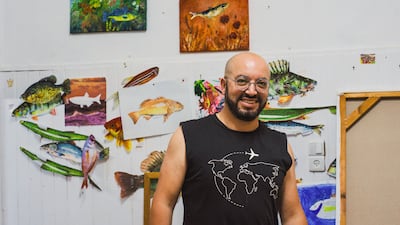
Wandering the narrow alleyways of Al Amari Refugee Camp in Ramallah, you might not expect to find a surrealist art gallery. But this is where acclaimed Palestinian artist Alaa Albaba has his studio.
His subject is the fish, an unlikely motif for an artist working within a dusty refugee camp in the West Bank. The only sea here is the Dead Sea, where no fish can survive.
“My story begins when I was searching for my own symbolic connection to displacement,” Albaba tells The National. “Living in a refugee camp in the hills, with family roots on the coast, I felt my connection to the sea wasn’t represented in my surroundings.”

Soft-spoken and introspective, Albaba offers a tour of the gallery, but stops to fumble with the malfunctioning rat traps needed to protect his work from gnawing teeth. Hundreds of oil-painted canvases are stacked in boxes in the modest two-room studio. On the walls, impossibly large, vibrant fish float within the clouds, swimming above the tightly packed buildings of the refugee camps below.
“Refugee camps don’t just need services,” Albaba explains of his gallery. “They need art.”
Albaba is a child of the camps, and he has lived in Al Amari his whole life. His family was originally from the Palestinian village of Lydd, in what later became Israel, on the coastal plains of the Mediterranean Sea. In 1948, his family and 700,000 other Palestinians were driven out to establish a Jewish-majority state. Many of the displaced fled to the West Bank, where they and their descendants still live in refugee camps 78 years later.

The refugee camps remain central to Palestinian political identity. While some refugees have moved from the camps into Palestinian urban centres, many remain there out of economic constraints or sheer principle – their living circumstances serving as a persistent reminder of the failures of the UN Resolution 194, which stipulated that Palestinian refugees be allowed to return to the homes from which they were driven out.
Many Palestinians assumed their displacement would be temporary, and they carried their house keys with them into exile – items that have since been passed down from generation to generation. The key has become the pre-eminent symbol of the right to return, and it’s prolific in Palestinian art.
But Albaba doesn’t paint keys. He wasn’t interested in painting any of the typical Palestinian symbols: the olive tree, the keffiyeh, the Dome of the Rock and its glittering gold roof. Rather, Albaba is busy imagining novel possible futures for his people.
“Too many Arab artists look to the past; I want to think about the future,” he says. “What will Amari look like in the future? Who will be here?”

A graduate of the International Academy of Art in Ramallah, Albaba developed a surrealist style rooted in his own experience of life in the refugee camp: displacement, pervasive uncertainty and ubiquitous walls. He came to understand the refugees as migrating fish, lost among the arid hills and concrete camps. But his paintings are vibrant and colourful, imbued with oddities and wonder. There is a sense of discomfort and uncertainty, but not dread.
His artworks also explore his personal relationship to the camp and anxieties about its future. Across the West Bank, Israeli military operations are increasingly focusing on the refugee camps. In January 2025, the Israeli army displaced 20,000 Palestinian refugees from Jenin Camp, sealing off its entry points then bulldozing its homes. For many Palestinians, being uprooted again compounds the generational trauma of repeated displacement.
But there’s a more subtle anxiety about the right of return: what will happen to Amari if its people do return?

Coming of age in the crowded, impoverished camp, Albaba began to ask these questions and imagine novel representations of the Palestinian struggle. To develop his own visual language, Albaba first took inspiration from a tin of sardines, which were infamously distributed by the UN Relief and Works Agency to Palestinian refugees in 1948. To him, the sardines symbolise the cramped conditions of the refugee camps, where they were packed in together like a tin of fish.
Across the West Bank’s 19 refugee camps today, UNRWA employees still keep the dusty paper identity cards of every resident: cards that identify which village they were expelled from, and the year their families registered in the camps. The camps on their IDs have become an integral part of many refugees’ identities, in a complicated relationship.
Albaba’s paintings may deal with the concept of a fish out of water, but it is one that has found temporary refuge within the camps. Many Palestinian refugees come from the Mediterranean coast, and they now live in exile, unable to embrace the sea, even for a moment. Meanwhile, their seaside villages were erased and bestowed with new Hebrew names. Jaffa became Tel Aviv; Akka turned to Acre; Tantura’s mass graves were covered by a parking lot for Dor beach.

To pay tribute to his people’s exodus, Albaba carried his fish beyond the walls of the refugee camp. He launched a graffiti project that stretched from Palestine to Jordan and Lebanon; he even illegally passed the separation barrier to enter Israel, where he painted hanging fish on condemned buildings in Jaffa and Haifa – original sites of the Palestinian exodus.
Together these murals form a body of work Albaba calls The Route of the Fish, which depicts Palestinian exile within distance from the Mediterranean Sea. He later painted a map tracing the locations of his fish murals, establishing a visual geography of migration and displacement.
But today, uncertainty hangs over the studio. Israeli military raids into Al Amari are frequent, and Albaba's life's work is stored in these two small rooms. Yet he continues to paint – not the symbols of the past, but visions of a future that Palestinians have not been given the space to imagine.
“No matter how far the fish strays from the sea, it must return,” he says. “The sea is part of our dreams.”

