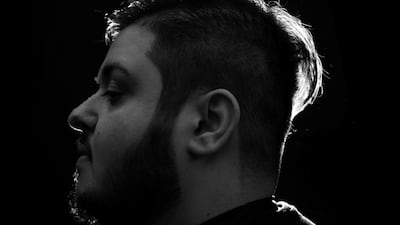

A simple question has driven many of BossLogic’s most successful ideas: what if?
The digital artist, whose real name is Kode Abdo, has built a global following by reimagining some of popular culture’s most recognisable characters.
Over the years, that has included John Krasinski as Mr Fantastic, Robert Pattinson as Batman and Keanu Reeves as Wolverine, as well as visualising casting rumours and fan theories before studios show audiences what those characters might look like. Many of those images have gone viral among comic-book and superhero fans – and some have even attracted the attention of international studios.

Abdo in Abu Dhabi
“I can look at a character everyone knows and my mind instantly starts going into 'what if' mode,” Abdo tells The National ahead of his appearance at this year's Middle East Film and Comic Con in Abu Dhabi.
“What if they were in this world? What if this actor played them? What if I changed the tone or told a different story with one image?”
Abdo will be among the artists appearing at the 14th MEFCC, which takes place at Adnec Centre from Friday to Sunday. The convention brings together film, television, gaming, anime and comics, alongside artists and creators.
It is familiar territory for Abdo, who also appeared at the convention in 2024.
His career began with the kind of fan art commonly found in comic conventions' Artist Alleys and across social media: art made by a fan simply because he wanted to see an idea realised.
“I wasn't waiting for permission or a brief,” he says. “If something excited me, I wanted to create around it. That is still a big part of how I work today.”
That approach eventually led to official commissions from major entertainment companies including Marvel, Disney, Warner Bros, Netflix, Paramount and Sony.
Marvel state of mind
One of the clearest turning points came around Avengers: Endgame.
After years of producing Marvel fan art, Abdo created official artwork connected to the film, including an exclusive poster for Atom Tickets and a series of character posters released by Marvel Studios.
The Russo brothers, the film's directors, had previously commissioned Abdo to create artwork for their social media profiles.
“It's funny because that line is basically where my whole career was built,” the artist says. “I was experimenting, putting work online and having fun with it. Then eventually the people behind those same characters started calling me to work on them officially.”
Although working for studios has brought with it guidelines, campaigns and the responsibility of representing somebody else's fictional world, Abdo has tried to retain the instincts that shaped his independent work.
“I never completely separated the fan from the artist.”
His fan art has continued to draw attention even as his studio credits have grown. Robert Downey Jr has shared his work on social media on several occasions, including a 2019 Iron Man image inspired by Jordan Peele's Us.
Owning his visual language
The tools available to digital artists have changed considerably over Abdo's career, from advances in Photoshop and photography to increasingly accessible 3D software. Generative AI has brought a more disruptive shift, and intensified debates around originality and authorship.
“AI has forced the industry to have conversations we probably needed to have anyway,” he says. “Tools will always change. I started doing this before half the tools artists have today existed.”
What matters to Abdo is whether the person behind an image remains visible through the technology used to make it. “Your taste, your mistakes, your life, the things you grew up loving, the weird experiments that didn't work, all of that becomes part of your visual language,” he says.
“Anyone can generate something that looks impressive for a second. The harder question is: can someone look at something and feel you in it?”
The polished images that helped Abdo build BossLogic's following reveal little of the trial and error behind them. When asked what people most often misunderstand about his process, Abdo says: “Probably how much of it is failing.”
He adds: “People see the final image. They don't see me trying something, deleting it, bringing it back, destroying it again, changing the whole direction and sometimes sitting there thinking this is absolute trash before something finally clicks.”
That remains part of his process even after years of professional work. “There isn't some BossLogic button I press and suddenly the image looks like my work,” he says.
Abdo remains committed to the sentiment of art being “made by humans for humans”, while advising younger artists against becoming too concerned with immediately trying to find a signature style.
“Let your portfolio look messy. Let it look like 10 different artists for a while,” he says. “You're learning. Eventually certain things start feeling like home and you naturally keep coming back to them. Your individual voice isn't something you select from a menu. You build it over years.”
It is also why he cautions younger artists against comparing themselves with creators who may have spent decades developing their craft. “What they're not seeing are the thousands of bad images that came before it,” he says. “You need those. The bad work teaches you what the good work can't.
“Don't be in a rush to become the finished version of yourself,” he says. “I'm still learning what BossLogic looks like too.”
Connection to the Middle East
Abdo's appearance in Abu Dhabi also has significance beyond his career in popular culture.
“The Middle East has always been special to me because, although I was raised in Australia, I was born in Syria, so there is a connection there that goes beyond just travelling somewhere for an event,” he says.
He has also watched the region's creative industries develop around an audience already deeply engaged with pop culture.
“What I've noticed in this region is the hunger,” he says. “There is so much talent here and so many people who genuinely love film, gaming, anime, comics, art and the culture around all of it. And now you're seeing the infrastructure and opportunities starting to catch up with that passion.”
Abdo sees parallels with his own experience of establishing an international career from Melbourne rather than from one of the traditional centres of the entertainment industry.
“I didn't grow up down the road from these studios,” he says. “The internet gave me a way to put my work in front of the world.”
But he believes the changing creative landscape means artists in the Middle East increasingly have the option to develop careers without looking elsewhere.
“Now there is also an opportunity to build something here instead of always feeling like you have to leave,” he says. “I don't just want to visit and watch it happen. I want to be part of that growth.”
Middle East Film and Comic Con runs from September 11 to 13 at Adnec Centre in Abu Dhabi

