
The page that slips out into the printer tray bears the word hub, or love in Arabic, designed in the bold calligraphy distinctive to Ibrahim Zaki’s work.
The design is printed in red – a grainy, textured red that is nothing like what you get from an office printer. “It is more fluorescent, vibrant,” Zaki says, holding up the page. The soy-based ink is thick and shimmers in the light.
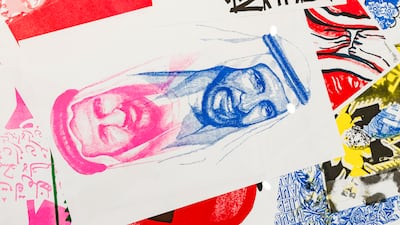
Zaki is demonstrating how a risograph printer – with all its quirks – works. The Palestinian artist is the curator of a group exhibition at Tashkeel that is dedicated to the medium.

It is a temperamental technology, he says, and the subsequent copies spitting out of the printer show this. The reds come out in varying shades, some pale enough to reveal the texture of the paper. Ink drips or smears in some of the printouts. Each is a unique artwork in itself.
“This is the identity of risograph,” Zaki says. “Everything isn’t a hundred per cent. You should expect an unexpected outcome.”

In a way, risograph is antithetical to the precision of modern printmaking. Originating in Japan in the 1980s, it was marketed as a cost-effective way of duplicating between 50 and 5,000 copies, an economical middle ground between photocopiers and the mass-scale offset printers.
The printer makes a stencil of the document, photograph or design. This master sheet – often made of banana tree fibre – then wraps around a cylindrical ink drum. As the drum spins, paper passes underneath. Most risograph printers use a single drum, capable of printing only one colour at a time.

The printer at Tashkeel, however, utilises two drums, which opens up possibilities. Still, if using more than two colours, the ink drums would need to be changed, and the pages would have to be fed back into the printer.
It has been 10 years since Tashkeel became the first art institution to introduce risograph printing to the UAE. It has routinely held workshops teaching artists how to use the technology, and there have been several risograph works in group exhibitions over the years.
But Khali Balak Men Riso is the first that exclusively features the medium.
The exhibition, running until August 21, draws its title from the 2021 hit Egyptian comedy series Khali Balak Men Zizi and roughly translates to Take Care of Riso.
“The title is meant to connect with the younger generation, but also to encourage people to try the risograph printer for themselves,” says Zaki, curator of the exhibition and one of the featured artists. “We wanted people to give it a chance, take care of it, play around with it.”
Khali Balak Men Riso brings together works by artists who have made the printer a core part of their process. Then there are pieces by painters and illustrators who are just beginning to discover this finicky technology.

Emirati illustrator Mariam Abbas, whose work often draws from the architecture of the UAE, is showing several works. In Binghatti Views, she abstracts the geometric facade of the titular residential building in Dubai Silicon Oasis in an illustration printed in a deep blue. The risograph wonderfully translates her crosshatches and thicker lines, no doubt as organic and vivid as the source drawing.
Syrian artist Mohannad Orabi, meanwhile, has experimented with what it would be like to duplicate an oil painting through risograph.
As the technology is only capable of printing as large as A3, Orabi has tiled together several pages to present the entirety of the work. It shows a figure in a floral bodysuit, sitting on a pedestal, a rose in hand. Like with Abbas’s piece, the risograph is in blue and shows the nuances between brushstrokes.
Sara Baali, on the other hand, has overlaid her photography with foliage. One of the works in the series shows a lavish couch set outside against a dilapidated wall. A frame is hung above the couch, showing what seems to be hand-drawn flowers, with green stems and red buds that are all the more vibrant amid the subdued blue of the print.
Aysha Saif Al Shamsi is presenting her character Nefafa through a series of risograph posters. Wearing her signature cat-eyed glasses and heart-shaped lipstick, the character has become something of a local celebrity, with more than 10,000 followers on Instagram,

“She’s a modern girl who has disposable income and is exploring the world,” Al Shamsi says of Nefafa. “Sometimes with characters like Betty Boop who wear lipstick, it’s addressed more to the male gaze. Nefafa is meant to resonate more with girls. She’s very reflective and represents women around us.”
Al Shamsi has just returned from Japan, where she presented Nefafa at Content Tokyo as part of a collaboration with Emirati Talent Agency, an IP venture studio from Dubai.
“It was the first participation from someone in the Middle East,” Al Shamsi says.
The posters displayed in the exhibition are more complex than meets the eye. They feature only two colours but to make sure that the red lipstick of Nefafa aligned perfectly with the character’s black outlines took considerable work.
Then some artists did not stop at two colours. Egyptian artist Bassem Boules is presenting a work with landmark architecture from Dubai, including the Museum of the Future, the Burj Al Arab and Burj Khalifa, layered with as many as five colours.
For the uninitiated, this is work at a monumental scale as it would need to run through the printer multiple times, with ample timein between to let the ink somewhat dry (it never fully dries). However, Boules says he has been experimenting with risograph printers for years – he even leads workshops on the medium at Tashkeel.
“It took about two hours to print,” he says. “You don’t need to wait for the ink to dry. You can control the contrast on the machine and can get different shades. With experience, it becomes easier to deal with the printer. But still, there are always surprises.”
Khali Balak Men Riso is running until August 21

