


AlUla’s striking Jabal Ikmah mountain has been added to Unesco's Memory of the World Register.
The list is meant to protect and preserve documentary heritage from around the world.
Dating back to the second half of the first millennium BCE, the site features more than 300 historically-significant carved inscriptions, recording many facets of the ancient Dadanite Kingdom’s life, rituals and customs.
“The significance of Jabal Ikmah’s inscriptions transcends regional boundaries to reach the level of global relevance, in particular as part of the evolution of Old Arabic languages and dialects,” said Jose Ignacio Gallego Revilla, executive director of the Kingdoms Institute, Archaeology, Heritage Research and Conservation Department at the Royal Commission for AlUla.

From religious rituals, depictions of kings, animals, agriculture, recording of daily activities and the Dadanite Kingdom’s relations with neighbouring peoples, the inscriptions of Jabal Ikmah reflect a variety of subjects that tell the story of Alula’s context in the region and its historical significance.
AlUla was at a crossroads on the incense and pilgrimage routes and acted as a hub of commercial and cultural exchange. This resulted in the growth of settlements, including Dadan where the Kingdom flourished, developing its own alphabet derived of the South Semitic writing system.
The Dadanites recorded their history through petroglyphs or rock carvings in the red and yellow sandstone rocks of AlUla.
“Their authenticity and integrity, both for the information preserved about ancient societies as well as the conservation of the site, bring together the essentials that make this place unique for the Memory of the World as the chronicle of a lost time through the largest number of inscriptions in an Ancient North Arabian script,” Revilla said.
AlUla is already home to Hegra Archaeological Site, Saudi Arabia’s first Unesco-inscribed world heritage site.
Other items added to the Memory of the World Register this year include the illuminated manuscripts of Charlemagne’s Court School, the archives and manuscripts of Macau Kong Tac Lam Temple in China and Cuban movie posters from 1915.
-
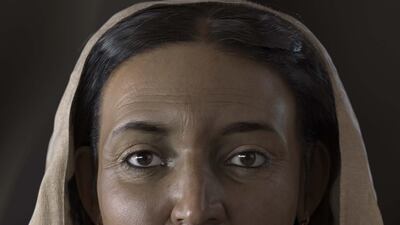
A reconstruction of a Nabataean women produced through a project in Saudi Arabia run by the Royal Commission for AlUla. All photos: Royal Commission for AlUla -

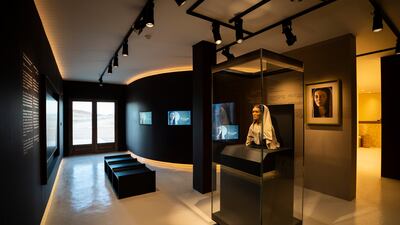
Hinat installed at the Hegra Welcome Centre -
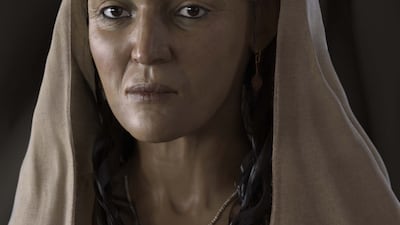
Looking uncannily real, Hinat was created through a complex process that melded expert scientific input with artistic flair -
Hinat was thought to have been aged over 45, suffered from osteoarthritis, may have had a mild form of spina bifida and her teeth were in poor condition -
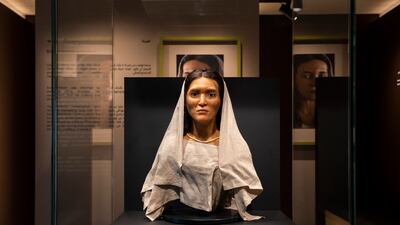
Her skeleton, which was nearly complete, was in 2008 excavated from the Hegra tomb, where work has been led by the Mada’in Salih Archaeological Project since 2002 -
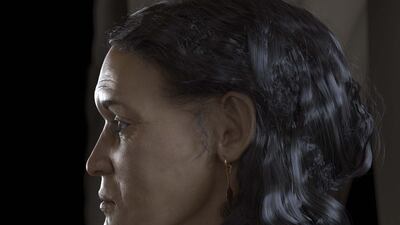
Experts such as archaeologists, forensic scientists, anthropologists and model makers worked to come up with the reconstruction of Hinat



