Despite numerous obstacles, North African masterpieces are out in force at this year's Abu Dhabi Art — the capital's flagship annual arts event, which runs until Sunday.
Curated by Rachida Triki, an art historian and professor of philosophy at the University of Tunis, the art fair’s Focus section brings together galleries from across the Maghreb, under the theme of New Tomorrow.
Triki says there is a dynamic art scene throughout North Africa, with a steady flow of new art centres and new galleries. However, she says they face several challenges.
"First, there is no real organised art market and there is no real financial support from the state, especially for young galleries. Most galleries also don't have the means to support and assist artists," she says. Compounding the issue are legislative issues, and a lack of media coverage, she adds.
This makes Abu Dhabi Art’s decision to build a programme focused on North Africa all the more important, says Triki.
“This is the first time in many years that we’ve seen a focus, joining Morocco, Algeria and Tunisia. It’s a good thing for our countries because we have many problems, especially in politics," she adds. The sector also includes galleries from Paris and Switzerland, focused on North African artists.
While galleries from Libya and Mauritania were unable to take part, Triki says for the other North African galleries, travelling to Abu Dhabi was “very courageous” given the costs involved.
Those who made it to Abu Dhabi Art, she says, share a common creative heritage. “In the history of the region, in the 16th and 17th centuries, artists were very near to each other. Now we have to create new contexts with them — that’s very important to me because I think artists are the ambassadors of creation, and of the rich culture of the Maghreb.”
Triki explains that painting was introduced to North Africa in the late 19th century, through colonialism, and its development went hand-in-hand with the subsequent socio-political transformation and revolutions.
“I chose the concept of New Tomorrow because when the three countries became independent, their local artists chose to create new ways to distinguish themselves from orientalism or exoticism, and construct new things for their countries."
This trend continues to this day, she adds — with contemporary artists using new mediums to respond to social upheaval in Tunisia, Algeria and Morocco. With this in mind, Triki has worked with the galleries to select an array of modern and contemporary creatives, whose work outlines the history of art in their countries.
Among the galleries present is Le Violon Blue, from Tunis, which features a sweeping selection of abstract modern art from across North Africa. The gallery founder’s daughter Selma Feriani tells The National: “Most of these artists left North Africa, and travelled to the US or Europe, where they were influenced by the different art movements there. Then, back home, they started working through abstraction.”
She points to works by Hedi Turki, who she calls “one of Tunisia’s most important abstract artists”. Born to a family of Turkish origin, Turki studied at Lycee Carnot in Paris, before returning home on the death of his father — where he worked a variety of odd jobs. Having studied in France, Italy and the US, he went on to develop a distinct abstract style, working on grid-like colour fields and lines — which is represented through acrylic works such as Souffleé de Printemps.
There is also a huge burlap work by Abderrazak Sahli hanging from one of the walls. Feriani says: “This is a specific fabric, he used to collect from factories and create these canvases from, and to which he applied his painting and shapes from his daily life. So you can find images of palm trees, eyes and some of his personage within.”
From the figurative School of Tunis movement, Feriani then moves on to a focus section on Algerian-born French painter and designer Mahjoub Ben Bella, whose sprawling tapestry Jerusalem, is mounted to one of the walls.
Elsewhere are works by Farid Belkahia, one of Morocco’s most celebrated modern artists, who worked with metal, paint and leather, treated with traditional techniques and natural dyes, such as henna. Egypt is represented through a bird statue by sculptor Adam Henein — a classic example of his work recreating ancient Egyptian iconography in modern forms using bronze, wood, clay and granite.
Next door, her own Selma Feriani Gallery features the works of Amina Saoudi, a Moroccan artist living in Tunisia, who is translating traditional Berber tapestry into a form of contemporary fine art. “She’s important,” says Feriani. “The only female tapestry artist in Tunisia.
“She works as a painter — she creates her own colours using natural pigments she finds in her garden, in the market or when she’s out. She uses cumin, plants and things like that.”
She produces two abstract tapestries each year, which are surprisingly diverse in form. Feriani points to one tapestry, Ait Khay, which comprises a geometric intersection of shapes. “This tapestry mixes cotton and wool and part of her experimentation here is using geometry and modern colours, with symbols of the sun and sky.” In some works, she also draws on the colours of the cities that inspire the pieces.
Others are more detailed, exploring Berber stories, and the lives of her parents and grandparents through abstract representation, which she weaves freehand. “Some of the elements, such as faces, are figurative, but then as a whole, the presentation and composition are abstract,” says Feriani.
“We brought her work because I think it's important to show that there is no contemporary art without this reference to modern art, or to our tradition and culture, especially when you come from a country like Morocco or Tunisia. We have over 3,000 years of history, and have a lot of artisans and know-how.”
At the back of the Focus section is a striking series of works, straddling an 11-metre wall. Chief among them is a work by Tunisian artist, Slimen Elkamel, whose work was the subject of a major retrospective at Arab World Institute in Paris this year.
Presented by La La Lande Gallery, Elkamel’s work at Abu Dhabi Art represents his striking painting style, which depicts overlapping figures, symbols and patterns, inspired by the folklore and poetry of his rural hometown of Sidi Bouzid. His largest piece at the fair is a seven-metre acrylic on canvas, priced at $120,000.
Elkamel tells The National: “I’m happy to be here because there’s such a high level of modern and contemporary artists on show.” His translator, and La La Lande’s Tunisian director Ilyes Messaoudi, is equally thrilled to be in the capital.
Explaining Elkamel’s work, Messaoudi says: “It’s inspired by his childhood because Slimen is from the place where the Tunisian revolution started. So asides from translating the stories of his grandparents and his family, his painting then sometimes becomes political and social, with other deeper dimensions.”
Messaoudi's own art is equally political in nature and is also on show — with the Swiss gallery, Foreign Agent. Through painting, collage and embroidery, he pairs tradition with modernity to dissect social issues and stereotypes in the Middle East.
He walks up to one of his pieces titled Help, which was included in an exhibition by the Middle East Institute in Washington. The brightly coloured, satirical work depicts a cross-section of society during the pandemic, along with the global inequalities the pandemic drew to the surface.
“This piece is about the pandemic, with a bit of humour. It’s figurative and we see different levels of society: the poor people and then the rich people who have private jets, and don’t have to wear masks.”
Alongside this is a more cheerful depiction of the first party Messaoudi attended in Paris as France emerged from lockdowns. The gallery also features some of his other works, where panes of glass are mounted to walls, with different images painted on each side.
Pointing to one of the works, he says, “this is the mirror”, before revealing the other side and adding "this is the other side of the mirror”. Massaoudi’s desire to go “beyond” is a tribute to the daring creative spirit of North Africa and a testament to Abu Dhabi Art’s commitment to connecting global art scenes through the cultural crossroads of Manarat Al Saadiyat.
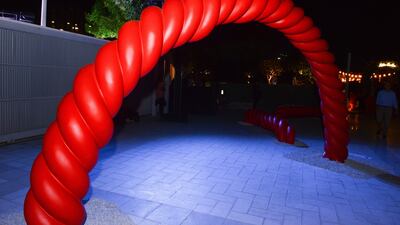
Scroll through images of the Christo and Jeanne-Claude Award's winning installation at Abu Dhabi Art below
What are the GCSE grade equivalents?
- Grade 9 = above an A*
- Grade 8 = between grades A* and A
- Grade 7 = grade A
- Grade 6 = just above a grade B
- Grade 5 = between grades B and C
- Grade 4 = grade C
- Grade 3 = between grades D and E
- Grade 2 = between grades E and F
- Grade 1 = between grades F and G
GRAN%20TURISMO
%3Cp%3E%3Cstrong%3EDirector%3A%3C%2Fstrong%3E%20Neill%20Blomkamp%3C%2Fp%3E%0A%3Cp%3E%3Cstrong%3EStars%3A%3C%2Fstrong%3E%20David%20Harbour%2C%20Orlando%20Bloom%2C%20Archie%20Madekwe%2C%20Darren%20Barnet%3C%2Fp%3E%0A%3Cp%3E%3Cstrong%3ERating%3A%3C%2Fstrong%3E%203%2F5%3C%2Fp%3E%0A
The specs
Engine: Dual 180kW and 300kW front and rear motors
Power: 480kW
Torque: 850Nm
Transmission: Single-speed automatic
Price: From Dh359,900 ($98,000)
On sale: Now
On Instagram: @WithHopeUAE
Although social media can be harmful to our mental health, paradoxically, one of the antidotes comes with the many social-media accounts devoted to normalising mental-health struggles. With Hope UAE is one of them.
The group, which has about 3,600 followers, was started three years ago by five Emirati women to address the stigma surrounding the subject. Via Instagram, the group recently began featuring personal accounts by Emiratis. The posts are written under the hashtag #mymindmatters, along with a black-and-white photo of the subject holding the group’s signature red balloon.
“Depression is ugly,” says one of the users, Amani. “It paints everything around me and everything in me.”
Saaed, meanwhile, faces the daunting task of caring for four family members with psychological disorders. “I’ve had no support and no resources here to help me,” he says. “It has been, and still is, a one-man battle against the demons of fractured minds.”
In addition to With Hope UAE’s frank social-media presence, the group holds talks and workshops in Dubai. “Change takes time,” Reem Al Ali, vice chairman and a founding member of With Hope UAE, told The National earlier this year. “It won’t happen overnight, and it will take persistent and passionate people to bring about this change.”
Ten tax points to be aware of in 2026
1. Domestic VAT refund amendments: request your refund within five years
If a business does not apply for the refund on time, they lose their credit.
2. E-invoicing in the UAE
Businesses should continue preparing for the implementation of e-invoicing in the UAE, with 2026 a preparation and transition period ahead of phased mandatory adoption.
3. More tax audits
Tax authorities are increasingly using data already available across multiple filings to identify audit risks.
4. More beneficial VAT and excise tax penalty regime
Tax disputes are expected to become more frequent and more structured, with clearer administrative objection and appeal processes. The UAE has adopted a new penalty regime for VAT and excise disputes, which now mirrors the penalty regime for corporate tax.
5. Greater emphasis on statutory audit
There is a greater need for the accuracy of financial statements. The International Financial Reporting Standards standards need to be strictly adhered to and, as a result, the quality of the audits will need to increase.
6. Further transfer pricing enforcement
Transfer pricing enforcement, which refers to the practice of establishing prices for internal transactions between related entities, is expected to broaden in scope. The UAE will shortly open the possibility to negotiate advance pricing agreements, or essentially rulings for transfer pricing purposes.
7. Limited time periods for audits
Recent amendments also introduce a default five-year limitation period for tax audits and assessments, subject to specific statutory exceptions. While the standard audit and assessment period is five years, this may be extended to up to 15 years in cases involving fraud or tax evasion.
8. Pillar 2 implementation
Many multinational groups will begin to feel the practical effect of the Domestic Minimum Top-Up Tax (DMTT), the UAE's implementation of the OECD’s global minimum tax under Pillar 2. While the rules apply for financial years starting on or after January 1, 2025, it is 2026 that marks the transition to an operational phase.
9. Reduced compliance obligations for imported goods and services
Businesses that apply the reverse-charge mechanism for VAT purposes in the UAE may benefit from reduced compliance obligations.
10. Substance and CbC reporting focus
Tax authorities are expected to continue strengthening the enforcement of economic substance and Country-by-Country (CbC) reporting frameworks. In the UAE, these regimes are increasingly being used as risk-assessment tools, providing tax authorities with a comprehensive view of multinational groups’ global footprints and enabling them to assess whether profits are aligned with real economic activity.
Contributed by Thomas Vanhee and Hend Rashwan, Aurifer
If you go
The flights
Emirates flies from Dubai to Seattle from Dh5,555 return, including taxes. Portland is a 260 km drive from Seattle and Emirates offers codeshare flights to Portland with its partner Alaska Airlines.
The car
Hertz (www.hertz.ae) offers compact car rental from about $300 per week, including taxes. Emirates Skywards members can earn points on their car hire through Hertz.
Parks and accommodation
For information on Crater Lake National Park, visit www.nps.gov/crla/index.htm . Because of the altitude, large parts of the park are closed in winter due to snow. While the park’s summer season is May 22-October 31, typically, the full loop of the Rim Drive is only possible from late July until the end of October. Entry costs $25 per car for a day. For accommodation, see www.travelcraterlake.com. For information on Umpqua Hot Springs, see www.fs.usda.gov and https://soakoregon.com/umpqua-hot-springs/. For Bend, see https://www.visitbend.com/.
Mercer, the investment consulting arm of US services company Marsh & McLennan, expects its wealth division to at least double its assets under management (AUM) in the Middle East as wealth in the region continues to grow despite economic headwinds, a company official said.
Mercer Wealth, which globally has $160 billion in AUM, plans to boost its AUM in the region to $2-$3bn in the next 2-3 years from the present $1bn, said Yasir AbuShaban, a Dubai-based principal with Mercer Wealth.
“Within the next two to three years, we are looking at reaching $2 to $3 billion as a conservative estimate and we do see an opportunity to do so,” said Mr AbuShaban.
Mercer does not directly make investments, but allocates clients’ money they have discretion to, to professional asset managers. They also provide advice to clients.
“We have buying power. We can negotiate on their (client’s) behalf with asset managers to provide them lower fees than they otherwise would have to get on their own,” he added.
Mercer Wealth’s clients include sovereign wealth funds, family offices, and insurance companies among others.
From its office in Dubai, Mercer also looks after Africa, India and Turkey, where they also see opportunity for growth.
Wealth creation in Middle East and Africa (MEA) grew 8.5 per cent to $8.1 trillion last year from $7.5tn in 2015, higher than last year’s global average of 6 per cent and the second-highest growth in a region after Asia-Pacific which grew 9.9 per cent, according to consultancy Boston Consulting Group (BCG). In the region, where wealth grew just 1.9 per cent in 2015 compared with 2014, a pickup in oil prices has helped in wealth generation.
BCG is forecasting MEA wealth will rise to $12tn by 2021, growing at an annual average of 8 per cent.
Drivers of wealth generation in the region will be split evenly between new wealth creation and growth of performance of existing assets, according to BCG.
Another general trend in the region is clients’ looking for a comprehensive approach to investing, according to Mr AbuShaban.
“Institutional investors or some of the families are seeing a slowdown in the available capital they have to invest and in that sense they are looking at optimizing the way they manage their portfolios and making sure they are not investing haphazardly and different parts of their investment are working together,” said Mr AbuShaban.
Some clients also have a higher appetite for risk, given the low interest-rate environment that does not provide enough yield for some institutional investors. These clients are keen to invest in illiquid assets, such as private equity and infrastructure.
“What we have seen is a desire for higher returns in what has been a low-return environment specifically in various fixed income or bonds,” he said.
“In this environment, we have seen a de facto increase in the risk that clients are taking in things like illiquid investments, private equity investments, infrastructure and private debt, those kind of investments were higher illiquidity results in incrementally higher returns.”
The Abu Dhabi Investment Authority, one of the largest sovereign wealth funds, said in its 2016 report that has gradually increased its exposure in direct private equity and private credit transactions, mainly in Asian markets and especially in China and India. The authority’s private equity department focused on structured equities owing to “their defensive characteristics.”
The%20specs
%3Cp%3E%3Cstrong%3EPowertrain%3A%20%3C%2Fstrong%3ESingle%20electric%20motor%0D%3Cbr%3E%3Cstrong%3EPower%3A%20%3C%2Fstrong%3E201hp%0D%3Cbr%3E%3Cstrong%3ETorque%3A%20%3C%2Fstrong%3E310Nm%0D%3Cbr%3E%3Cstrong%3ETransmission%3A%20%3C%2Fstrong%3ESingle-speed%20auto%0D%3Cbr%3E%3Cstrong%3EBattery%3A%20%3C%2Fstrong%3E53kWh%20lithium-ion%20battery%20pack%20(GS%20base%20model)%3B%2070kWh%20battery%20pack%20(GF)%0D%3Cbr%3E%3Cstrong%3ETouring%20range%3A%20%3C%2Fstrong%3E350km%20(GS)%3B%20480km%20(GF)%0D%3Cbr%3E%3Cstrong%3EPrice%3A%20%3C%2Fstrong%3EFrom%20Dh129%2C900%20(GS)%3B%20Dh149%2C000%20(GF)%0D%3Cbr%3E%3Cstrong%3EOn%20sale%3A%3C%2Fstrong%3E%20Now%3C%2Fp%3E%0A
Key facilities
- Olympic-size swimming pool with a split bulkhead for multi-use configurations, including water polo and 50m/25m training lanes
- Premier League-standard football pitch
- 400m Olympic running track
- NBA-spec basketball court with auditorium
- 600-seat auditorium
- Spaces for historical and cultural exploration
- An elevated football field that doubles as a helipad
- Specialist robotics and science laboratories
- AR and VR-enabled learning centres
- Disruption Lab and Research Centre for developing entrepreneurial skills
End of free parking
- paid-for parking will be rolled across Abu Dhabi island on August 18
- drivers will have three working weeks leeway before fines are issued
- areas that are currently free to park - around Sheikh Zayed Bridge, Maqta Bridge, Mussaffah Bridge and the Corniche - will now require a ticket
- villa residents will need a permit to park outside their home. One vehicle is Dh800 and a second is Dh1,200.
- The penalty for failing to pay for a ticket after 10 minutes will be Dh200
- Parking on a patch of sand will incur a fine of Dh300
THE SPECS
Engine: 6.75-litre twin-turbocharged V12 petrol engine
Power: 420kW
Torque: 780Nm
Transmission: 8-speed automatic
Price: From Dh1,350,000
On sale: Available for preorder now
Zayed%20Centre%20for%20Research
%3Cp%3EThe%20Zayed%20Centre%20for%20Research%20is%20a%20partnership%20between%20Great%20Ormond%20Street%20Hospital%2C%20University%20College%20London%20and%20Great%20Ormond%20Street%20Hospital%20Children%E2%80%99s%20Charity%20and%20was%20made%20possible%20thanks%20to%20a%20generous%20%C2%A360%20million%20gift%20in%202014%20from%20Sheikha%20Fatima%20bint%20Mubarak%2C%20Chairwoman%20of%20the%20General%20Women's%20Union%2C%20President%20of%20the%20Supreme%20Council%20for%20Motherhood%20and%20Childhood%2C%20and%20Supreme%20Chairwoman%20of%20the%20Family%20Development%20Foundation.%3C%2Fp%3E%0A
Stree
Producer: Maddock Films, Jio Movies
Director: Amar Kaushik
Cast: Rajkummar Rao, Shraddha Kapoor, Pankaj Tripathi, Aparshakti Khurana, Abhishek Banerjee
Rating: 3.5
Results
Stage 7:
1. Caleb Ewan (AUS) Lotto Soudal - 3:18:29
2. Sam Bennett (IRL) Deceuninck-QuickStep - same time
3. Phil Bauhaus (GER) Bahrain Victorious
4. Michael Morkov (DEN) Deceuninck-QuickStep
5. Cees Bol (NED) Team DSM
General Classification:
1. Tadej Pogacar (SLO) UAE Team Emirates - 24:00:28
2. Adam Yates (GBR) Ineos Grenadiers - 0:00:35
3. Joao Almeida (POR) Deceuninck-QuickStep - 0:01:02
4. Chris Harper (AUS) Jumbo-Visma - 0:01:42
5. Neilson Powless (USA) EF Education-Nippo - 0:01:45