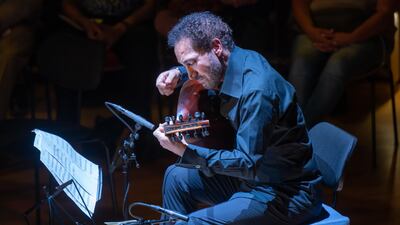

When Naseer Shamma joined the UAE National Orchestra for its inaugural concert in January, the performance was a celebration of what the newly formed ensemble could become.
Nine months later, the Iraqi oud virtuoso is returning to an orchestra with a full season and more than two dozen concerts across the emirates behind it, and a more ambitious programme ahead.
At Friday's Harmony concert at NYU Abu Dhabi's Arts Centre, Shamma will perform four of his compositions in new orchestral arrangements, including a concerto for oud and orchestra.

“The first concert was different. It was a celebration. We were saying, here we are, we are together. But now we have a concrete programme. We have something much deeper, with different pieces,” he tells The National.
“I think the orchestra is clearly at another level now compared with the first concert. The first show was very good, and if you notice, each concert since then has been about going deeper and finding new forms of creative expression. I am so glad to be part of that journey.”
For Shamma, one of the Arab world's most influential oud players and educators, the collaboration continues nearly four decades of experimentation with the instrument's sound, design and repertoire.
He has helped to develop a family of ouds covering different musical registers, composed for film and theatre, and founded Bait Al Oud in Cairo in the late 1990s, later expanding the conservatory to Abu Dhabi, Alexandria and Baghdad.
His interest in oud-inspired orchestral music is long-standing, having led a 70-member Eastern Orchestra at Abu Dhabi Festival in 2008.

Friday's programme includes Concerto for Oud and Orchestra, which Shamma says has been developed through extensive rehearsals and discussions with musicians. Despite previously performing orchestral works, including an adaptation of Vivaldi's Mandolin Concerto for the oud, he describes it as the ideal concerto for the occasion.
“I hope it will be a good work because we have taken time with the composition, with rehearsals and with discussing the ideas with different musicians. Now I think it is ready to be presented on stage with the orchestra,” he says.
Shamma acknowledges the contributions of earlier Arab composers, including Iraqi oud musician Jamil Bashir, who wrote for the instrument in orchestral settings. He now hopes to expand the repertoire available to future generations of oud players.
“For that reason, I think it is time to compose differently. To compose one concerto every year would be great, because this would create a repertoire for other musicians who come after us,” he adds.
“Of course, many Arab composers have written concertos for the oud, qanun, nay and other instruments. But when I compose something for the oud as an oud soloist myself, it will be different from what another composer writes. Because that composer may only be a composer, not an oud player.”
Writing for a symphony orchestra also means balancing its instrumental range with the oud's distinctive sound and characteristics.
“I think the oud has its own special characteristics. Its sound, its power, its chords, its quarter-tones and many other things,” he says.
To keep the instrument from getting lost in the orchestra, “we have to preserve the oud's identity”, Shamma says. “Not in a traditional way but in a contemporary way. It must remain an oud in the middle of the orchestra.”

Shamma's collaboration with the orchestra has also developed through his relationship with its musicians. He recalls their curiosity during January's rehearsals about his oud's clarity of sound and his playing style, and how the experience helped to establish a rapport.
“It was a beautiful experience. I felt that we had covered a great distance through a single piece of music.
“It is a distance that might take two years to cover in ordinary life, just to create a friendship. But we achieved it through one piece lasting eight minutes.”
Some of the orchestra's musicians have an earlier connection to Shamma through Abu Dhabi's Bait Al Oud, which he set up with clear expectations.
“When I established it in Cairo in 1998, and then the second in Abu Dhabi in 2007, I had a clear idea that one day the UAE would need professional musicians. So I began preparing these musicians.”
Several Emirati musicians who trained at the institution have joined the UAE National Orchestra, according to Shamma.
“So this is a collaboration. We complement one another. We complete one another's projects,” he says. “We are working to become bridges that lead to the other side, to professional music.”
Harmony by the UAE National Orchestra: Friday, October 16 at The Arts Centre, NYU Abu Dhabi. 8pm. Tickets start from Dh100

