
There are patterns to our lives that become so familiar that we stop noticing them.
The road taken to work each morning, the objects kept around the house, the changing light across a city skyline or the small gestures repeated without thought can gradually become part of a personal rhythm.
“Every household keeps a script no one wrote down, the gestures, routines and small fidelities through which a life quietly holds itself together,” says Shafeena Yusuff Ali, founder and executive director of Rizq Art Initiative.

Those unwritten scenarios are at the heart of Unseen Script, the latest exhibition at Rizq Art Initiative on Abu Dhabi's Reem Island. Running until October 28, it brings together 10 artists exploring repetition, memory, nature and the ways people make sense of the world around them.
Chief curator Meena Vari says those ideas have taken on new significance as technology becomes increasingly capable of identifying patterns in human behaviour.

“We are in this time of artificial intelligence where patterns become the code, and the code then comes back to us and will pre-empt things for us,” she tells The National.
That thinking is reflected in the work of Syrian artist Ismail Al Rifai, whose landscapes draw on roads and routes travelled repeatedly.
Vari says an everyday journey can become so embedded in a person's routine that it almost disappears from conscious thought. At the same time, those repeated movements can now become data from which technology predicts where someone might go next.
“But then as artists and as individuals, we always have our own consciousness, which is different from an artificial intelligence,” she says.
Rather than making AI the subject of the exhibition, Vari uses it as a way into a wider question of what human observation, memory and subjective experience can reveal.
The answer unfolds across works of dramatically different scales.

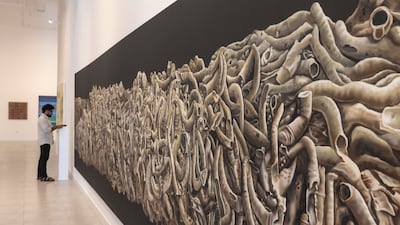
One of the largest is by Indian artist Abdulla P A, whose oil painting stretches more than 10 metres. At the other end are intimate assemblages by Colombian-French artist Ana Escobar Saavedra, made using seashells and other found objects.
The contrast is striking. One work demands distance to take in its scale, while the other draws the viewer closer to notice details that could easily be missed.
Abdulla’s work considers the idea of home through natural and human-made structures.
Vari says her conversations with the artist moved towards abandoned homes, particularly in parts of South Asia and the Middle East where migration or a lack of work can leave houses empty and nature gradually begins reclaiming them.
“He wants to embody that and reflect it in some way in his work,” Vari says.
The artist's interest in biomimicry also draws connections between human dwellings and forms created by other living creatures.

Saavedra, meanwhile, collects seashells from beaches and brings them back to her studio, where the fragments are assembled and accented with gold.
Vari says the process elevates something that might otherwise decay or disappear. “She could have used anything else, but she's using this broken, dying thing.”
The exhibition also features Emirati artists Najat Makki, Nujoom Alghanem and Nasir Nasrallah, alongside Lebanese artist Fadi Balhawan, Palestinians Joanna Barakat and Neveen Abu Samra, and Indian-born Simrin Mehra Agarwal.
Vari says her curatorial approach involves looking for recurring ideas within each artist's practice.
“With every artwork, I'm trying to find that pattern in the practice of the artists where they are going back to the same thing again and again,” she says.
Ali describes it as another layer of observation.
“It's also Meena saying: ‘I see your pattern, and I want other people to see it too,’” she says.

Nasrallah takes a more personal approach. Vari says the Emirati artist spent time among objects in the antique shop once owned by his grandfather in Sharjah, inventing stories around the things he encountered there.
His works in Unseen Script have the character of a diary, while Balhawan combines language, calligraphy and abstraction.
“He draws with his words,” Vari says. “He uses his words like poetry.”
Elsewhere, pioneering artist Makki moves into three dimensions, with works in steel extending an abstract practice known for its focus on colour and landscape.
The exhibition also reaches into the natural world through Mehra Agarwal, whose work examines decaying palm leaves, and Abu Samra, who repurposes everyday materials that might otherwise be discarded.
“There is a script that is being written for us by nature too,” Vari says.
Perhaps the exhibition's broadest view comes through the paintings of Emirati artist and filmmaker Alghanem.
She represented the UAE at the Venice Biennale in 2019 with Passage, but Ali says Alghanem's wider practice is less familiar to some audiences.
“She has such a varied practice, a large part of which the contemporary world doesn't know,” Ali says.
Alghanem's work extends beyond filmmaking into painting, ceramics, cement, resin and digital art.
In Unseen Script, her paintings consider the relationship between the city and nature. Vari points to one recurring feature in the city works: the absence of a conventional horizon.
“This cityscape is actually the new horizon that we are all living with, the reality we're living with today,” she says.

The exhibition follows Under the Same Sky, Vari's previous group show at Rizq, which explored how artists living in the UAE experience belonging, memory and place.
Unseen Script shifts focus towards the less visible forces shaping everyday experience.
Ali says this also reflects how Rizq Art Initiative, founded in 2023, wants to evolve as an arts organisation in Abu Dhabi.
“I know what the conversation today needs to be,” she says. “But if I'm already seeing what the conversation needs to be in about five years, then I'm no longer contemporary. I'm no longer talking about the times of today.”
Vari says that the same openness applies to how audiences encounter the artworks. The exhibition may identify the scripts and patterns running through everyday life, but it does not dictate what they should mean.
“You read it your way,” she says.
Unseen Script runs until October 28 at Rizq Art Initiative in Reem Island, Abu Dhabi

