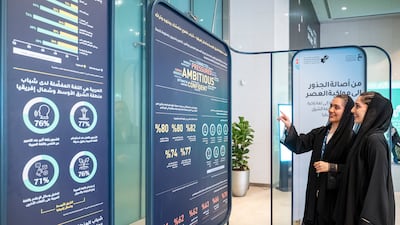
The first white paper from the Congress of Arabic & Creative Industries in Abu Dhabi has found that young people want Arabic to keep pace with the way they learn, work and create. The thought piece, in partnership with Strategy& and Ipsos, marked the 5th Congress on September 20.
For young people across the Middle East and North Africa, Arabic remains overwhelmingly the language of home, family and identity. But when they enter the classroom, workplace or digital world, the picture begins to change.
The new white paper, based on extensive research involving more than 4,000 young people across 10 countries in the Middle East and North Africa, has highlighted a growing tension in how a generation aged between 18 and 25 uses language.
While 91 per cent of respondents use Arabic at home and 76 per cent say it connects them to their roots, 77 per cent consider English essential to achieving their goals.
The findings do not suggest that young Arabs are turning away from their mother tongue. Instead, they raise a more complex question: whether Arabic is keeping pace with the environments in which young people increasingly expect to build their futures.
The research was announced as part of the Congress of Arabic & Creative Industries (Congress ACI), held in Abu Dhabi, and forms the basis of a new report, From Roots to Relevance: Making Arabic the Language of Opportunity for Mena's Young People.

Developed by the Abu Dhabi Arabic Language Centre, Strategy& Middle East, part of the PwC network, and Ipsos, the report draws on the Congress ACI Arab Youth Pulse Survey 2025.
The results reveal a marked shift in language use as young people move between different parts of their lives.
Arabic is used by 91 per cent of respondents at home, but that falls to 64 per cent at work, university or school, and 60 per cent when undertaking online learning. English, meanwhile, rises from 7 per cent at home to 33 per cent in education and the workplace and 36 per cent in online learning.
Almost three quarters (74 per cent) want Arabic to evolve to better reflect how they learn, create and work.
Dr Ali Bin Tamim, chairman of the Abu Dhabi Arabic Language Centre, said the findings reflect young people’s expectations for the language rather than a weakening of their connection to it.
“Young people are not turning away from Arabic; they are asking for it to evolve with them and to be present wherever they learn, work, create and build their futures,” he said.
“Our responsibility is to ensure that this deep connection to Arabic is matched by opportunity; by strengthening its presence in education, technology, knowledge production and the creative industries.”
Technology emerges as the priority
For young people, one area stands out.
Half of those surveyed identify technology and artificial intelligence as the leading priority for greater investment in Arabic, ahead of schools and universities at 42 per cent, government and public services at 39 per cent, and media and entertainment at 32 per cent.
The scale of the digital challenge extends beyond the survey. In 2024, 86 per cent of people aged between 15 and 24 in Arab States were online, yet Arabic-language websites accounted for just 0.6 per cent of websites as of July 2026.
The report also points to gaps in Arabic-language AI, noting that many large language models perform less effectively in non-English and lower-resource language contexts and can struggle to reflect cultural context accurately.
Among its recommendations is the development of shared Arabic-language technology infrastructure, including high-quality datasets, language models, speech-recognition tools and translation resources that can be used across sectors and dialects.

Nay Abi Ramia, partner at Strategy& Middle East, said the findings demonstrate why the future of Arabic needs to be considered as an economic and technological question as well as a cultural one.
“The strong connection young people have with Arabic is clear. What is equally clear is their expectation that the language should give them access to the same opportunities to learn, create and build careers that they find in English,” she said.
“Closing that gap requires investment in the infrastructure around the language – from education and digital content to Arabic data and AI tools. If Arabic can operate effectively across these environments, it can become not only a language young people identify with, but one through which they participate fully in the region’s future economy.”
The question sits closely within the theme of this year's Congress ACI: “Arabic as Infrastructure: Identity, Knowledge and Economic Power in the Digital Age.”
The Congress has sought to move discussion about Arabic beyond preservation and towards the systems that allow a language to function effectively within a modern economy – from publishing and intellectual property to artificial intelligence, investment, education and the creative industries.
Ambition without abandoning identity
The research also challenges the idea that modernity and cultural identity necessarily pull young Arabs in opposite directions.
Some 81 per cent of respondents believe they have the power to shape their own future, while 77 per cent say balancing tradition and modernity is important when making career choices.
That ambition sits alongside a strong attachment to heritage. More than three quarters, 76 per cent, say Arabic connects them to their roots, while 70 per cent are concerned about losing traditions and values and 66 per cent about the declining use of Arabic.
But valuing Arabic does not mean young people want it to remain static.
77 per cent say they feel proud when they encounter Arabic being used in modern contexts. At the same time, 67 per cent believe the Arabic content they find feels dated compared with content in English.

Taken together, the findings suggest young people are not asking to choose between tradition and modernity, or between Arabic and participation in a global economy. They want the language that connects them to their identity to be equally present in the contemporary spaces in which they study, work and create.
“Arabic has always been a language of knowledge and creativity,” Dr Bin Tamim said. “By listening to this generation and responding to their ambitions, we can ensure it remains a language through which they can participate confidently in shaping the future.”
The figures also complicate a familiar debate about Arabic and English in the region.
For a generation already moving fluidly between languages, English can be regarded as essential to international education, employment and communication without diminishing Arabic’s importance to identity and belonging.
The question, then, is not how to displace English. It is how to expand the spaces in which Arabic offers young people the same access to knowledge, technology, creativity and opportunity.
The research suggests young people want that future for the language. Delivering it will depend on whether education systems, technology companies, governments and the cultural and creative industries can build the infrastructure to make it possible.

