For decades, Abu Dhabi's economic story was inseparable from oil. Today, another story is taking shape — one that could determine how the emirate participates in the next generation of the global economy.
Artificial intelligence has become an increasingly visible part of Abu Dhabi's diversification drive, backed by sovereign capital, computing infrastructure, research institutions and an expanding technology ecosystem. The shift is not simply about how much the emirate is investing in technology, but where Abu Dhabi wants to sit in the global technology value chain.
What it takes to build an AI economy
The economic backdrop is already changing. Abu Dhabi's non-oil economy grew 7.6 per cent year-on-year in the third quarter of 2025 and accounted for about 54 per cent of GDP. At the federal level, the UAE intends to increase the contribution of the digital economy to GDP from 9.7 per cent in 2022 to 19.4 per cent within a decade.
Abu Dhabi-backed investment group MGX closed its first fund at $49 billion this year, targeting semiconductors, AI infrastructure and technology platforms. The planned 5-gigawatt UAE-US AI Campus in Abu Dhabi, which includes Stargate UAE, would place the emirate within the global race to build the computing capacity required for increasingly powerful AI systems.
The government itself is becoming a major technology customer. Abu Dhabi has committed Dh13 billion to its Government Digital Strategy 2025-2027, with the stated ambition of becoming the world's first fully AI-native government.
However, capital, computing power and government ambition alone do not create a technology economy. The real test is whether that ecosystem can produce companies capable of developing their own technology, deploying it in complex real-world environments and ultimately competing internationally.
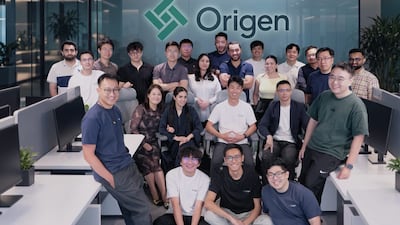
Origen, an Abu Dhabi-based technology company, offers one early example. In February, it secured a $50 million strategic investment from BlueFive Capital to accelerate product development and AI deployment.
From adopting technology to building it
Origen develops AI systems for cities, intelligent infrastructure and industrial environments, reflecting the broader shift towards AI that can increasingly perceive, reason about and interact with the physical world.
Its SpatialWare platform is designed as an AI-native spatial intelligence layer, combining BIM and CAD models, point clouds, sensor feeds and operational data in a continuously updated representation of the physical world. Spatial reasoning, agentic AI and physics-based models help it understand relationships between assets, simulate conditions and support predictive decisions.
The aim is to make AI part of operational infrastructure rather than a standalone software tool.
One of the most significant tests of that approach is Nabd, an AI-powered digital governance framework being developed with Abu Dhabi's Department of Municipalities and Transport.
Origen serves as system architect for the project, which brings city and operational information into a live three-dimensional representation of Abu Dhabi. Nabd integrates more than 70 data sources across more than 15 connected systems, covering buildings, roads, utilities, underground infrastructure and other urban assets.
The technical challenge goes beyond creating a 3D model. Nabd uses a federated architecture designed to connect existing government systems rather than replace them, with an AI orchestration layer allowing information from previously fragmented platforms to work together.
Origen says its appointment followed a competitive process involving international technology groups and strong local players, with its proposal prevailing largely on technical merit.
For an emerging technology company, that distinction matters. For Abu Dhabi, the significance extends beyond a single project: it points to the emirate's ability to move from acquiring world-class technology to building globally competitive technology of its own.
Why Abu Dhabi matters
Frank Dai, Origen's founder and chief executive, sees the company's emergence in Abu Dhabi as part of a broader technological transition.
“We are living through one of those rare technological shifts that goes far beyond a single industry,” he said. “AI will change how almost every sector operates. When a transformation happens at that scale, it creates the conditions for a new generation of important companies to emerge.”
Abu Dhabi's appeal also extends beyond capital. Mr Dai points to the UAE's political and economic stability, policy continuity, global connectivity and ability to attract international talent - factors that matter to companies making long-term investments in emerging technology.
“Technology companies are built by people, and talent is global,” Mr Dai said. “Talent has choices. Stability, connectivity and opportunities to build and deploy technology at scale are important to creating a lasting technology ecosystem.”
That advantage is reinforced by policy. The UAE adopted a national AI strategy early, while Abu Dhabi has increasingly moved from experimentation to deploying artificial intelligence across government and the wider economy. The combination of capital, regulation and willingness to adopt new technology creates an unusual environment for emerging technology businesses.
The test of global competitiveness
There are still significant questions ahead. Building data centres and deploying capital can happen relatively quickly. Developing deep technical expertise, creating intellectual property, and building globally competitive companies takes much longer.
Origen faces the same test. Nabd may demonstrate an ability to operate in a complex, city-scale environment, but international competitiveness will ultimately be measured by whether its technology can scale beyond its home market.
That is why companies like Origen stand as indicators of a broader transition. Abu Dhabi has already demonstrated its ability to finance technologies shaping the global economy and is rapidly building the infrastructure on which they run. The next stage is harder: building the capability to create them at home.

