


When London’s West End stores emerged from lockdown, a queue soon formed outside Louis Vuitton on New Bond Street.
It seemed perverse; the world was in the throes of a health crisis, struggling to cope with illness and death on an enormous scale. Everywhere fear abounded, about the virus and its effects.
Across the globe, people were afraid for their vulnerable and elderly relatives and friends, children were denied access to school, social lives ground to a standstill, planes stopped flying, mental well-being plummeted and job insecurity soared. Yet, here were people who wanted to spend thousands on a handbag or a pair of boots. It was perverse.
Was it, really? When they were asked why they were doing this, the shoppers replied that they wished to treat themselves, that while they were holed up in their homes, they’d dreamt of one day touching, smelling, buying the sort of quality product that “LV” specialised in. They could have bought online but they wanted to enjoy the experience of being cosseted and indulged, and indulging, again.
Confirmation that luxury products are different, that they cater for a need in human beings outside the normal, everyday humdrum of just getting by, comes this week from Rolls-Royce. The BMW-owned company sold 5,586 vehicles last year, an increase of 49 per cent on 2020 and the highest total in its history.

According to Rolls-Royce’s boss, Torsten Müller-Otvös, wealthy motorists realised that “life is short”. He said: “Quite a lot of people witnessed people in their community dying from Covid, that makes them think life can be short, and you’d better live now than postpone it to a later date. That also has helped [Rolls-Royce sales] quite massively.”
His analysis is borne out by the fact that soaring demand was across the board, it really was worldwide. As, of course, were the ravages of the virus. Just as 5.5 million people have died due to Covid around the world, so too has Rolls-Royce enjoyed a commensurate rise in sales. The boom was not confined to one market but applied to all of them — something again the carmaker had never seen before. Normally, while one country or region is up, another is down. That was not the case this time. China and the Americas saw 30 per cent sales increases, Europe was up 20 per cent and the Middle East 10 per cent. South Korea and Russia also did well.
The surge was not confined to Rolls-Royce. Bentley also enjoyed a 30 per cent rise, selling 14,659 cars. The best-seller for Rolls-Royce was its new SUV, the Cullinan, which retails at £264,000, although customers were lining up to design their own Rolls-Royce Boat Tail model for a mere £20m.
The sense of parallel universes was exemplified by semiconductors. Elsewhere in cars and other industries there was a chronic shortage of the computer chips. Factories in Asia, hit by Covid, were unable to manufacture enough of them to keep pace with orders. Their absence added to worldwide supply chain woes. But Rolls-Royce and Bentley don’t make as many cars as other manufacturers and therefore require fewer chips. In the case of the former, parent BMW was able to lend its weight to source the chips; similarly, Volkswagen, which owns Bentley, helped the British subsidiary.

The Rolls-Royce results come on the back of figures from elsewhere in luxury goods. Hermes International reported a more than doubling of sales, to pre-pandemic levels. Revenue climbed by 127 per cent in the Birkin handbag-maker’s second quarter, beating City estimates, and was 33 per cent higher than in the same period of 2019. Likewise, LVMH posted a 40 per cent gain from 2019 for its fashion and leather goods. Gucci and Prada have also reported buoyant trading.
As with Rolls-Royce and Bentley, the designer labels are more insulated from the production problems besetting the rest of manufacturing. They depend less on the use of technology and mass-produced electronic components and more upon the application of finer, natural materials and artisanal craftsmanship.
Nevertheless, it appears odd that one section of society should be splashing out on such items while the rest is wilting. Superyachts — 894 were sold last year, costing $5.2bn, up from 465 at $3.2bn the year before, according to VesselsValue — and rare wines are also enjoying a roaring trade.
But wealth has climbed. Borrowing costs are low and stock markets are soaring (the S& P 500 was 27 per cent higher last year), making the super-rich even richer. Accelerating inflation, recession, slowdown in China and the US could all change the mood. For now, though, they must find something to do with that money. Normally, that would be the getaway trip to the villa or ski chalet, but that is off limits. Besides, they’re sitting on so much that a spot of retail therapy via a new Roller or bit of LV won’t make much of a dent in their fortunes. In the UK, sales of mansions and country estates are also powering upwards — so much cash is there floating around.
-

The Rolls-Royce Cullinan SUV is powered by a 6.75-litre V12 engine, which gets it from 0 to 100kph in 5.2 seconds -

The off-road button offers five drive modes: snow, mud, sand, gravel and rutted track -
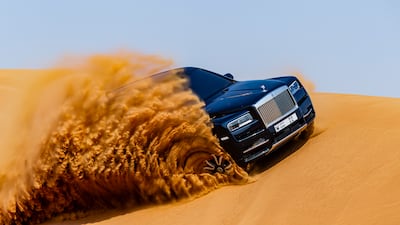
The Hill Descent Control takes care of the throttle on steep descents -

The Cullinan’s raised height gives it 540 millimetres of wading depth, which the company claims is the highest of any super-luxury SUV -
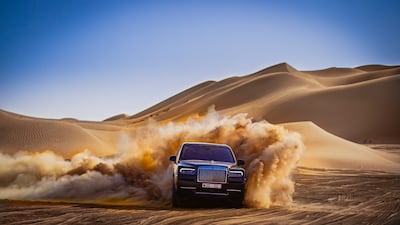
A series of stereo cameras adjust the suspension in milliseconds to flatten out bumps or dips before they arrive -
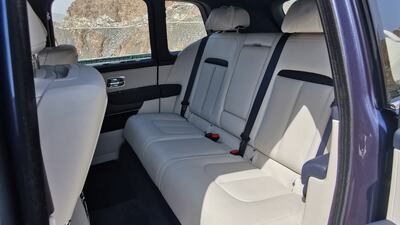
The rear offers the option of a 60:40 split-fold three-seat bench or the more traditional four-seat layout -
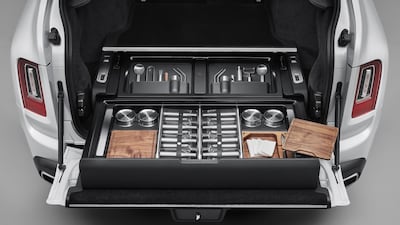
The Rolls-Royce Hosting Service offers a range of accoutrements and customisation options. Photo: Rolls-Royce -
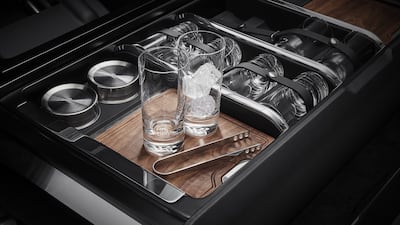
Owners can request chilled drinks cabinets with crystal glassware or picnic hampers, for example. Photo: Rolls-Royce -

A photography and drone kit can be installed alongside a computer and iPad, stowed away in an air-conditioned box below the cargo floor. Photo: Rolls-Royce -
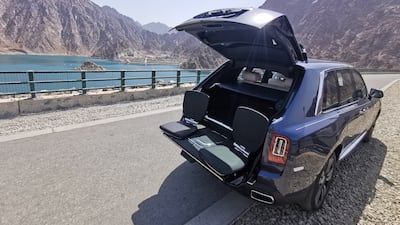
'The National'’s review car featured electrically operated, leather chairs that swivel out from the rear floor over the tailgate -
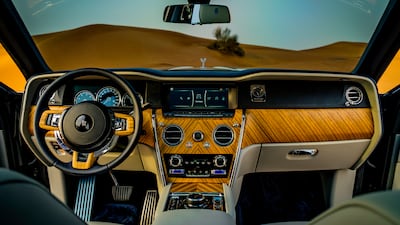
The Cullinan SUV is powerful and luxurious, making it a delight for drivers and passengers alike -

Colonel TE Lawrence famously described his fleet of nine armoured Rolls-Royces as 'more valuable than rubies'. Photo: Rolls-Royce


There is, too, an extra factor. Rolls-Royce reports that the average age of its buyer is now 43, down from 56 over the last decade. The younger owners hail from tech and crypto, from industries that are equally youthful and have prospered during the previous, Covid-affected, two years.
What’s occurring is that people want to enjoy themselves, that’s the effect of the pandemic — get ready for the outpouring of crazy celebrations when the outbreak officially ends. As F Scott Fitzgerald wrote: “Let me tell you about the very rich. They are different from you and me. They possess and enjoy early …”
While we can only stand and gawp, a few — and exclusivity is the point — lucky companies are reaping the benefit.

