In pictures: Inside the Sheikh Khalifa at the Palace of Fontainebleau
-
-
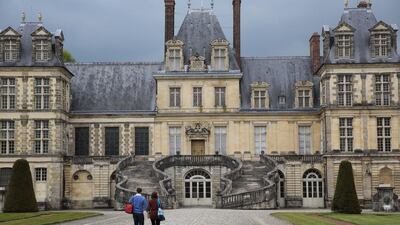
Fontainebleau started life as 12th century hunting lodge, was transformed into a palace in the 16th century and became associated with every French ruler — king, queen, empress and emperor — for almost 800 years. -
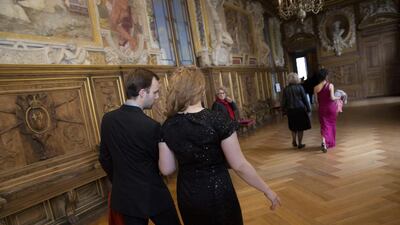
Now, thanks to Abu Dhabi’s sponsorship of the restoration of Fontainebleau’s theatre, Sheikh Khalifa bin Zayed’s name will be added to an illustrious list that includes Francois I, Henry IV, Louis XVI, and Napoleon III. -
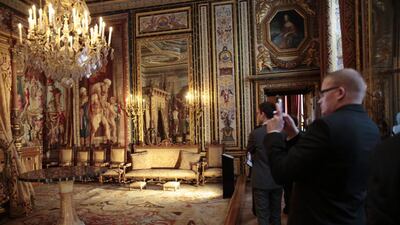
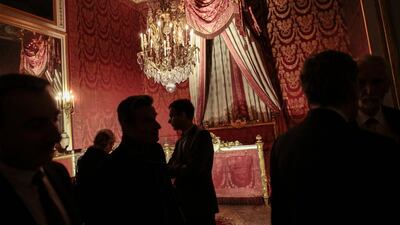
Visitors in the Papal Apartment of the Palace. -
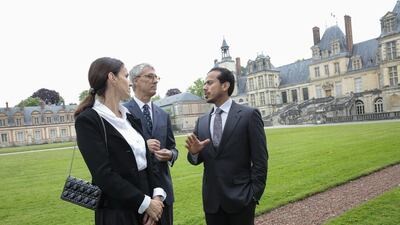
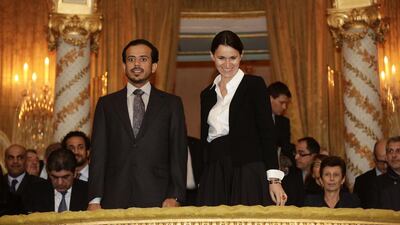
Sheikh Sultan bin Tahnoon, with the French culture minister Aurelie Filippetti, left, and Jean Francois Hebert, centre, the president of the Public Establishment of Fontainebleau. -
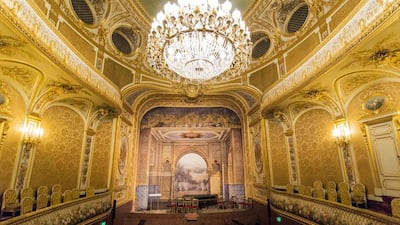
The small 430-seat theatre is one of the few to survive unmodified from the time of the French Second Empire (1852-1870). Napoleon III commissioned the ‘Imperial Theatre’ in 1853 from Hector Lefuel, the palace architect who was later responsible for the renovation and completion of the Pavilion de Flore at the Palais du Louvre. -
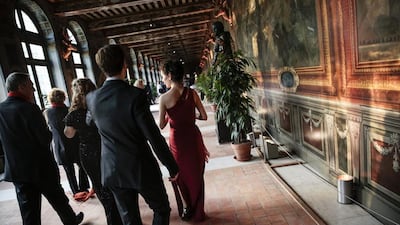
Visitors in the Gallery of Stags. -
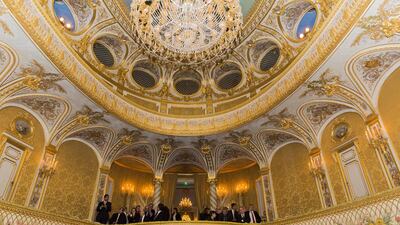
Directly inspired by Marie Antoinette’s theatre at Versailles, the theatre was inaugurated in May 1857 during the visit of the Grand Duke Constantine of Russia, the brother of Tsar Alexander II but only used about a dozen times during Napoleon III’s reign. -
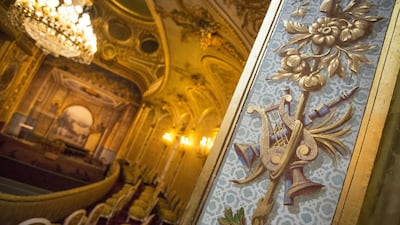
As Vincent Cochet explained, the idea is not to turn the theatre into a full-functioning performance space. “The idea of a working theatre was abandoned in favour of a restoration and display as a museographic space — yet with the possibility of organising performances five times a year.” -
“In France, it has been thought that the style of the Second Empire was rather lacking in imagination,” Mr Cochet explained. “But when you see the theatre now, it is like arriving back in the Second Empire. Before we had a grey theatre, but now we have a bright theatre and we can show the reality.” -
As part of the opening ceremony, a programme of works by the French Baroque composer, Jean-Philippe Rameau, was performed on period instruments in front of an audience that included Dr Zaki Anwar Nusseibeh, Cultural Advisor to the UAE Ministry of Presidential Affairs, Mubarak Al Muhairi, the director general of TCA Abu Dhabi and Mohammed Al Raisi, the UAE’s Ambassador to France along with Jean-Luc Martinez, the President-Director of the Musee du Louvre.


Most popular today

