

President Bashar Al Assad has been pushing the idea that he has all but won the civil war in Syria and it is time to rebuild the country.
Since the conflict began in 2011, three UN envoys have failed to achieve a political transition, which they later blamed on the intransigence of the regime.
But last week the regime began UN-supervised talks with the opposition to draw up a new constitution that is seen as a first step to achieving that goal.
The 150-member Constitutional Committee comprises 50 members each from the opposition and the regime representatives.
The UN chose the other third, defining them as civil figures whether they were close to the regime or the opposition. A majority of 75 per cent is needed to pass the document.
The new constitution, under a UN Security Council Resolution in December 2015, is part of a Syrian-led political process towards “credible, inclusive and non-sectarian governance”.
The major point of the resolution is the formation of a transitional governing body of regime and opposition representatives, which was envisioned in the Geneva Communique of 2012.
The timing of its formation was kept deliberately vague in the UN resolution and later ones based on it, together with what defines a political transition.
Diplomats said it was the only way for the resolutions to be passed, as Russia and the US continued to have major differences over Syria.
-
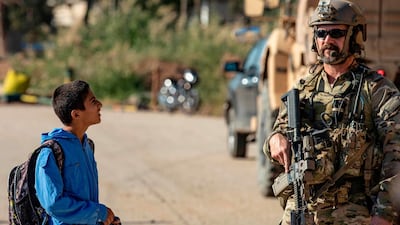
A Syrian boy looks at a US soldier on patrol in the village of Ein Diwar in Syria's northeastern Hasakeh province. AFP -
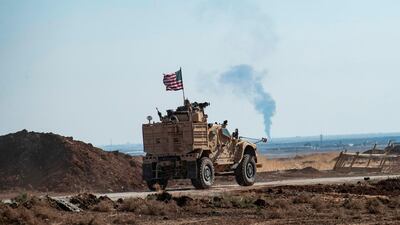
A US armoured vehicle patrols the village of Ein Diwar in Syria's northeastern Hasakeh province. AFP -
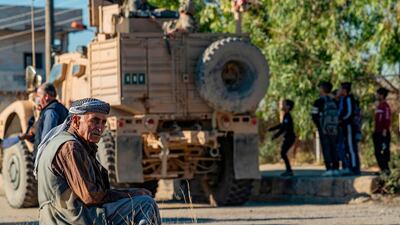
A Syrian elderly man sits near a US armoured vehicle on patrol in the village of Ein Diwar in Syria's northeastern Hasakeh province. AFP -
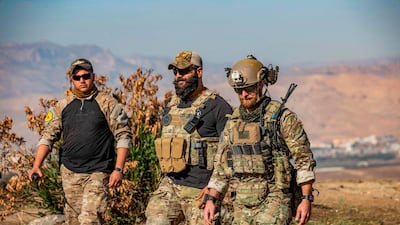
(L to R) A member of the Kurdish People's Protection Units (YPG) walks with US soldiers during a patrol in the village of Ein Diwar in Syria's northeastern Hasakeh province. AFP -
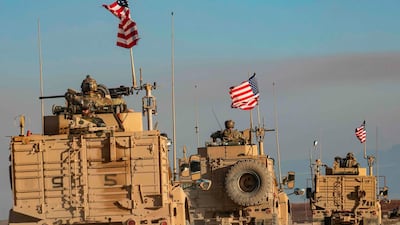
A convoy of US armoured vehicles patrols the village of Ein Diwar in Syria's northeastern Hasakeh province. AFP -
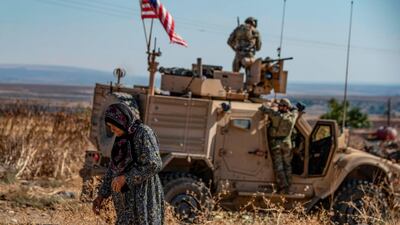
A Syrian elderly woman walks past a US armoured vehicle on a patrol in the village of Ein Diwar in Syria's northeastern Hasakeh province. AFP -

A convoy of US armoured vehicles (background) patrols the village of Ein Diwar in Syria's northeastern Hasakeh province. AFP


The constitution was prioritised under Russian pressure, with the US acquiescing to Moscow’s position, a UN official said.
Moscow’s intervention in the civil war in late 2015 saved Mr Al Assad, allowing his regime to regain significant territory.
Russia intervened after Iranian efforts failed to halt a major rebel advance from the north that threatened to isolate the Alawite Mountains, the heartland of Mr Al Assad’s minority sect, from his seat of rule in Damascus.
If Mr Al Assad continues to rule, few doubt that the Geneva constitution will be as toothless as the two constitutions enacted in the past 49 years of Assad family rule over Syria.
An early 1970s constitution stipulated a maximum of two seven-year terms for the president.
But that limit was ignored as Hafez Al Assad ruled from 1970 until his death in 2000, and the slogan “Hafez Al Assad for eternity” became a centrepiece of state propaganda.

In 2012, with two years left to complete two terms, Bashar Al Assad replaced the constitution, keeping the two-term limit but starting anew, meaning he can rule until 2026 without breaking the law.
Pressured by Russia to come up with an internationally supported constitution, Mr Al Assad is negotiating with an opposition he supposedly vanquished on a document he may not be able to dictate.
But the regime has the advantage in that no time frame has been set to finish the process and the opposition is divided.
A significant proportion of the opposition delegation in the committee is influenced by Moscow and by Turkey, an opponent of Mr Al Assad which has yielded to Russia in major ways.
A confidential study presented to western and Arab governments involved in Syria shows that 17 of the 50 members of the opposition quota in the Constitutional Committee live in Turkey.
The study found Turkey had most influence in the opposition delegation, with sway over 20 members, compared with seven for Moscow and four for Egypt.
-
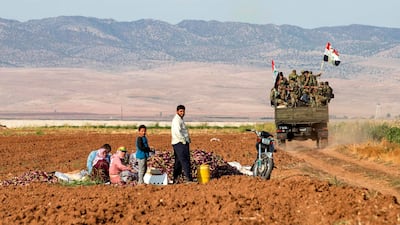
Syrian government soldiers ride in the back of a truck with national flags past people sitting in a field with harvested aubergines, as government forces deploy for the first time in the eastern countryside of the city of Qamishli in the northeastern Hasakah province. AFP -
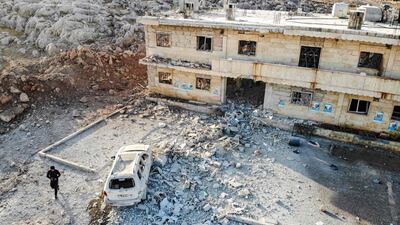
This picture shows an aerial view of a hospital that was reportedly hit by an airstrike in the Syrian village of Shinan, about 30 kilometres south of Idlib in the northwestern Idlib province. AFP -
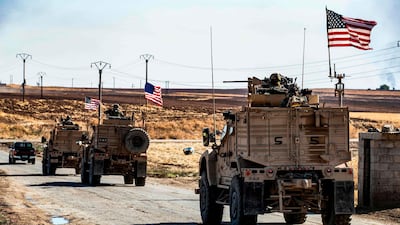
US military armoured vehicles drive in a patrol past an oil well in Rumaylan (Rmeilan) in Syria's northeastern Hasakeh province. AFP -

This picture taken shows a view of the aftermath of an airstrike in the Syrian village of al-Sahharah in the countryside west of the northern city of Aleppo. AFP -
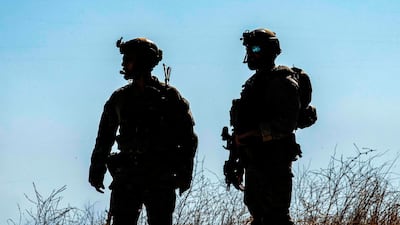
US soldiers stand during a patrol near an oil well in Rumaylan (Rmeilan) in Syria's northeastern Hasakeh province. AFP -
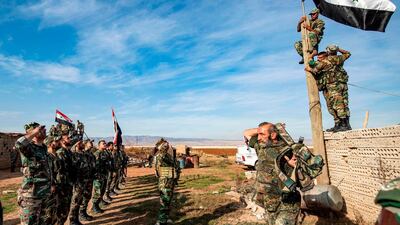
Syrian government soldiers perform a salute as others raise up a government national flag upon a wooden pole as they deploy for the first time in the eastern countryside of the city of Qamishli in the northeastern Hasakah province. AFP -
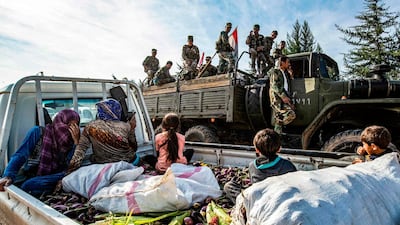
Syrian government soldiers ride in the back of a truck with national flags past a pickup truck carrying women and children seated above harvested aubergines and maize, as government forces deploy for the first time in the eastern countryside of the city of Qamishli in the northeastern Hasakah province. AFP -
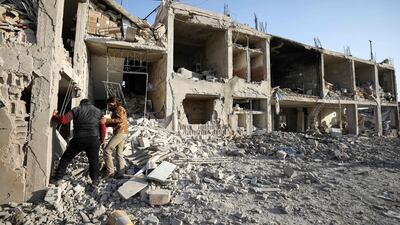
Men inspect the rubble of a hospital that was reportedly hit by an airstrike in the Syrian village of Shinan, about 30 kilometres south of Idlib in the northwestern Idlib province. AFP


Russia’s core allies among the opposition are the five members of the so-called Moscow Platform, whose stance on not demanding Mr Al Assad’s departure is closely aligned with Russia’s.
Another five members belong to the closely aligned Cairo Platform, and six are members of the National Co-ordination Committee, who live in Syria and whose actions are under the regime’s scrutiny.
In a possible dress rehearsal for Geneva, Russia in January 2018 convened the Conference of the Syrian Peoples, in Sochi.
Billed as a national dialogue, the meeting was supposed to adopt a federal constitution, followed by elections.
Under pressure from Turkey, members of the Syrian opposition took part in the conference, although they considered it to be aimed solely at legitimising the regime.
Ahmad Tumeh, a veteran opposition member who went to Sochi and is on the Constitutional Committee, told The National that while the opposition did not want to be seen as obstructionist, that did not mean it would compromise on the core objectives of the 2011 revolt against Assad family rule.
Mr Tumeh also leads the opposition delegation to the Astana process, dominated by Moscow, which undermined the UN approach to resolving the conflict by burying requirements for a political transition.
He was a political prisoner for three years before 2011, but has lately been accused of selling out by Syrians opposed to Mr Al Assad.
But Mr Tumeh and Hadi Al Bahra, head of the opposition delegation in Geneva, are among a group that consider themselves to be pragmatists.
They regard the process in Geneva and the need to keep Turkey on their side as the only avenues left for an opposition abandoned by the rest of its allies, and a people whose plight under tyranny was eventually met with western indifference.
So far the major western powers have remained united in refusing to take part in rebuilding Syria without a fundamental change in the political system.
Although Russia shows no signs of abandoning Mr Al Assad, it also has an interest in a rebuilt Syria to show the efficacy of its approach in the Middle East.
The "pragmatists" among the Syrian opposition see their engagement in Geneva as yielding results that could undermine Mr Al Assad in the long term, however weak their position is now.

