The UAE's approach to food technology has been held up as a model for the rest of world to follow by an influential industry figure.
"In Abu Dhabi and the UAE you are seeing sovereign wealth funds step the right way," said Sara Menker, CEO of agricultural data company Gro Intelligence, at the launch of a report looking at the role of technology in reforming food systems.
Technology to Feed the World has been produced by the Tony Blair Institute for Global Change and enumerates the multifarious challenges facing FoodTech if it is indeed to bring about an epochal shift in agriculture.
What is the role of data in FoodTech?
"We have created data models for large organisations but how do we get that data down to the smaller players in the ecosystem?" said Ms Menker.
She suggested that the prodigious quantity of agricultural data makes its collation "humanly impossible" and thus a task for artificial intelligence.
Processing data is one problem, another is the global "bifurcation" in attitudes towards it.
That was the view of Sonia Lo, CEO of Sensei Ag, a tech firm with the mission to make nutritional food affordable to all.
Speaking virtually alongside Ms Menker, Ms Lo outlined "the divide between those who feel the collection of data is an infringement on privacy, or those nations where data collection is imposed."
She cited the US where to fly a drone it is a requirement to hold a pilots licence. In effect, this prohibits American farmers from flying drones over their crops to harvest data. Ms Lo argued that countries where the collection of data is etched within the regulatory framework are at an advantage, calling the scenario "data leapfrogging".
What are the similarities between FoodTech and renewables?
The inchoate FoodTech sector is frequently compared to the renewables industry, and Ms Menker drew the nexus. "There are deep intersections between the two. Forty per cent of corn produced in the US goes into ethanol."
She warned of drawing too much equivalence, however, and pointed out the fears that exist surrounding the monetisation of food.
Sonia Lo's warning was for investors.
"People holding [FoodTech] assets in their funds will be disappointed and there will be a backlash."
Ms Lo foreshadowed a much longer wait for venture returns, and that the sizeable costs involved in scaling up vertical farming technologies would require initial fiscal investment, in the shape of sovereign wealth funds like Abu Dhabi's.
"This needs to be replicated all over," said Ms Menker.
What more can governments do to boost FoodTech?
While both applauded the involvement of the UAE and sovereign wealth funds in general, Ms Lo stressed that the FoodTech skill set is "esoteric" and that is where education must fill the void.
The Netherlands high-tech vocational agricultural universities were mentioned as being a template for other countries to follow with many more conventional institutions suffering from a knowledge gap when it comes to the farms of the future.
Governments should also look to FoodTech as a source of job creation, said Ms Lo, now more important than ever given the Covid-induced cataclysm scything through the world's economies.
She called new agriculture jobs "jobs with dignity" but cautioned that the foundations must be laid first.
"We want to see better distribution of production assets and better localisation of production assets."
With costs already mentioned as an obstacle, a more optimistic note was struck with regard to lab-grown meat.
Ms Lo highlighted a tech firm in the US which, in the course of a year, has brought down the cost of lab meat production by a frankly bewildering 30,000 per cent. She said that this step change could see lab-grown meat soon overtake plant-based alternatives and even livestock farming.

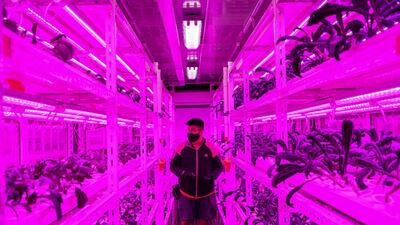
The continued evolution of vertical farming also augurs well financially, said Ms Lo. Vertical farms on average produce 200 times more food per acre than non vertical farms. The ability to shorten the juvenile lifespans of plants can also help to improve farm efficiency.
Without the wider system around farmers improving, however, then the progress of FoodTech will be stunted, was the general consensus.
"We have some fixing to do on the government side," Ms Menker concluded.

