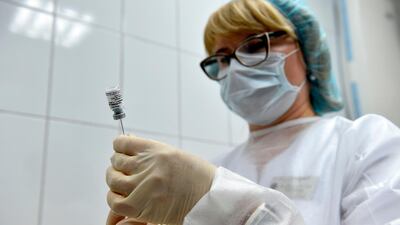
Efforts to end the Covid-19 pandemic could be hampered by public fears over the safety of vaccines, according to a new global survey.
Researchers are now calling for action from authorities and experts alike to build public confidence ahead of the roll-out of a potential Covid-19 vaccine.
There are currently six research laboratories in Phase 3 of World Health Organisation-recognised clinical trials for a vaccine.
The report found that trust in vaccines is relatively low in Europe - ranging from 19 per cent in Lithuania to 66 per cent in Finland in December 2019 - but is on the rise in other parts of the continent such as France, Italy and the UK.
Significant spikes in numbers disagreeing that vaccines are safe were noted in Azerbaijan (from 2 per cent of those surveyed in 2015 to 17 per cent in 2019), Pakistan (from 2 per cent to 4 per cent) and Serbia (up from 4 per cent to 7 per cent).
Where did the findings come from ?
The biggest-ever study of attitudes towards vaccines, covering more than 280,000 people in 149 countries, was published in The Lancet.
Set up a decade ago with international funding, the Vaccine Confidence Project carries out surveys to monitor “vaccine hesitancy” – public scepticism about vaccination described by the World Health Organisation in 2019 as one of the ten biggest threats to global health.
What did the study find ?
The comparison showed that confidence in the safety and effectiveness of vaccines is low in many countries, including Japan, Russia and much of Europe.
Active hostility to vaccination is also emerging in some, including Indonesia, Nigeria, Pakistan and Serbia.
-
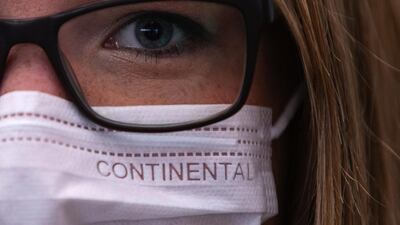
An employee wears a Continental-branded protective face mask at the Continental AG factory in Hanover, Germany. Bloomberg -
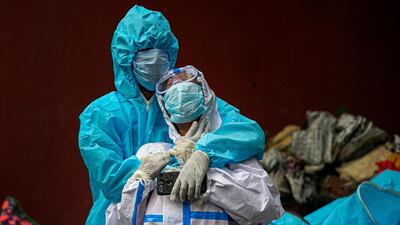
An Indian woman mourns after taking a glimpse of her husband's body, a victim of Covid-19, at a cremation ground in Gauhati, India. AP Photo -
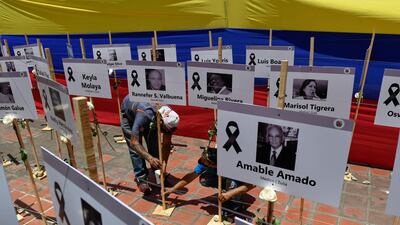
Workers place signs with portraits of health workers who died from Covid-19 at the Venezuelan Medical Federation in Caracas, Venezuela. AFP -
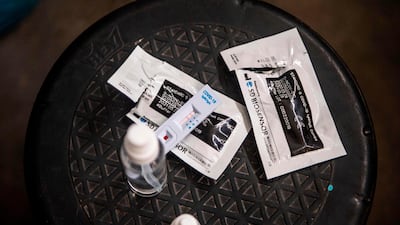
A Covid-19 test that came out positive is seen on a chair during a doctor's visit in Ate, on the eastern outskirts of Lima, in Peru. AFP -
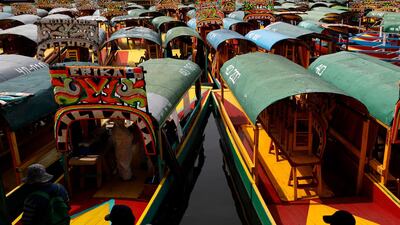
Men wait in a distanced line to get tested for Covid-19 aboard a trajinera, one of the colorful wooden boats popular with tourists and revelers, in the Xochimilco district of Mexico City. AP Photo -
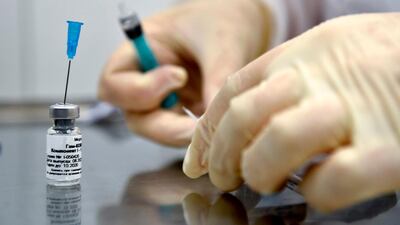
A nurse prepares to inoculate volunteer Ilya Dubrovin, 36, with Russia's new coronavirus vaccine in a post-registration trials at a clinic in Moscow. AFP -
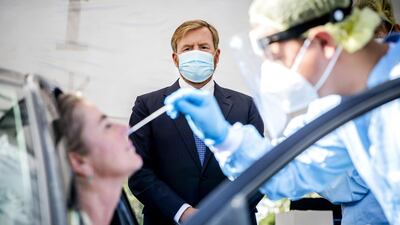
Netherland's King Willem-Alexander looks on as he visits a coronavirus (Covid-19) test site in Leiderdorp, The Netherlands. AFP -
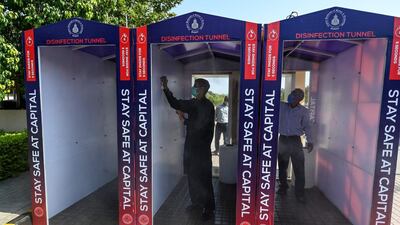
Workers check disinfection tunnels at the Capital University of Science and Technology in Islamabad, Pakistan. AFP -
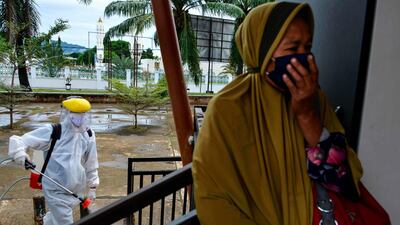
A worker disinfects a bus stop in Banda Aceh, Indonesia. AFP -
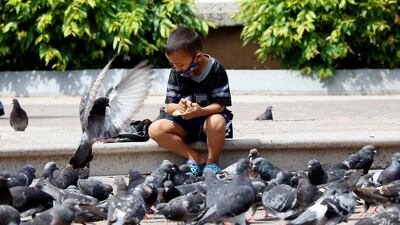
A boy shares his breakfast with the birds of the central park after begging with his father, in Tegucigalpa, Honduras. EPA -
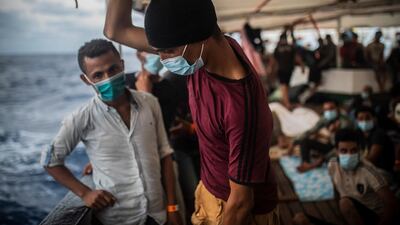
Migrants from different nationalities rest on board the Spanish NGO Open Arms vessel after being rescued in international waters, in the Central Mediterranean sea. AP Photo -
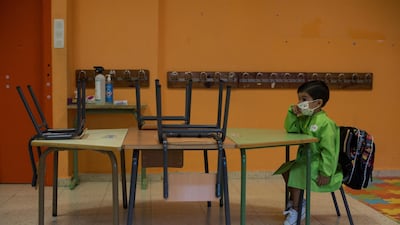
A child sits down during his first on-site day at Albino Nunez school after months of lockdown in Ourense, Spain. EPA -

New Zealand Prime Minister Jacinda Ardern visits inMusic in Auckland, New Zealand. Getty Images -

Johnny Lopez makes his way past a mural on the side of Hideaway Pizza on Rockford Ave. while walking home from work in Tulsa, Oklahoma, USA. Tulsa World via AP


However, contrary to widespread belief, the survey found that confidence in vaccination has generally risen in the United States in recent years, despite publicity given to “anti-vaxxer” campaigns. Levels of confidence in the UK have also remained relatively high.
What drives such wide-ranging views?
Uptake of vaccines was most consistently linked to confidence in their benefits, trust in information from health-care workers rather than family and friends, better science education and belonging to younger age-groups. Income and religion were found to be relatively weakly linked to uptake, although minority religious groups tended to be more likely to be sceptical.
What are the implications of the study?
The survey found attitudes towards vaccines are extremely fluid, and can quickly change for the worse as the result of a local scare.
The researchers cite the surge in vaccine scepticism in the Philippines between 2015 and 2018 following concerns about a vaccine against dengue fever.
Reports of the deaths of children led to the vaccine being withdrawn – prompting widespread scepticism about vaccines in general. A similar scare about the HPV vaccine has led to Japan remaining deeply sceptical about vaccination, with social media spreading the concern globally.
-

A health worker checks the temperature of a newborn Palestinian baby before being administered a vaccine at a United Nations-run clinic during the coronavirus disease outbreak, in the southern Gaza Strip. Reuters -

Palestinians wear protective face masks amid the ongoing coronavirus Covid-19 pandemic in Gaza port, Gaza City. EPA -

Palestinians wait to buy from a chicken shop in Gaza port, Gaza City. EPA -

Iraqi shoppers walk past a souvenir shop selling locally made leather bags and other gifts in Baghdad's Al-Saray Market, one of the Iraqi capital's oldest bazaars. AFP -
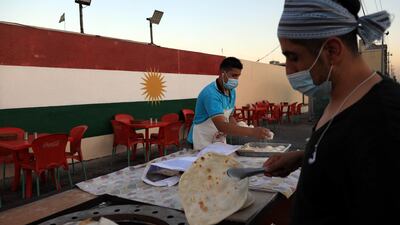
Iraqi Kuridish men prepare bread in Arbil, the capital of the autonomous Kurdish region of northern Iraq. AFP -
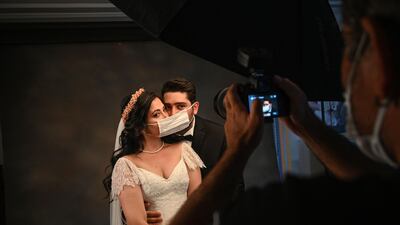
28-year-old Ayse Keles and her husband Alp Colak pose with disposable face masks for a wedding photo shoot in Istanbul, Turkey. -
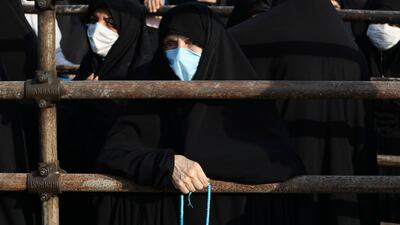
A protester attends a rally condemning the French weekly magazine Charlie Hebdo for republishing caricatures of the Muslim Prophet Muhammad, in Tehran, Iran. AP Photo -
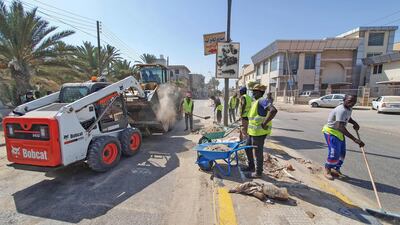
Municipal workers fix a road in Libya's Tajura area, a coastal suburb east of the capital. AFP


What does it mean for Covid-19 vaccines ?
According to the researchers, the results underline the need for governments to monitor attitudes towards vaccinations and act swiftly to combat scepticism.
“What stood out was the volatility and the ups and downs,” said Prof Heidi Larson, director of the Vaccines Confidence Project. “High uptake does not mean it will stay that way.
“It is vital with new and emerging disease threats such as the Covid-19 pandemic, that we regularly monitor public attitudes to quickly identify countries and groups with declining confidence, so we can help guide where we need to build trust to optimise uptake of new life-saving vaccines”, she said.
Experts must combat misinformation to reassure public
“One of the main threats to the resilience of vaccination programmes globally is the rapid and global spread of misinformation," said Dr Larson.
"When there is a large drop in vaccination coverage, it is often because there's an unproven vaccine safety scare seeding doubt and distrust.
"Sometimes there is a genuine small risk that gets rapidly spread and amplified to appear to be a much larger risk.
"There are also cases where vaccine debates have been purposefully polarised, exploiting the doubting public and system weaknesses for political purposes, while waning vaccine confidence in other places may be influenced by a general distrust in government and scientific elites.”
Co-lead author of the study, Clarissa Simas, said it fell to experts to ensure members of the public had access to accurate information.
"The public seem to generally understand the value of vaccines, but the scientific and public health community needs to do much better at building public trust in the safety of vaccination, particularly with the hope of a Covid-19 vaccine," she said.
According to the latest findings by the team, not published in the new paper, attitudes towards a Covid-19 vaccine have changed in the UK since the outbreak started.
At the end of March, when fears about the pandemic were starting to peak, only 5 per cent of those asked said they would decline vaccination. Yet by June, with daily cases of Covid-19 rapidly declining, the proportion saying they would not be vaccinated had tripled to 15 per cent.
According to Prof Larson, the global VCP survey has identified which countries need to make the most effort to combat vaccine hesitancy: “It needs to start yesterday,” she said.
Robert Matthews is visiting professor of science at Aston University, Birmingham, UK

