


Live updates: Follow the latest news on Israel-Gaza
Lebanon's caretaker Foreign Minister Abdallah Bou Habib said Israel has been the primary source of war threats since the Gaza conflict started, stressing his country's desire for peace.
“The threat of war is coming from the Israeli side … from day one of the war, they've been threatening,” he told The National in an interview this week.
Since the Hamas attack on southern Israel on October 7, Hezbollah and Israel have shelled each other across the Lebanon-Israel border and Israel has repeatedly threatened to pursue Hezbollah within Lebanon if the shelling does not stop.
In December, Israeli Prime Minister Benjamin Netanyahu said Israel would “single-handedly turn Beirut and South Lebanon … into Gaza and Khan Younis” if Hezbollah launched an all-out war against Israel.
Mr Bou Habib, who was in New York for a UN Security Council meeting on Gaza, emphasised that neither Lebanon nor Hezbollah have declared war, and he underscored the government’s commitment to peace.
“Hezbollah is not threatening. The Lebanese government is not threatening,” he said.
“A war with Lebanon is very dangerous to the Israelis and the Lebanese. It's not going to be a picnic.”
Mr Bou Habib pointed to his efforts to revive the long-ignored UN Resolution 1701, which aimed to bring an end to the 2006 war between Lebanon and Israel.
He said that he has spoken with 14 other foreign ministers as well as UN Secretary General Antonio Guterres about a comprehensive plan to address the enforcement of the resolution.
The resolution mandates the withdrawal of the Iran-backed militant group Hezbollah from the border area south of the Litani River, located about 30 kilometres from the demarcation zone between Lebanon and Israel known as the Blue Line.
Hezbollah leader: 'War with us would be very costly' – video
Similarly, the Lebanese government has asked Israel to pull back from territories that are under dispute, including Shebaa farms, the Kfarshuba hills and the Lebanese portion of the village of Ghajar.
The initiative also requests that Lebanon’s army be given a bigger role in the establishment and enforcement of the buffer zone, in a diplomatic push to prevent a full-blown conflict erupting between Hezbollah and Israel.
“We should aim at having 10,000 Lebanese troops,” Mr Bou Habib said.
Israel warned last month of intensifying military action should the resolution not be fully enforced, with Defence Minister Yoav Gallant stating in August that a full-blown war would result in Lebanon being returned “to the Stone Age”.
Mr Bou Habib highlighted the US involvement in “closing the gap” between both countries, saying that American officials have discussed the proposal with the Israelis, but “we don’t have an answer yet”.
“We don't want half solutions. We want the whole solution, a package. We'll make a deal. And then we'll put timetable for its execution,” he said.
When asked if there was communication with Hezbollah about the proposal, he said: “We are always in communication with Hezbollah … the government engages with all parties willing to communicate with us.

“We had the maritime agreement … and it was negotiated by the Americans. We didn't talk with the Israelis. Hezbollah told us from the beginning – they are not endorsing it or rejecting it.
“This is a government issue. And the borders are a government issue. It's not a Hezbollah issue.”
However, with Israel striving to keep Hezbollah away from its northern border, Lebanon's present political structure is unable to make decisions on any issue without first electing a president.
The position has remained vacant since October 2022 amid political infighting.
“Without a president, we can't do much,” said Mr Bou Habib.
“Even if we reach an agreement with Israel, we can't sign it, because there is no president. So electing a president is very important for us.”
Funerals held for Hezbollah fighters in south Lebanon – in pictures
-

Women attend the funeral of a Hezbollah militant killed during clashes against Israeli forces in the southern border of Lebanon. Getty Images -
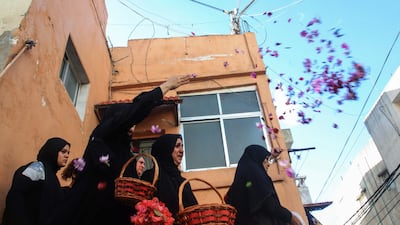
Women at the funeral of Hezbollah fighter Kamal Al Masri in Burj Al Shemali, southern Lebanon. AFP -
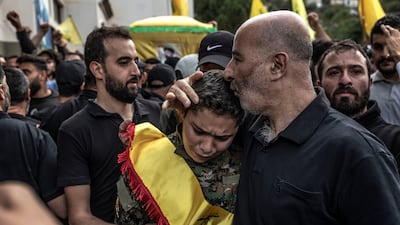
A man comforts the son of a Hezbollah militant killed during clashes against Israeli forces in the southern border of Lebanon. Getty Images -
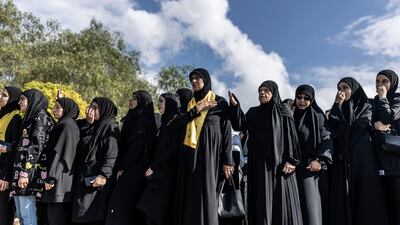
Hezbollah supporters attend the funeral of a Hezbollah militant killed in Lebanon. Getty Images -
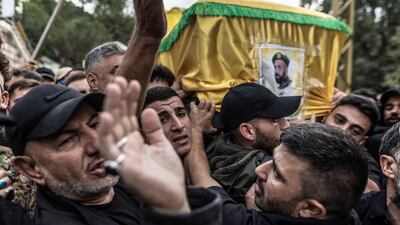
Hezbollah supporters carry the coffin of a Hezbollah militant. Getty Images -
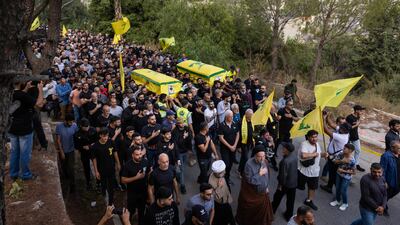
Men carrying the coffins at a funeral for two Hezbollah soldiers killed in south Lebanon. Getty Images -

Members and supporters of Hezbollah take part in the funeral of Kamal Al Masri, one of the group's fighters, in southern Lebanon. AFP -
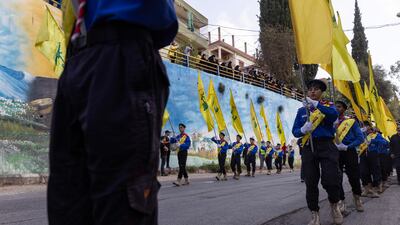
Scouts carry Hezbollah flags at a funeral for two Hezbollah soldiers killed in South Lebanon. Getty Images -

Hezbollah fighters attend the funeral procession of two comrades in Kherbet Selem, south Lebanon. AP Photo -
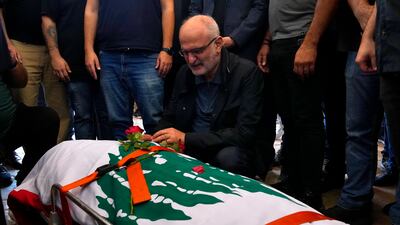
Member of Lebanese parliament Ali Hassan Khalil mourns the body of Reuters videographer Issam Abdallah, who was killed by Israeli shelling, during his funeral in Khiam, southern Lebanon. AP Photo -
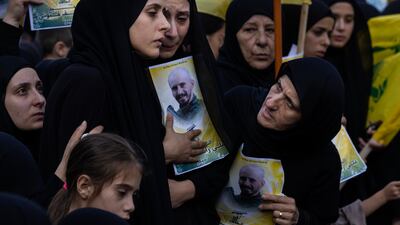
Women at a funeral for two Hezbollah soldiers killed in south Lebanon. Getty Images -
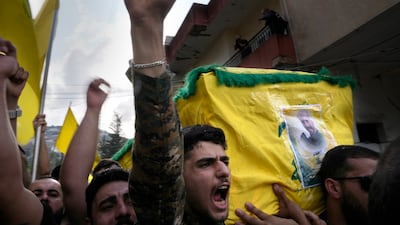
A Hezbollah fighter carries the coffin of his comrade who was killed by Israeli shelling in Kherbet Selem, south Lebanon. AP Photo -

Hezbollah fighters at the funeral of their two comrades in Kherbet Selem. AP Photo -
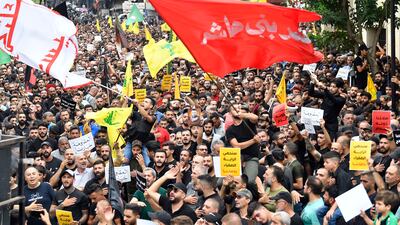
Hezbollah supporters shout religious slogans during the funeral of Hezbollah fighter Ahmed Qassas in a southern suburb of Beirut. EPA



