


Live updates: Follow the latest news on Israel-Gaza
The old quote “if you want to make God laugh, tell him your plans” seems to grow more pertinent for President Joe Biden and his Middle East agenda by the day.
If the President was hoping to continue Washington's “long goodbye” to the Middle East, his administration's ramped-up response to the Israel-Gaza war may invoke some divine chuckles.
This week, top administration officials went to the Senate to plead the case for an extra $106 billion in funding, in part to boost support for Israel's military.
Washington has also sent more than 300 troops back to the region and deployed military assets in the Eastern Mediterranean to deter regional adversaries – namely Iran and its proxies – from attacking Israel.
Several US administrations, starting with Barack Obama's, have attempted to pivot Washington's attention away from the Middle East and towards Asia.
Mr Biden's regional goals continued that course – largely centring on expanding normalisation agreements between Israel and its neighbours under the Abraham Accords and emphasising a “de-escalation” in the Middle East.
But experts in Washington argue that the Israel-Gaza war has changed that toned-down regional posture, and US engagement in the short and medium term is important.
The US is “going to have to help the parties, along with partners in the region, to get to that space where real negotiations and international support for them can take place”, Gina Abercrombie-Winstanley, president of the Middle East Policy Council and former State Department director for the Office of Egypt and the Levant, argued at a policy conference.
Secretary of State Antony Blinken said the postwar outlook in Palestine and Israel “is a very active, continuing deliberation” for Washington, which is aiming to “fundamentally and materially change” Israeli security and Hamas's leadership of Gaza.

White House National Security Council spokesman John Kirby told reporters that Washington is “working with our partners in the region to explore what governance in Gaza can and should look like over the long term”.
But the war has also put Washington at odds with some of its most important Arab partners.
Jordan pulled its ambassador from Israel this week, after King Abdullah II condemned the western “double standard” on alleged Israeli war crimes.
The White House has so far sidestepped questions about any tension between Washington and its important regional ally Amman. Mr Blinken is visiting Jordan and Israel on Friday.
Mr Kirby said the US believes “there is great power and there's great promise in a more integrated, more co-operative Middle East, and we're not going to give up on that”.
Brian Katulis, senior fellow and vice president of policy at the Middle East Institute, said the postwar regional scenario Washington must navigate will differ from past years when there has been “an alignment of interests” on key issues.
“2023 in the region, and America's relationship with it, is not like 2014, or 1990,” Mr Katulis told The National, referencing the regional unity on building an anti-ISIS coalition and when Saddam Hussein invaded Kuwait.
“That made it easier for the US to lead and build a regional coalition but in this instance, you're already starting from some gaps.”
David Mack, a senior fellow with the Atlantic Council’s Middle East Programmes and former deputy assistant secretary of state for Middle East affairs, looks at that history a bit differently.
As a senior official in 1990, “I watched in awe as President [George HW] Bush … capitalised on the immense prestige that the United States achieved.
“They brought initially reluctant Arabs and Israelis together to address their decades-old conflict,” Mr Mack, who also previously served as US ambassador to the UAE, wrote for the Atlantic Council.
“The skill shown in subsequent years of diplomacy included the Oslo Process … an initially promising period of security co-operation between Israel and the PLO.”
Gerald Feierstein, MEI's senior fellow on US diplomacy and director of Arabian Peninsula affairs, argued that the Negev Forum is an existing framework that could be a “vehicle” for Washington to bring together its regional partners for peace building.
Mr Biden's administration last year helped to establish the Negev Forum, a framework of regional co-operation between the UAE, Israel, Bahrain, Morocco, Egypt and the US, following the success of the Abraham Accords.
“We need to have an international conference that can't be returned to the US as the mediator between Israel and Palestine. We need to bring in the rest of the international community,” Mr Feierstein told a Thursday conference at MEI.
Outside of Israeli normalisation, another area the Biden administration planned to increasingly engage with is the Yemen peace process.
The Biden administration's decision to appoint Tim Lenderking as special envoy marked a “doubling down” in getting the US more engaged on diplomatic efforts to bring an end to the conflict, and Mr Lenderking signalled that focus on Yemen is not dwindling amid the war in Gaza.
“Secretary Blinken did two things right away: he received the UN envoy, Hans Grundberg, in Washington in the midst of all this two weeks ago, [and said] we've got to keep Yemen diplomacy going,” Mr Lenderking told the US Institute of Peace last week after returning from a Gulf trip.
“The United States wants to show we know Yemen is a priority.”
The historic scale of the violence and devastation in Gaza and Israel, argued Mr Katulis, has served as a check on the Biden administration's bigger picture goals in the Middle East.
The war “just served as a reminder that even while you try to have those proactive, big picture visions, you can't really succeed if you try to push certain thorny issues like the Palestinian issue to the sidelines”, he added.
“This episode serves as a reminder that it seems quite unlikely that you'll get to a broader regional stability in the long run, if those issues are not addressed.”
Israel intensifies attack on Gaza – in pictures
-
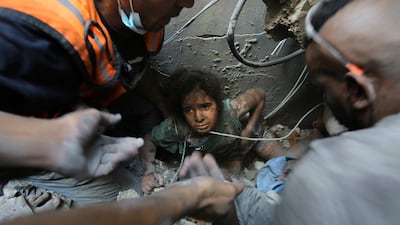
A girl is rescued from the rubble of a building destroyed by Israeli air strikes in Jabalia refugee camp, in the northern Gaza Strip. AP Photo -

An Apache helicopter fires flares, seen from Sderot in southern Israel, close to the border with Gaza. Reuters -

Palestinians plug their phones into portable charging stations on a street in Khan Younis, Gaza. Bloomberg -
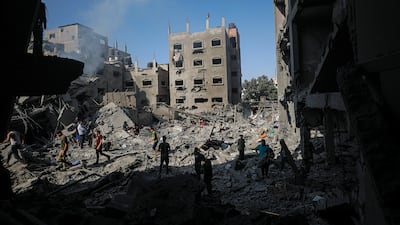
Residents search survivors among the rubble following Israeli strikes on Jabalia, northern Gaza. EPA -
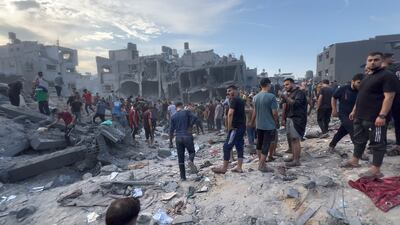
Palestinians search for survivors and bodies following Israeli airstrikes at the Jabalia, the largest refugee camp in Gaza. AP -
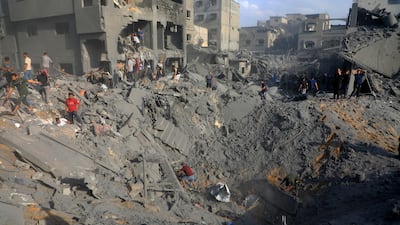
Palestinians look for survivors among the rubble of destroyed buildings following Israeli strikes on Jabalia refugee camp in northern Gaza. AP -
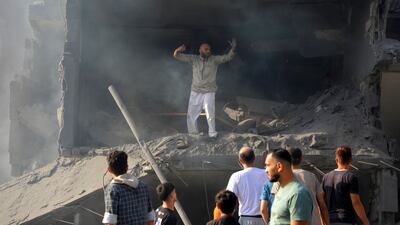
Palestinians look for survivors among the rubble of destroyed buildings following Israeli strikes on Jabalia refugee camp in northern Gaza. AP -

A fire burns in western Gaza after an Israeli air strike. Reuters -

Missiles are fired from Israel towards the Gaza Strip. Getty Images -
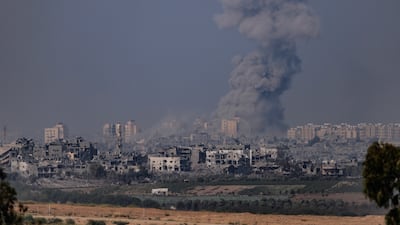
Smoke rises from an explosion in Gaza. Getty Images -
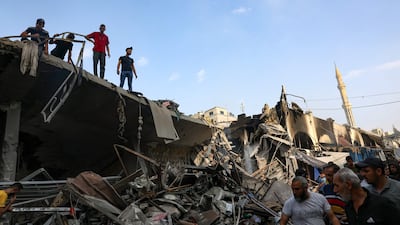
A group of men survey the destruction following air strikes on Al Shatee camp in Gaza city, as Israeli forces entered the northern area of the Gaza Strip. AFP -
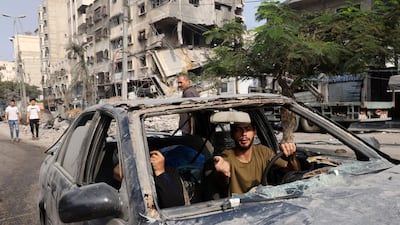
A man drives a damaged car following air strikes on Gaza city. AFP -
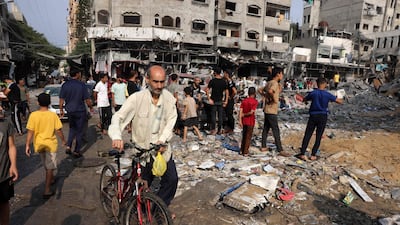
A man pushes a bicycle past the remains of buildings destroyed in Israeli strikes on Al Shatee camp in Gaza city. AFP -

A woman and children walk past a house destroyed in Israeli strikes on Al Shatee camp in Gaza city. AFP -
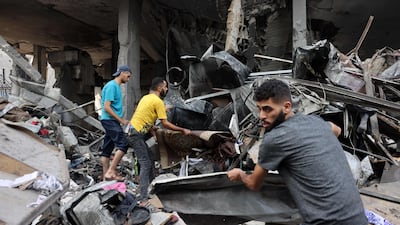
People dig through the rubble of a destroyed building following Israeli strikes on Al Shatee camp in Gaza city. AFP -

A man drives a damaged car past a building destroyed in Israeli strikes on Al Shatee camp in Gaza city. AFP -
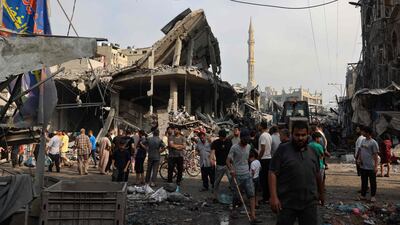
People gather amid the destruction following Israeli strikes on Al Shatee camp in Gaza city. AFP -
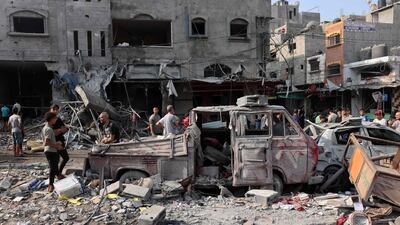
Wrecked vehicles and rubble on the streets following Israeli strikes on Al Shatee camp in Gaza city. AFP -
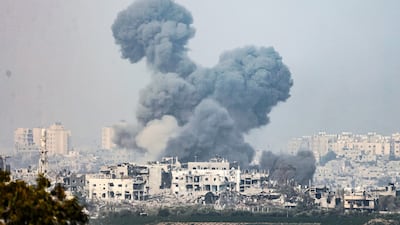
Smoke rises from the northern Gaza Strip as Israeli air and ground forces amplified their military activities against Hamas. EPA -

An Israeli Apache attack helicopter flies close to the border with the Gaza Strip, near Israel's southern city of Ashkelon. AFP -
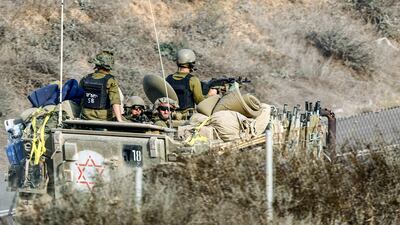
Israeli soldiers in an armoured personnel carrier on patrol near Israel's border with Gaza. EPA -

The crew of an Israeli tank prepare for ground operations near the border with Gaza. EPA -
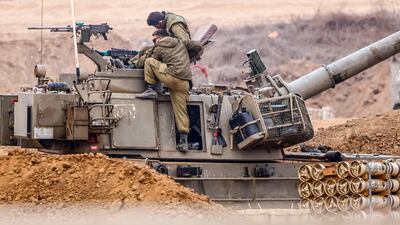
Israeli soldiers prepare for ground manoeuvres at an undisclosed location in Israel near the border with Gaza. EPA -
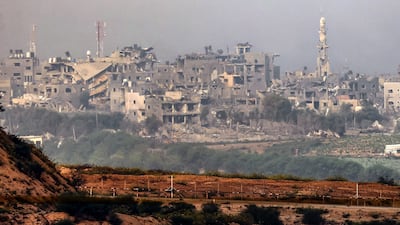
The ruins of northern Gaza seen from Sderot in southern Israel. EPA -
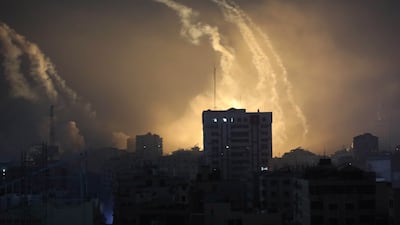
Smoke and explosions caused by Israeli bombardment over northern Gaza. AP Photo -

An explosion on the Israel-Gaza border. Reuters -
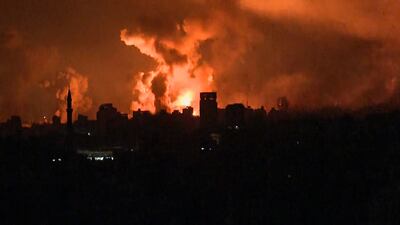
A video grab shows fireballs and smoke rising above Gaza city following an Israeli attack. AFP -

An explosion in Gaza seen from Sderot in southern Israel. Reuters -

A video grab shows rockets fired from Gaza city. AFP -
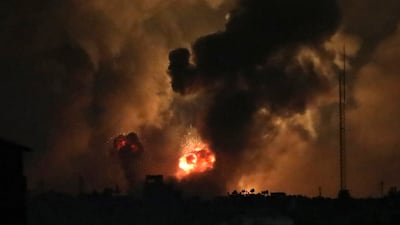
Israeli air strikes in the northern Gaza Strip. AP Photo -
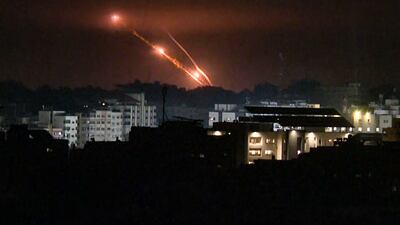
A video grab shows a salvo of rockets fired from Gaza city. AFP -
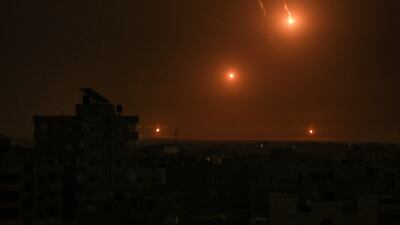
A flare trail fired by the Israeli army east of Khan Younis on the southern Gaza Strip. AFP -

Smoke from the bombing of the Gaza Strip over the Israeli border city of Ashkelon. AFP -

Flares over Gaza as seen from Sderot in southern Israel. Reuters



