


Carlos Ghosn, the larger-than-life international business tycoon who fell from grace and left Japan smuggled inside a music box, is the subject of a new documentary series on Apple TV+.
Wanted: The Escape of Carlos Ghosn investigates the early life and swift rise of a man whom Forbes magazine in 2006 called “the hardest-working man in the brutally competitive global car business”.
The four-part series traces the life of the Brazilian-born former executive who lived the high life for two decades in Japan as the head of Nissan and Renault.
Amid legal troubles, however, in 2019, he escaped to Lebanon aboard a private jet with the help of a former Green Beret.
The series, directed by British filmmaker James Jones, is released on Friday.
“It is a Shakespearean morality play about modern CEOs and corporations and you have Ghosn as the tragic hero, a man who worked his way up from nothing,” Sean McLain, a Wall Street Journal reporter and a consulting producer on the series, told The National.
The documentary details his 2019 brazen escape from Japan that followed several arrests over charges that he underreported his earnings and misappropriated company funds – allegations he has firmly denied.
“I think one thing that the documentary does really well is we're painting a portrait, though not as a villain or a hero, but as a human being with all their works,” Mr McLain said.
“In real-life stories, no person is black or white.”
The documentary includes interviews with Mr Ghosn and his wife Carole in Lebanon, a country that has not signed an extradition agreement with Japan, where he remains a wanted man.
To enable his escape from Tokyo, Mr Ghosn, who holds French, Lebanese and Brazilian citizenship, sought the services of Mike Taylor, who had served in US special forces, and who was also interviewed in the series.
Mr Taylor hid the executive in a custom-made musical instrument box with holes in it so Mr Ghosn could breathe, and then put him on a private jet heading to Lebanon.
But after returning to the US, Mr Taylor and his son Peter, who had also helped Mr Ghosn escape, were extradited to Japan to face charges.
In July 2021, the elder Mr Taylor was sentenced to two years in jail while his son received a 20-month sentence. More than a year later, the two were transferred to the US, where they were allowed to finish the remainder of their sentences. The elder Mr Taylor maintains that he was never paid in full for his services.
Asked in June if he felt any guilt over the two men receiving jail sentences, Mr Ghosn told The National with a laugh: “This is a contract. Come on, these are professional people.”
Earlier this year, Mr Ghosn filed a $1 billion lawsuit against Nissan and accused it of defamation, violating the sanctity of his residence and fabricating charges.
He has also claimed that the Japanese judicial system is unfair.
“I did not escape justice. I escaped injustice,” Mr Ghosn said at a news conference shortly after arriving in Lebanon.
-
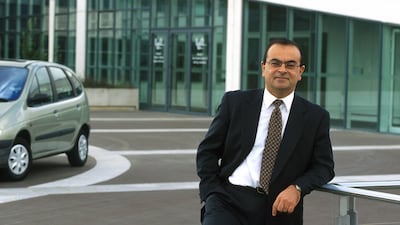
Former Renault-Nissan chief executive Carlos Ghosn in France in 1998. Getty Images -

Mr Ghosn, British prime minister Tony Blair and trade secretary Stephen Byers, right, announce the expansion of the carmaker's plant in Sunderland in January 2001. Getty Images -

Carlos Ghosn at the Tokyo unveiling of the latest model of Nissan's Primera sedan in 2001. Reuters -
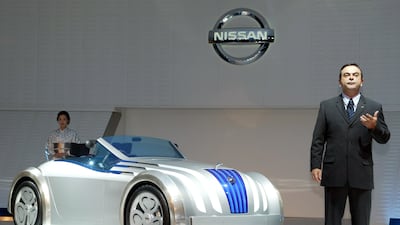
Mr Ghosn poses in front of the Jikoo concept car at the 2003 Tokyo Motor Show. Getty Images -

Former Renault-Nissan chief executive Carlos Ghosn speaks at news conference at the carmaker's Tokyo headquarters in 2004. Reuters -

Mr Ghosn takes a ride in a Nissan Pivo concept car ahead of the Tokyo Motor Show in 2005. Reuters -

Mr Ghosn meets Russian President Vladimir Putin at St Petersburg International Economic Forum in 2006. Reuters -

The former executive presents the Renault Koleos four-wheel drive concept car at the Paris Mondial de l'Automobile in 2006. Reuters -

Mr Ghosn and family members attend gala screening of Serbian director Emir Kusturica's film Promise Me This at Cannes Film Festival in 2007. Reuters -

Mr Ghosn is seeking more than $1 billion from Nissan, including $500 million in moral damages. Reuters -

The former executive was arrested in Japan in November 2018 amid allegations he under-reported his earnings and misappropriated company funds. Reuters -
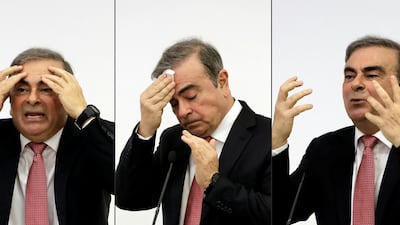
The former automotive executive addresses journalists in Beirut after leaving Japan in January 2020 ahead of his financial misconduct trial. AFP -
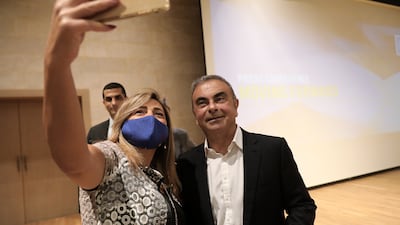
Mr Ghosn poses for a selfie after a press conference to launch a joint initiative with the University of Kaslik in Jounieh, Lebanon in September 2020. AFP


Diana Moukalled, a Lebanese journalist and filmmaker, said that for the past four years Mr Ghosn has largely been living a normal life in Lebanon.
She says he is often seen out in public, is running a new business and has been invited to give lectures to business students at universities.
“In Lebanon, Carlos Ghosn was viewed as a success story, and he is still being treated as such, despite all the charges stacked against him,” Ms Moukalled tells The National.
“His alleged crimes were committed outside of Lebanon, and therefore not a priority for the public as an figure who must face justice.”
But though he is safe from extradition in Lebanon, he has not been able to leave the country, as Japan has issued an Interpol red notice against him, meaning he could be arrested if he travels abroad. He also faces charges in France.
For Mr McLain, what the new documentary achieves is challenging the perception of Mr Ghosn in extreme terms.
“A lot of people see this as a binary debate where Carlos Ghosn is either viewed as the victim of a secret plot by Nissan executives who did not want the Japanese company to merge with Renault,” Mr McLain says.
“Or, Mr Ghosn as a criminal who was using his company as his own personal piggy bank.
“The documentary does a good job of showing that both things can be true.”

