Trees toppled by Typhoon Doksuri block a road in Baguio City, in the northern Philippines. AP

Courts register sharp rise in climate litigation, UN report finds


Adla Massoud
  • English
  • Arabic

The number of lawsuits being filed over the effects of climate change has more than doubled in recent years as people and groups turn to the courts to seek compensation and action on global warming.

A report released by the UN on Thursday found that 2,180 climate litigation cases were filed worldwide across 65 jurisdictions as of the end of 2022, a significant increase from the 884 cases recorded in 2017.

Thirty-four of the cases were brought by and on behalf of children and youth under the age of 25, the report from the UN Environment Programme (Unep) and the Sabin Centre for Climate Change Law at Columbia University found.

The US is leading with 1,522 cases, followed by 127 cases in Australia, 79 in the UK and 62 in the EU. Other regions, including other countries in Oceania, which is vulnerable to sea-level rise, also filed lawsuits.

Report authors stated that the increase in litigation highlights the legal impacts of climate change and the growing responsibility of government and the private sector to address its consequences.

“The climate crisis is getting worse and not better. And people are increasingly turning to the courts for answers,” Andrew Raine, Unep's head of the International Environmental Law, told reporters.

Climate litigation, which traces its origins back to the late 1980s in the US, has now evolved into a global phenomenon.

It escalated significantly after the adoption of the 2016 Paris Climate Agreement.

Despite its non-legally binding nature, the accord has played a vital role in promoting accountability and ambition among nations in combating climate change.

In 2021, indigenous groups from Brazil and Colombia lodged a lawsuit against the French supermarket chain, Casino, alleging systematic violations of human rights and environmental laws.

The accusation pertained to the supermarket's sale of beef that was allegedly associated with land grabbing and deforestation in the Amazon rainforest.

“Courts around the world are responding to these cases,” Lucy Maxwell, co-director of the Climate Litigation Network, told The National.

"Since 2018, the highest courts in the Netherlands, Ireland, France, Germany, Nepal and Colombia have all recognised that climate action by governments is a legal duty."

In March, the first climate change case at the European Court of Human Rights was brought by a group of Swiss women pensioners who claim that their country's inaction in the face of rising temperatures puts them at risk of dying during heatwaves.

The same month, the small Pacific Island nation of Vanuatu won a major victory to advance international climate law after it persuaded the UN General Assembly to ask the world’s highest international court to rule on the obligations of countries to address climate change.

The request for an advisory ruling from the International Court of Justice is expected to clarify the legal obligations of countries to address climate change and to create a path for them to be sued if they fail to do so.

Increased public awareness has also spurred a rise in “climate greenwashing” litigation against corporations over their false or misleading climate communications, according to the report.

Last year in France, environmental groups sued TotalEnergies over its advertising campaign, saying they were false and misleading in their depiction of the role of gas and biofuels.

The report also anticipates a rise in litigation centred around migrants, internally displaced people, and asylum seekers who are seeking temporary or permanent relocation from their home countries or regions, in part due to the effects of climate change.

Climate tipping points – in pictures

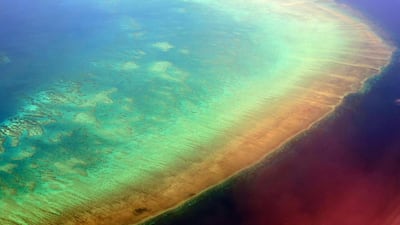
  • An aerial shot of the Great Barrier Reef in Australia, showing parts of the reef that has been subjected to coral bleaching.
    An aerial shot of the Great Barrier Reef in Australia, showing parts of the reef that has been subjected to coral bleaching.
  • A house located on land that has been deformed by permafrost thaw at a former airfield in Churapcha, Russia. Reuters
    A house located on land that has been deformed by permafrost thaw at a former airfield in Churapcha, Russia. Reuters
  • Native vegetation has been cut down to give space for eucalyptus plantations in the Setubinha region in Brazil. AFP
    Native vegetation has been cut down to give space for eucalyptus plantations in the Setubinha region in Brazil. AFP
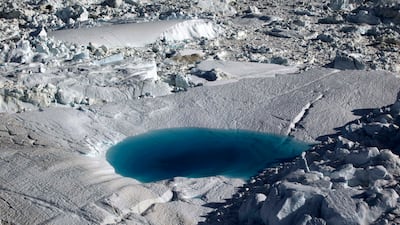
  • A large melt pool forms in the Ilulissat ice fjord below the Jakobshavn Glacier at the fringe of the Greenland ice sheet. AP
    A large melt pool forms in the Ilulissat ice fjord below the Jakobshavn Glacier at the fringe of the Greenland ice sheet. AP
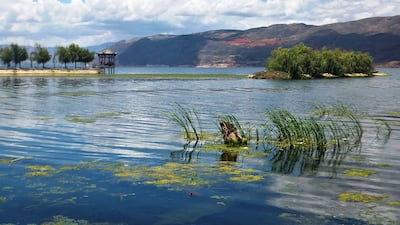
  • Lake Erhai in China has become eutrophic (where an entire body of water becomes enriched with nutrients and minerals) which caused algal growth that destroyed other life. Photo: Ronan O'Connell
    Lake Erhai in China has become eutrophic (where an entire body of water becomes enriched with nutrients and minerals) which caused algal growth that destroyed other life. Photo: Ronan O'Connell
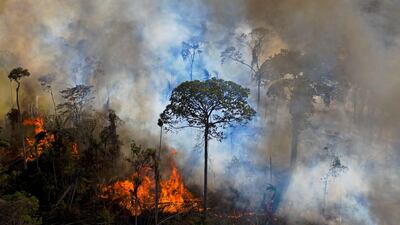
  • Deforestation in Para state, Brazil. AFP
    Deforestation in Para state, Brazil. AFP
  • Moai statues in Easter Island, Chile, were damaged after a wildfire. Reuters
    Moai statues in Easter Island, Chile, were damaged after a wildfire. Reuters

Mercer, the investment consulting arm of US services company Marsh & McLennan, expects its wealth division to at least double its assets under management (AUM) in the Middle East as wealth in the region continues to grow despite economic headwinds, a company official said.

Mercer Wealth, which globally has $160 billion in AUM, plans to boost its AUM in the region to $2-$3bn in the next 2-3 years from the present $1bn, said Yasir AbuShaban, a Dubai-based principal with Mercer Wealth.

Within the next two to three years, we are looking at reaching $2 to $3 billion as a conservative estimate and we do see an opportunity to do so,” said Mr AbuShaban.

Mercer does not directly make investments, but allocates clients’ money they have discretion to, to professional asset managers. They also provide advice to clients.

“We have buying power. We can negotiate on their (client’s) behalf with asset managers to provide them lower fees than they otherwise would have to get on their own,” he added.

Mercer Wealth’s clients include sovereign wealth funds, family offices, and insurance companies among others.

From its office in Dubai, Mercer also looks after Africa, India and Turkey, where they also see opportunity for growth.

Wealth creation in Middle East and Africa (MEA) grew 8.5 per cent to $8.1 trillion last year from $7.5tn in 2015, higher than last year’s global average of 6 per cent and the second-highest growth in a region after Asia-Pacific which grew 9.9 per cent, according to consultancy Boston Consulting Group (BCG). In the region, where wealth grew just 1.9 per cent in 2015 compared with 2014, a pickup in oil prices has helped in wealth generation.

BCG is forecasting MEA wealth will rise to $12tn by 2021, growing at an annual average of 8 per cent.

Drivers of wealth generation in the region will be split evenly between new wealth creation and growth of performance of existing assets, according to BCG.

Another general trend in the region is clients’ looking for a comprehensive approach to investing, according to Mr AbuShaban.

“Institutional investors or some of the families are seeing a slowdown in the available capital they have to invest and in that sense they are looking at optimizing the way they manage their portfolios and making sure they are not investing haphazardly and different parts of their investment are working together,” said Mr AbuShaban.

Some clients also have a higher appetite for risk, given the low interest-rate environment that does not provide enough yield for some institutional investors. These clients are keen to invest in illiquid assets, such as private equity and infrastructure.

“What we have seen is a desire for higher returns in what has been a low-return environment specifically in various fixed income or bonds,” he said.

“In this environment, we have seen a de facto increase in the risk that clients are taking in things like illiquid investments, private equity investments, infrastructure and private debt, those kind of investments were higher illiquidity results in incrementally higher returns.”

The Abu Dhabi Investment Authority, one of the largest sovereign wealth funds, said in its 2016 report that has gradually increased its exposure in direct private equity and private credit transactions, mainly in Asian markets and especially in China and India. The authority’s private equity department focused on structured equities owing to “their defensive characteristics.”

Key facilities
  • Olympic-size swimming pool with a split bulkhead for multi-use configurations, including water polo and 50m/25m training lanes
  • Premier League-standard football pitch
  • 400m Olympic running track
  • NBA-spec basketball court with auditorium
  • 600-seat auditorium
  • Spaces for historical and cultural exploration
  • An elevated football field that doubles as a helipad
  • Specialist robotics and science laboratories
  • AR and VR-enabled learning centres
  • Disruption Lab and Research Centre for developing entrepreneurial skills
Updated: July 27, 2023, 4:16 AM