


Follow the latest news from Sudan crisis here
War. Ceasefire. Evacuation. Crisis. These are the headlines that have captured the chaos now engulfing Sudan, but on the morning of April 25, “dad's dialysis appointment” was top of the agenda for Dr Bushra Ibnauf Sulieman before the violence found him.
Dr Sulieman, 49, a Sudanese-American father of four, had been living in Sudan with his wife and two of his children. Life there meant taking care of his elderly parents, fulfilling his passion for teaching and serving as a leader in the medical community, practising in a “much-needed” area of the embattled country.
As the military conflict and humanitarian crisis mounted, Dr Sulieman “was on the front lines providing emergency medical aid,” the Sudanese American Physicians Association said.
But on that tragic Tuesday, the medical front lines lost a highly respected worker. Dr Sulieman's loved ones say looters, emboldened by Sudan's chaotic state of lawlessness, surrounded him, fatally stabbing him in front of his family home as he was attempting to bring his father to a morning medical appointment.

The killing has compounded the trauma of war for Dr Sulieman's family, and Sudanese-American advocates say they have lost an “exceptional” and “selfless” member of their community.
“The martyr was an impeccable teacher, and a pioneer of medical education, deeply committed to educating his students and trainees … a spark of goodness is extinguished in our country,” wrote Sapa in an obituary published on Facebook.
“He had this aura of respect about him … he always gave back, I cannot think of a person he hated or that hated him,” Ameir Eltom, a close friend of Dr Sulieman and Sapa's Assistant General Secretary, told The National. “He was an exceptionally smart individual..”
But one of the things that “set him apart” from other accomplished doctors, was an untiring passion for teaching and giving back to younger students.
“He found the time to teach other medical and dental students, as well as high school students … that was just Bushra,” Mr Eltom said. “He always gave back, and he always helped people.”
That selfless spirit crystallised for Dr Sulieman in co-founding the first-of-its-kind Sudanese American Medical Association, which was primarily aimed at helping new Sudanese immigrants in the medical field navigate the American system, said Mr Eltom. That work would ultimately expand to his humanitarian work in Sudan.

Living between Iowa and Khartoum, he eventually became a permanent resident in the Sudanese capital when his ageing parents there needed their son to help care for them. He became a full-time professor at his own alma mater, the University of Khartoum.
The impact of Dr Sulieman's “magnetism” can be seen in the outpouring of love and heartbreak on social media. Reflective of his enthusiasm for teaching and mentoring, his former students wrote heartfelt obituaries, many calling him a “father figure”.
The scope of his loss, Mr Eltom says, is hard to fully process.
“It's a loss to the country, it's a loss to the medical community, it's a loss whether in the US or in Sudan,” he said.
Adding to the sense of heartbreak is how close Dr Sulieman had been to leaving.
“Finally a friend of ours convinced him … you can't benefit Sudan if you're dead, and that's really what made him change his mind and decide to take his parents and leave,” Mr Eltom said. “He was supposed to leave through Port Sudan to the US or Saudi Arabia.”
A Washington-organised convoy that carried US citizens, locally employed staff and nationals from allied and partner countries arrived at Port Sudan on April 29.
The loss of the “powerhouse” doctor came just before Sudan's Doctor's Union delivered the grim warning that there are no functioning hospitals left in Khartoum after weeks of fighting.
All the capital's hospitals are out of service, the union told Al Arabiya on Tuesday, hours after it urged civilians to be evacuated from the “senseless war”.
Mr Eltom says this has devastating implications for the whole country, with minimal health care availability as fighting compounds a shortage of basic goods.
“Khartoum was the most developed area, so a lot of hospitals and even major cities don't have the capacity to deal with more intricate cases or situations,” he told The National. “They refer to Khartoum. So when Khartoum is not able to accommodate them, this has a cascading effect all over Sudan.
“Whenever things like this happen, it becomes obvious that hospitals are targeted … and one of my friends as he was fleeing from Khartoum, other doctors told him to get rid of any ID that would identify him as a doctor. Because one of the warring factions can take them to become their 'personal doctor'.”

Sudan's warring military factions agreed to a seven-day ceasefire from Thursday last week, but air strikes and gun battles in the Khartoum region undermined their latest efforts at a truce.
Ceasefires have ranged from 24 to 72 hours in length but they have regularly been broken in the conflict between military factions that began last month.
The UN migration agency estimates that about 330,000 Sudanese have been internally displaced by the war.
Mr Eltom, a Sudanese-American who himself has had family displaced by the violence, said this tragic and chaotic moment has filled him with “a sense of determination”.
“In the beginning I had the sense of helplessness, but together with other physicians, dentists and pharmacists, we've been working around the clock to help in any way,” he said. “So it's just seeing the energy of the people around me is definitely encouraging.
“Eventually the people will prevail. The people with guns are only more powerful for a short period of time … people like us are here for the long haul.”
-

Evacuees disembark from Saudi ship Amanah after it docked in Jeddah. AP Photo -
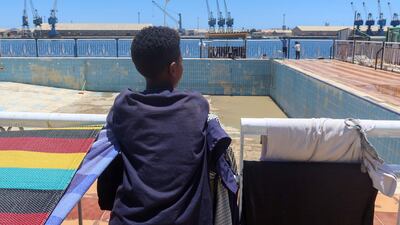
A boy waits with his family's luggage before being processed for evacuation in Port Sudan. Reuters -

Smoke billows during fighting in Khartoum. AFP -
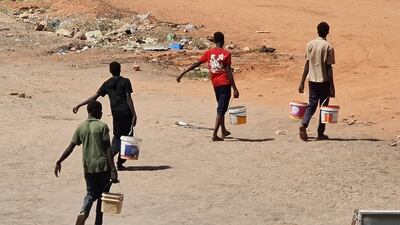
Youths carry buckets of water in the Sudanese capital. AFP -
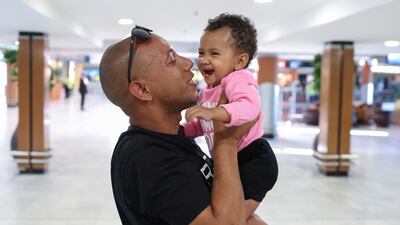
South African evacuee Muzzammil Raubenheimer greets his one-year old daughter Amana after arriving home at Cape Town airport. Reuters -
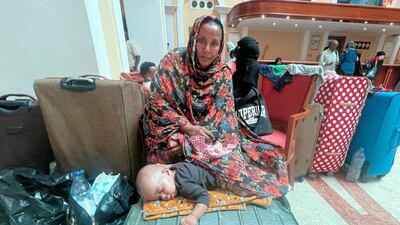
Sudanese citizens wait at a makeshift evacuation centre in Port Sudan amid the fighting in Khartoum. Reuters -
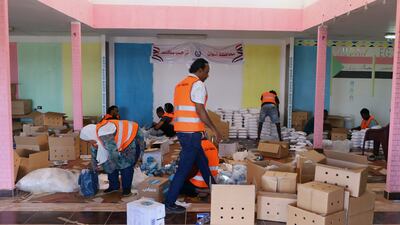
Volunteers prepare aid packages for people who fled the fighting in Sudan, at Wadi Karkar bus station in Aswan, Egypt. EPA -
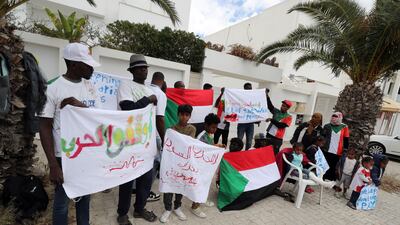
Sudanese call for the end of the war as they protest in front of their country's embassy in Tunis, Tunisia. EPA -
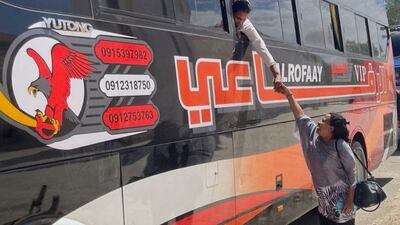
A Sudanese woman with UK citizenship leaves on a bus before being processed for evacuation. Reuters -

Smoke rises above buildings after an aerial bombardment in Khartoum. Reuters -

People walk on an almost empty street in southern Khartoum. AFP -
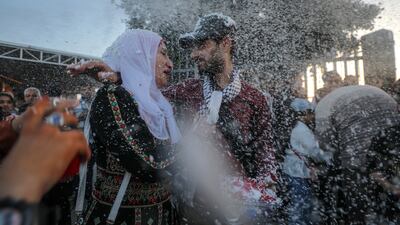
Palestinians evacuated from Sudan arrive at the Rafah crossing, between Egypt and the southern Gaza Strip. EPA -
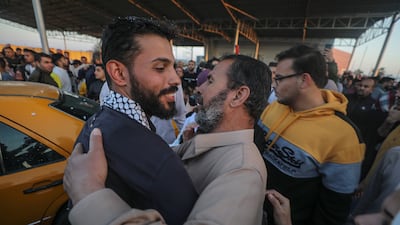
Palestinians greet each other at the Rafah crossing, after fleeing Sudan. EPA -
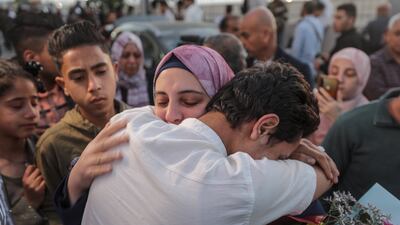
The Palestinian evacuees crossed into Egypt first as they fled the fighting in Sudan. EPA -
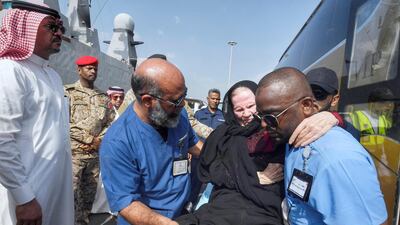
Civilians of different nationalities arrive at Jeddah Sea Port after being evacuated by Saudi Arabia from Sudan. Reuters -
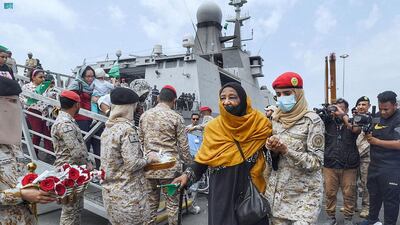
Civilians of different nationalities arrive at Jeddah Sea Port after being evacuated by Saudi Arabia from Sudan. Reuters -
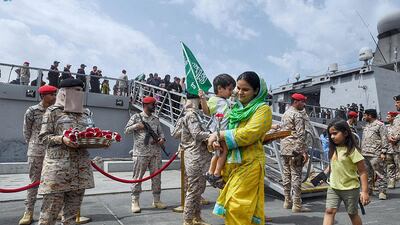
Civilians of different nationalities arrive at Jeddah Sea Port after being evacuated by Saudi Arabia from Sudan. Reuters -
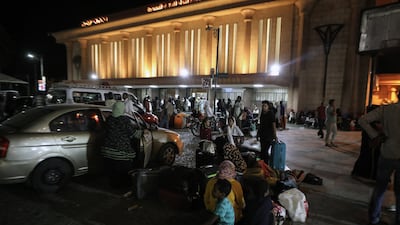
Passengers fleeing from Sudan wait outside the railway station in Aswan, Egypt. EPA -
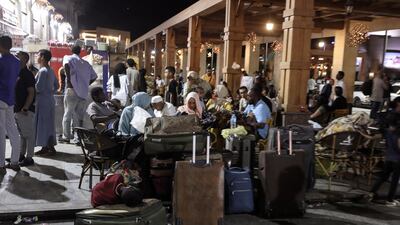
Passengers fleeing from Sudan wait outside the railway station in Aswan, Egypt. EPA -

Zimbabwean evacuees from Sudan are seen upon arrival at Robert Mugabe International airport in Harare, Zimbabwe. AP Photo -
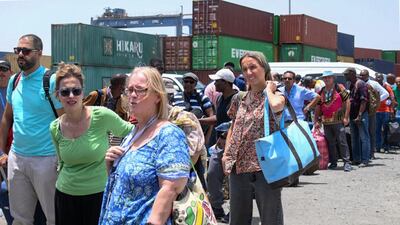
People fleeing war-torn Sudan queue to board a boat from Port Sudan. AFP -
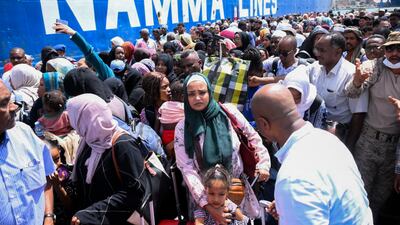
People fleeing war-torn Sudan queue to board a boat from Port Sudan. AFP



