


Washington is completing internal and external consultations on Iran's response to the European Union proposal to revive the nuclear deal, a State Department official said on Monday, confirming that Tehran has dropped its demand to remove the Islamic Revolutionary Guards Corps from the US list of foreign terrorist organisations.
“We are encouraged by the fact that Iran appears to have dropped some of its non-starter demands, such as lifting the FTO designation of the IRGC,” State Department spokesman Ned Price said.
US President Joe Biden's administration rejected that condition when it was first proposed earlier in the year.
But the US still sees “outstanding issues that must be resolved some gaps that must be bridged” for a full return to the nuclear deal, which was first signed in 2015 and placed curbs on Iran's nuclear programme in exchange for sanctions relief. Former president Donald Trump withdrew from the agreement in 2018.
These issues and gaps are part of the internal US deliberations, as Washington prepares its response to Iran’s latest offer.
Mr Price did not set a timeline for the response but hinted that it would happen after completing consultations with regional and other partners.
-
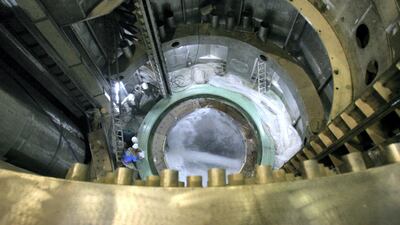
Russian contractors work at the Bushehr nuclear reactor site in 2007. The plant opened four years later. Bloomberg -
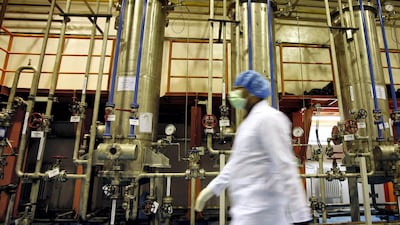
An Iranian technician at the International Atomic Energy Agency inspects the country's Isfahan plant in 2007. Tehran is no longer co-operating with the agency at nuclear sites across the country. EPA -

Workers wait to begin constructing a second reactor at the Bushehr nuclear power plant in 2019. AFP -
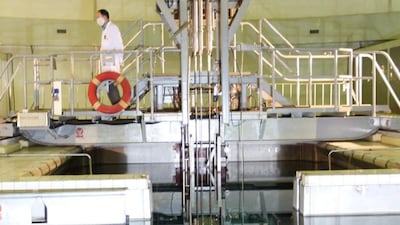
A metal-encased rod with 20 per cent enriched nuclear fuel is inserted into a reactor in Tehran in 2012. AFP -
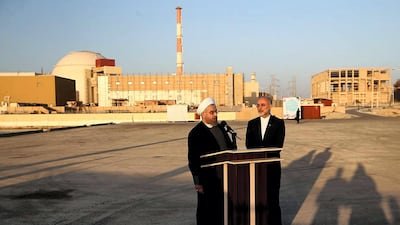
Fomer Iranian President Hassan Rouhani and the country's Atomic Energy Organisation chief Ali Akbar Salehi speak at the Bushehr nuclear site in 2015. AFP -
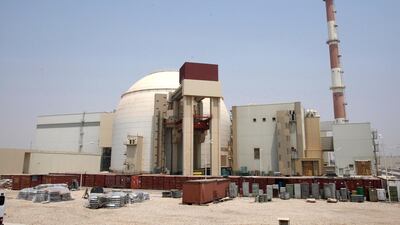
Iran's Bushehr nuclear plant has been restarted. EPA -
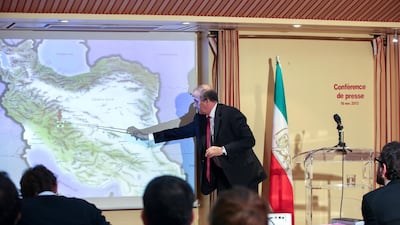
Mehdi Abrichamtchi, chairman of the Peace and Security Committee at the National Council of Resistance of Iran, shows journalists the location of a secret nuclear site in Iran in 2013. AFP -
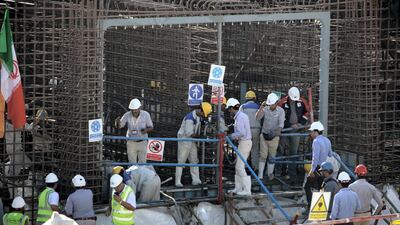
Workers prepare to begin the construction of a second reactor at the Bushehr site. AFP


“We'll respond as soon as we have a response prepared, as soon as those consultations that we're undertaking internally, as well as with our close partners, as soon as those are completed,” he said.
Some of the issues delaying the US response appear to be technical in nature, the US official explained.
“We're looking at this and Iran's nuclear programme as a national security challenge. The questions of safeguards. This is a question that goes really to the core of the mandates of the safeguard investigations [that] are not political,” Mr Price said.
The safeguard assurances pertain to checks and balances on Iran’s nuclear materials and ensures that the International Atomic Energy Agency (IAEA) has a mechanism to guarantee they remain peaceful.
In a report in June, the IAEA said Tehran has not fully declared its nuclear inventory.
Washington is currently speeding up consultations over the deal with regional and European partners. Eyal Hulata, Israel’s national security adviser, is visiting Washington this week and was due to meet Wendy Sherman, deputy secretary of state, on Monday.
“We've been discussing this [Iran’s negotiations] with our Israeli partners since day one, since going back to the start of this process in Vienna in the spring of last year, and really, before that, at every step of the process that we have been in touch with our Israeli partners to update them on where we are,” Mr Price said.
The State Department also welcomed the UAE’s announcement on Sunday that it will return its ambassador to Iran after six years of absence. Mr Price said the decision is consistent with the UAE’s policy of de-escalation.
“The UAE, across a number of issues, has demonstrated time and again that it can play a constructive role in resolving and de-escalating sources of regional tension,” he said.

