


US Secretary of State Antony Blinken hosted International Atomic Energy Agency (IAEA) chief Rafael Grossi in Washington on Monday to discuss a protracted dispute between the global watchdog organisation and Iran over access to its nuclear sites.
The impasse between the IAEA and Iran comes as President Joe Biden’s administration continues its efforts to bring Tehran back to the negotiating table in a bid to resurrect the ailing nuclear deal.
Mr Blinken told reporters before the meeting that “needless to say, Iran is a big part of the focus”.
“The United States strongly supports the work of the IAEA,” said Mr Blinken.
“It is critical to helping to maintain international peace and stability. ... It’s obviously playing a vital role in moderating Iran’s nuclear activities. And it plays a critical role in helping to forge co-operation on the peaceful uses of nuclear power.”
For his part, Mr Grossi told reporters that the meeting had a “vast agenda”, including “important political issues like Iran or the situation in [North Korea] and the other parts of the world".
Although the 2015 Iran nuclear deal paved the way for IAEA inspectors to monitor the Iranian nuclear programme, the agency's access has been in jeopardy throughout much of the year.
The Iranian Parliament passed a law last year to kick out IAEA inspectors unless the country received relief from US sanctions that former president Donald Trump reinstated after he withdrew from the nuclear deal in 2018.
The IAEA and Iran reached a deal last month to continue video surveillance of the nuclear sites after an interim agreement expired in June.
-
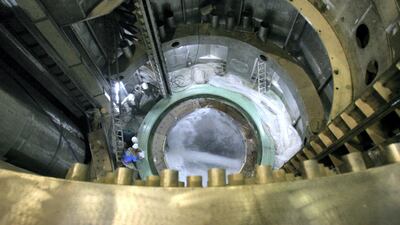
Russian contractors work at the Bushehr nuclear reactor site in 2007. The plant opened four years later. Bloomberg -
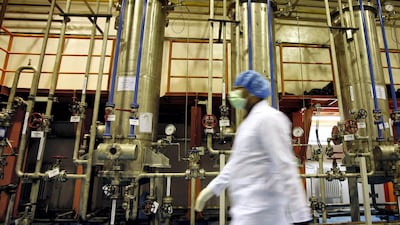
An Iranian technician at the International Atomic Energy Agency inspects the country's Isfahan plant in 2007. Tehran is no longer co-operating with the agency at nuclear sites across the country. EPA -

Workers wait to begin constructing a second reactor at the Bushehr nuclear power plant in 2019. AFP -
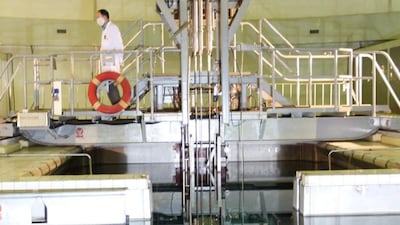
A metal-encased rod with 20 per cent enriched nuclear fuel is inserted into a reactor in Tehran in 2012. AFP -
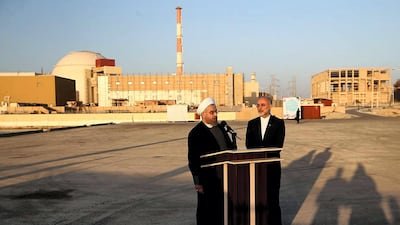
Fomer Iranian President Hassan Rouhani and the country's Atomic Energy Organisation chief Ali Akbar Salehi speak at the Bushehr nuclear site in 2015. AFP -
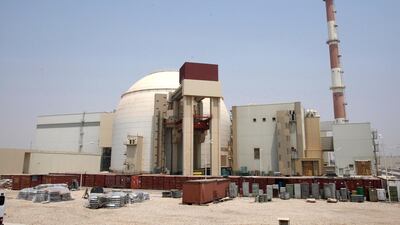
Iran's Bushehr nuclear plant has been restarted. EPA -
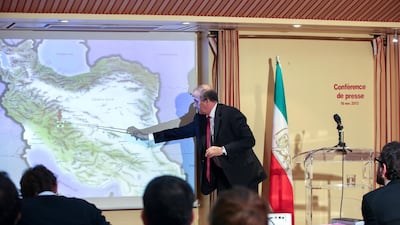
Mehdi Abrichamtchi, chairman of the Peace and Security Committee at the National Council of Resistance of Iran, shows journalists the location of a secret nuclear site in Iran in 2013. AFP -
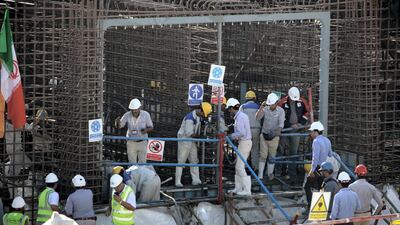
Workers prepare to begin the construction of a second reactor at the Bushehr site. AFP


Under that agreement, Iran would preserve video surveillance footage but would not turn it over to the IAEA until it reached an agreement with the US to restore the nuclear deal.
But the IAEA said shortly afterwards that Tehran was already violating their deal by refusing to allow inspectors into its TESA Karaj centrifuge component manufacturing workshop to restore the site's cameras.
In addition to scaling back IAEA access, Iran has steadily ratcheted up other breaches of the nuclear deal since Mr Trump’s withdrawal.
A senior US official said this month that Iran’s breakout time to build a nuclear weapon had been reduced from a year to a few months following the US withdrawal from the deal.
Indirect negotiations with Iran in Vienna have made little headway since the sixth round of talks concluded under former president Hassan Rouhani in June.
Under Mr Rouhani, the two sides agreed in principle that the US would scale back its sweeping sectoral sanctions on Iran in exchange for Tehran scaling back its nuclear accord breaches — though differences remained on the status of some additional sanctions instated under Mr Trump.
Iran has not agreed to resume indirect talks since hard-line cleric and nuclear deal sceptic Ebrahim Raisi took office in August.
Iranian Foreign Ministry spokesman Saeed Khatibzadeh hinted this month that Iran could return to the negotiating table by November.
Mr Biden’s Iran envoy, Robert Malley, is visiting the UAE, Saudi Arabia and Qatar this week, in part to discuss contingency plans should the US and Iran fail to reach an agreement on reviving the nuclear deal.
Mr Blinken reaffirmed last week that the US still preferred the diplomatic option, but said: “We are prepared to turn to other options if Iran doesn't change course.”

