

Franklin Martin crouches down and strokes the remnants of a lonely blade of grass amid a sea of red dirt and rocks, the dry earth crunching beneath his feet.
“It’s barely green and something has already nibbled on it,” the Navajo rancher laments.
It’s another patch of rare nutrients that his cattle will be deprived of.
Mr Martin grazes his cattle on the western edge of the Navajo Nation, near where the Colorado River carves its way through the Grand Canyon.
Twenty-two years of drought has left the Colorado River Basin a shadow of its former self. The river, which provides drinking water to 40 million people in the south-western US and fuels the farms and ranches that feed the country, is hurting like never before.
Next month, the US federal government is expected to declare the first ever water shortage in the lower basin, prompting water cuts in Arizona, Nevada and Mexico.
The cuts are expected to be especially difficult for indigenous communities living near the river, like Mr Martin’s.
“It’s been dry for quite a while,” he said. “It’s not good around here.”
Mr Martin keeps his cattle on a remote tract of land, whose red earth stretches towards the horizon until it plunges into the Grand Canyon. There are no pipes that reach it, so the community is forced to rely on a series of earth dams — little mounds of dirt built up to help pool water.
The area is dotted with more than 100 of these dams, and all but a few are now dry, leaving nothing behind but cracked dirt unable to sustain even a few blades of grass for the cattle.
That means Mr Martin has to bring water in on a daily basis.
“I don't like it,” he told The National. Waiting in line to fill up his tanks, Mr Martin said he finds it hard to believe this is happening in America — instead, he said it seems more like a developing country he might see on the news.
A recent study by the US Water Alliance found Native Americans are 19 times more likely not to have access to drinking water and indoor plumbing than other Americans. This statistic makes them even more vulnerable to the effects of drought.
-

The remote western edge of the Navajo Nation reservation, the largest Native American reservation in the US. -
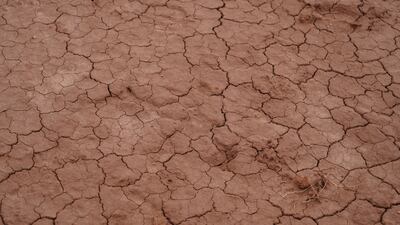
Dry, cracked earth where water would normally pool in the Bodaway area of the Navajo Nation reservation. -
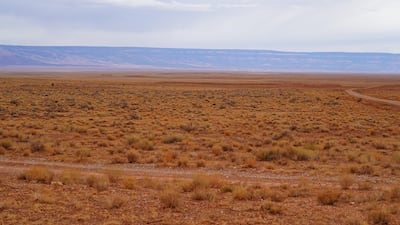
An arid stretch of land in the Bodaway area of the Navajo Nation reservation. -

A rare healthy plant in an arid stretch of the Navajo Nation reservation. -

A dry stretch of the Colorado River near Moab, Utah. -
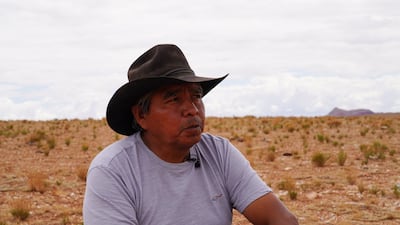
Franklin Martin, a Navajo rancher, looks out at the dry earth dam in the Bodaway area of the Navajo Nation reservation. -
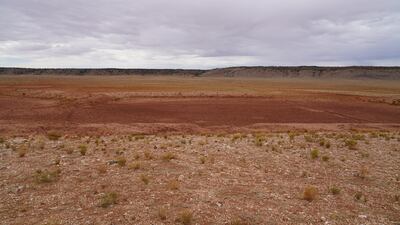
A depleted earth dam in the Bodaway area of the Navajo Nation reservation. -
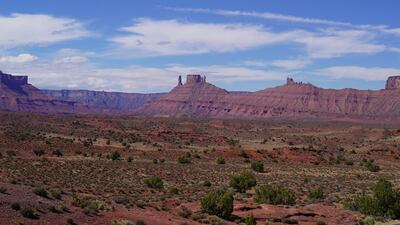
Castleton Tower and the Rectory, 121-metre high sandstone towers in Utah. -
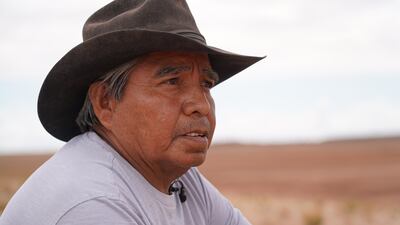
Franklin Martin, a Navajo rancher, looks out at dry a earth dam in the Bodaway area of the Navajo Nation reservation. -
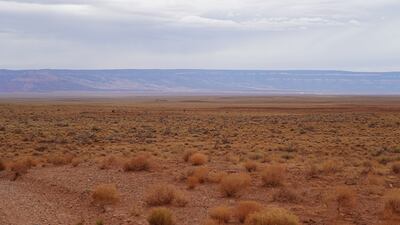
An arid stretch of land in the Bodaway area of the Navajo Nation reservation. -
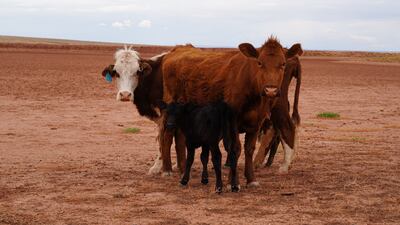
Cows huddle together at a dry earth dam in the Bodaway area of the Navajo Nation reservation. -
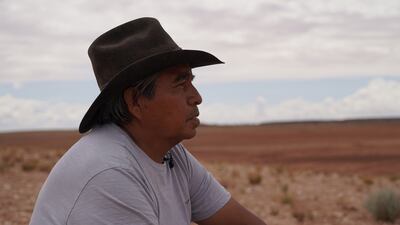
Franklin Martin, a Navajo rancher, looks out at a dry earth dam in the Bodaway area of the Navajo Nation reservation. -

A lone cow looks for food in the the Bodaway area of the Navajo Nation reservation.


Water rights along the Colorado River are coveted and highly complicated. In theory, Native American tribes have senior water rights to roughly 20 per cent of what the river can give. But in reality, the tribes are only able to draw a fraction of that due to a lack of infrastructure and unfinished contracts with the states they are in.
A new report published by a collection of tribes along the river is calling on the federal government to help cover the cost of infrastructure projects that would give tribes better access to the shrinking water source.
In April, a bipartisan bill appeared to address that very issue: the Drinking Water and Wastewater Infrastructure Act, which was pushed through the Senate, called for significant investments in water infrastructure projects on Native American reservations.
The bill, coupled with President Joe Biden’s proposed infrastructure package, is viewed by some Native Americans as an important step in resolving the water crisis that plagues many reservations.
‘The life-giver of our people’
In Navajo culture, the land and river are sacred, a concept shared by many of the other tribes that dot the shores of the once mighty river.
“In the tribal belief system, the river is the life-giver of our people,” explained Loretta Jackson-Kelly of the Hualapai tribe, one of the 30 tribes whose members live within the Colorado River Basin.
“We as a people believe through our own ancestral stories that we have backbones — you know, our spine, that allows us to live. We feel the same way about the river itself, that it is a living entity,” she said.
The health of the river is central to the Haulapai people's belief system, but its fate is far out of their control.

In America’s relatively brief history, the country has altered the Colorado River in considerable ways. The US has built 15 dams along the waterway, and the two biggest ones, the Hoover Dam and the Glen Canyon, flooded sacred tribal lands to create the country’s largest reservoirs.
Those reservoirs, Lake Powell and Lake Mead, serve the West’s growing population by providing fresh water to millions of Americans and generating hydroelectric power.
But increased demands on the reservoirs and the punishing drought have left their water levels at record lows.
Mr Martin blames a culture of excess that has put too heavy a demand on the river.
“There’s people, they want water for golf, you know, and to wash their vehicles. Then they got lawns, green lawns but no agriculture on it, nothing. So, to me, that’s a waste,” he said.
While the West has a long history of battling droughts, climate scientists say global warming is magnifying the problem.
“It’s hard to wrap our heads around the severity of the drought and what that means,” said Keith Musselman, a scientist at the University of Colorado’s Institute of Arctic and Alpine Research.
“There are many people who live in the West who have spent their entire lives in this drought and this is what they know and I think it’s difficult for us to see these long-term implications that are now becoming very prominent and are risking life in the West as we know it.”

Mr Martin said his father warned him of these problems.
“My dad, he never went to school, he didn't speak English, but the way he talked about things, he said there is a limit to things, everything has a limit, and I think right now, we went beyond that limit,” he said. “Our climate has changed. It’s getting worse.”
This story is part of a series on the Colorado River drought in the American West. Read more here and here.

