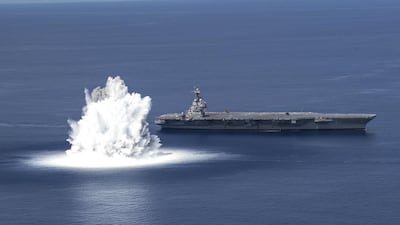
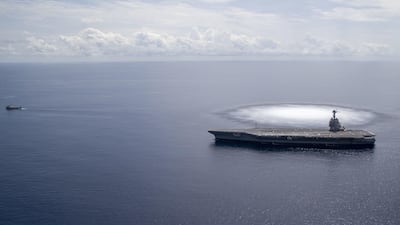
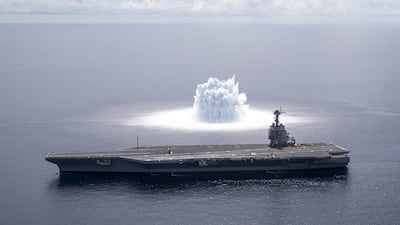
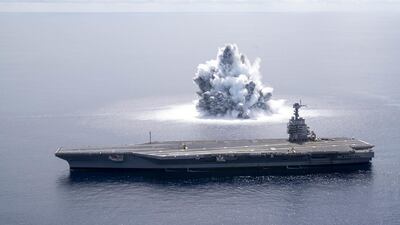
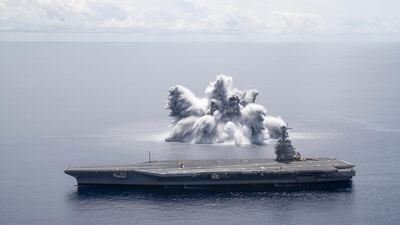
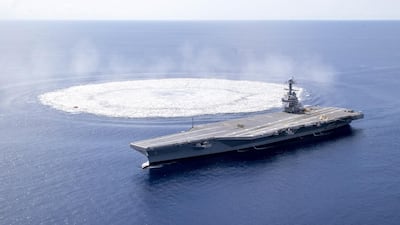
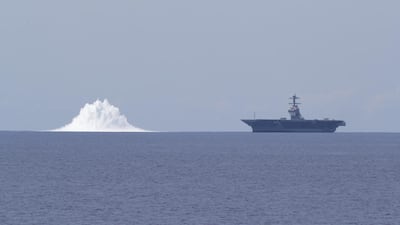
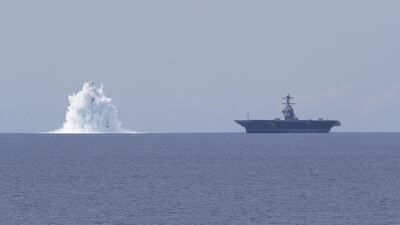
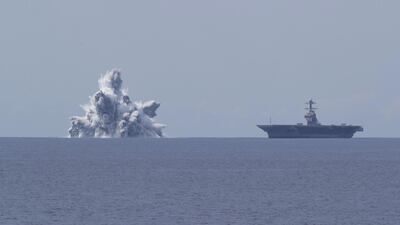
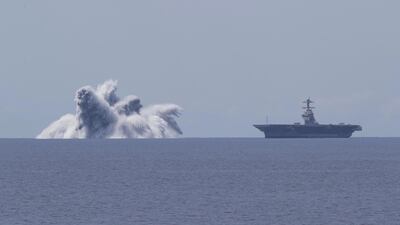
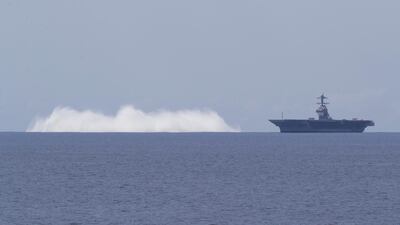
In this handout image courtesy of the US Navy the aircraft carrier USS Gerald R. Ford (CVN 78) completes the first scheduled explosive event of Full Ship Shock Trials while underway in the Atlantic Ocean, June 18, 2021. The US Navy has started carrying out what it calls 'Full Ship Shock Trials' by detonating powerful explosions to test whether its aircraft carriers are ready for war. A navy statement Sunday said the 40,000-pound (18,143-kilo) explosion was triggered as part of work to evaluate the aircraft carrier, USS Gerald R. Ford's battle readiness. - RESTRICTED TO EDITORIAL USE - MANDATORY CREDIT "AFP PHOTO / US NAVY / RILEY MCDOWE " - NO MARKETING - NO ADVERTISING CAMPAIGNS - DISTRIBUTED AS A SERVICE TO CLIENTS / AFP / US NAVY / Riley MCDOWE / RESTRICTED TO EDITORIAL USE - MANDATORY CREDIT "AFP PHOTO / US NAVY / RILEY MCDOWE " - NO MARKETING - NO ADVERTISING CAMPAIGNS - DISTRIBUTED AS A SERVICE TO CLIENTS
In this handout image courtesy of the US Navy the aircraft carrier USS Gerald R. Ford (CVN 78) completes the first scheduled explosive event of Full Ship Shock Trials while underway in the Atlantic Oc

US military ‘shock trial’ explodes 20-tonne bomb near new 'Gerald R Ford' aircraft carrier


Robert Tollast
  • English
  • Arabic

The US military has detonated a 20-tonne bomb next to the new Gerald R Ford aircraft carrier, blasting the ship with the equivalent force of a 3.9 magnitude earthquake.

The blast – comparable to 100 modern depth charges exploding simultaneously – dwarfed the 100,000-tonne vessel.

The test was what the US Navy calls a “Full Ship Shock Trial,” and ships are not considered ready for combat without one.

  • The aircraft carrier USS Gerald R. Ford (CVN 78) completes the first scheduled explosive event of Full Ship Shock Trials while underway in the Atlantic Ocean, June 18, 2021. The US Navy conducts shock trials of new ship designs using live explosives to confirm that warships can continue to meet demanding mission requirements under harsh conditions they might encounter in battle. Photo: US Navy
    The aircraft carrier USS Gerald R. Ford (CVN 78) completes the first scheduled explosive event of Full Ship Shock Trials while underway in the Atlantic Ocean, June 18, 2021. The US Navy conducts shock trials of new ship designs using live explosives to confirm that warships can continue to meet demanding mission requirements under harsh conditions they might encounter in battle. Photo: US Navy
  • The aircraft carrier USS Gerald R. Ford (CVN 78) completes the first scheduled explosive event of Full Ship Shock Trials while underway in the Atlantic Ocean, June 18, 2021. The US Navy conducts shock trials of new ship designs using live explosives to confirm that warships can continue to meet demanding mission requirements under harsh conditions they might encounter in battle. Photo: US Navy
    The aircraft carrier USS Gerald R. Ford (CVN 78) completes the first scheduled explosive event of Full Ship Shock Trials while underway in the Atlantic Ocean, June 18, 2021. The US Navy conducts shock trials of new ship designs using live explosives to confirm that warships can continue to meet demanding mission requirements under harsh conditions they might encounter in battle. Photo: US Navy
  • The aircraft carrier USS Gerald R. Ford (CVN 78) completes the first scheduled explosive event of Full Ship Shock Trials while underway in the Atlantic Ocean, June 18, 2021. The US Navy conducts shock trials of new ship designs using live explosives to confirm that warships can continue to meet demanding mission requirements under harsh conditions they might encounter in battle. Photo: US Navy
    The aircraft carrier USS Gerald R. Ford (CVN 78) completes the first scheduled explosive event of Full Ship Shock Trials while underway in the Atlantic Ocean, June 18, 2021. The US Navy conducts shock trials of new ship designs using live explosives to confirm that warships can continue to meet demanding mission requirements under harsh conditions they might encounter in battle. Photo: US Navy
  • The aircraft carrier USS Gerald R. Ford (CVN 78) completes the first scheduled explosive event of Full Ship Shock Trials while underway in the Atlantic Ocean, June 18, 2021. The US Navy conducts shock trials of new ship designs using live explosives to confirm that warships can continue to meet demanding mission requirements under harsh conditions they might encounter in battle. Photo: US Navy
    The aircraft carrier USS Gerald R. Ford (CVN 78) completes the first scheduled explosive event of Full Ship Shock Trials while underway in the Atlantic Ocean, June 18, 2021. The US Navy conducts shock trials of new ship designs using live explosives to confirm that warships can continue to meet demanding mission requirements under harsh conditions they might encounter in battle. Photo: US Navy
  • The aircraft carrier USS Gerald R. Ford (CVN 78) completes the first scheduled explosive event of Full Ship Shock Trials while underway in the Atlantic Ocean, June 18, 2021. The US Navy conducts shock trials of new ship designs using live explosives to confirm that warships can continue to meet demanding mission requirements under harsh conditions they might encounter in battle. Photo: US Navy
    The aircraft carrier USS Gerald R. Ford (CVN 78) completes the first scheduled explosive event of Full Ship Shock Trials while underway in the Atlantic Ocean, June 18, 2021. The US Navy conducts shock trials of new ship designs using live explosives to confirm that warships can continue to meet demanding mission requirements under harsh conditions they might encounter in battle. Photo: US Navy
  • The aircraft carrier USS Gerald R. Ford (CVN 78) completes the first scheduled explosive event of Full Ship Shock Trials while underway in the Atlantic Ocean, June 18, 2021. The US Navy conducts shock trials of new ship designs using live explosives to confirm that warships can continue to meet demanding mission requirements under harsh conditions they might encounter in battle. Photo: US Navy
    The aircraft carrier USS Gerald R. Ford (CVN 78) completes the first scheduled explosive event of Full Ship Shock Trials while underway in the Atlantic Ocean, June 18, 2021. The US Navy conducts shock trials of new ship designs using live explosives to confirm that warships can continue to meet demanding mission requirements under harsh conditions they might encounter in battle. Photo: US Navy
  • The aircraft carrier USS Gerald R. Ford (CVN 78) completes the first scheduled explosive event of Full Ship Shock Trials while underway in the Atlantic Ocean, June 18, 2021. The US Navy conducts shock trials of new ship designs using live explosives to confirm that warships can continue to meet demanding mission requirements under harsh conditions they might encounter in battle. Photo: US Navy
    The aircraft carrier USS Gerald R. Ford (CVN 78) completes the first scheduled explosive event of Full Ship Shock Trials while underway in the Atlantic Ocean, June 18, 2021. The US Navy conducts shock trials of new ship designs using live explosives to confirm that warships can continue to meet demanding mission requirements under harsh conditions they might encounter in battle. Photo: US Navy
  • The aircraft carrier USS Gerald R. Ford (CVN 78) completes the first scheduled explosive event of Full Ship Shock Trials while underway in the Atlantic Ocean, June 18, 2021. The US Navy conducts shock trials of new ship designs using live explosives to confirm that warships can continue to meet demanding mission requirements under harsh conditions they might encounter in battle. Photo: US Navy
    The aircraft carrier USS Gerald R. Ford (CVN 78) completes the first scheduled explosive event of Full Ship Shock Trials while underway in the Atlantic Ocean, June 18, 2021. The US Navy conducts shock trials of new ship designs using live explosives to confirm that warships can continue to meet demanding mission requirements under harsh conditions they might encounter in battle. Photo: US Navy
  • The aircraft carrier USS Gerald R. Ford (CVN 78) completes the first scheduled explosive event of Full Ship Shock Trials while underway in the Atlantic Ocean, June 18, 2021. The US Navy conducts shock trials of new ship designs using live explosives to confirm that warships can continue to meet demanding mission requirements under harsh conditions they might encounter in battle. Photo: US Navy
    The aircraft carrier USS Gerald R. Ford (CVN 78) completes the first scheduled explosive event of Full Ship Shock Trials while underway in the Atlantic Ocean, June 18, 2021. The US Navy conducts shock trials of new ship designs using live explosives to confirm that warships can continue to meet demanding mission requirements under harsh conditions they might encounter in battle. Photo: US Navy
  • The aircraft carrier USS Gerald R. Ford (CVN 78) completes the first scheduled explosive event of Full Ship Shock Trials while underway in the Atlantic Ocean, June 18, 2021. The US Navy conducts shock trials of new ship designs using live explosives to confirm that warships can continue to meet demanding mission requirements under harsh conditions they might encounter in battle. Photo: US Navy
    The aircraft carrier USS Gerald R. Ford (CVN 78) completes the first scheduled explosive event of Full Ship Shock Trials while underway in the Atlantic Ocean, June 18, 2021. The US Navy conducts shock trials of new ship designs using live explosives to confirm that warships can continue to meet demanding mission requirements under harsh conditions they might encounter in battle. Photo: US Navy
  • The aircraft carrier USS Gerald R. Ford (CVN 78) completes the first scheduled explosive event of Full Ship Shock Trials while underway in the Atlantic Ocean, June 18, 2021. The US Navy conducts shock trials of new ship designs using live explosives to confirm that warships can continue to meet demanding mission requirements under harsh conditions they might encounter in battle. Photo: US Navy
    The aircraft carrier USS Gerald R. Ford (CVN 78) completes the first scheduled explosive event of Full Ship Shock Trials while underway in the Atlantic Ocean, June 18, 2021. The US Navy conducts shock trials of new ship designs using live explosives to confirm that warships can continue to meet demanding mission requirements under harsh conditions they might encounter in battle. Photo: US Navy
  • The aircraft carrier USS Gerald R. Ford (CVN 78) completes the first scheduled explosive event of Full Ship Shock Trials while underway in the Atlantic Ocean, June 18, 2021. The US Navy conducts shock trials of new ship designs using live explosives to confirm that warships can continue to meet demanding mission requirements under harsh conditions they might encounter in battle. Photo: US Navy
    The aircraft carrier USS Gerald R. Ford (CVN 78) completes the first scheduled explosive event of Full Ship Shock Trials while underway in the Atlantic Ocean, June 18, 2021. The US Navy conducts shock trials of new ship designs using live explosives to confirm that warships can continue to meet demanding mission requirements under harsh conditions they might encounter in battle. Photo: US Navy

US Navy vessels are packed with sensitive equipment, connected by millions of feet of cable – in the Gerald S Ford's case, 14 million feet of electrical connections.

Everything from communications equipment to infrared sensors could be damaged by a blast shockwave and even the operation of the ship’s A1B nuclear reactor could be affected by explosive shockwaves if it was in combat.

In the case of the US Navy’s Arleigh Burke-class destroyers, 4,460 components were monitored during shock trials in 1994, according to a US Navy report.

"The US navy conducts shock trials of new ship designs using live explosives to confirm that our warships can continue to meet demanding mission requirements under harsh conditions they might encounter in battle," the US Navy said.

"The first-in-class aircraft carrier was designed using advanced computer modelling methods, testing and analysis to ensure the ship is hardened to withstand battle conditions, and these shock trials provide data used in validating the shock hardness of the ship."

The US Navy was also keen to point out that the massive explosion could have affected less than battle-shock-proof marine life, and that precautions had been taken to ensure the test, “complies with environmental mitigation requirements, respecting known migration patterns of marine life in the test area".

Now that the shock trials are complete, the aircraft carrier will be assessed for damage, and the navy has set aside six months for "modernisation, maintenance, and repairs". After that, it will be ready for deployment across the globe.


Company%20profile
%3Cp%3E%3Cstrong%3ECompany%20name%3A%3C%2Fstrong%3E%20FinFlx%3C%2Fp%3E%0A%3Cp%3E%3Cstrong%3EStarted%3A%3C%2Fstrong%3E%20January%202021%3C%2Fp%3E%0A%3Cp%3E%3Cstrong%3EFounders%3A%3C%2Fstrong%3E%20Amr%20Yussif%20(co-founder%20and%20CEO)%2C%20Mattieu%20Capelle%20(co-founder%20and%20CTO)%3C%2Fp%3E%0A%3Cp%3E%3Cstrong%3EBased%20in%3A%3C%2Fstrong%3E%20Dubai%3C%2Fp%3E%0A%3Cp%3E%3Cstrong%3EIndustry%3A%3C%2Fstrong%3E%20FinTech%3C%2Fp%3E%0A%3Cp%3E%3Cstrong%3EFunding%20size%3A%3C%2Fstrong%3E%20%241.5m%20pre-seed%3C%2Fp%3E%0A%3Cp%3E%3Cstrong%3EInvestors%3A%3C%2Fstrong%3E%20Venture%20capital%20-%20Y%20Combinator%2C%20500%20Global%2C%20Dubai%20Future%20District%20Fund%2C%20Fox%20Ventures%2C%20Vector%20Fintech.%20Also%20a%20number%20of%20angel%20investors%3C%2Fp%3E%0A
Brief scoreline:

Liverpool 5

Keita 1', Mane 23', 66', Salah 45' 1, 83'

Huddersfield 0

How to wear a kandura

Dos

  • Wear the right fabric for the right season and occasion 
  • Always ask for the dress code if you don’t know
  • Wear a white kandura, white ghutra / shemagh (headwear) and black shoes for work 
  • Wear 100 per cent cotton under the kandura as most fabrics are polyester

Don’ts 

  • Wear hamdania for work, always wear a ghutra and agal 
  • Buy a kandura only based on how it feels; ask questions about the fabric and understand what you are buying
England squads for Test and T20 series against New Zealand

Test squad: Joe Root (capt), Jofra Archer, Stuart Broad, Rory Burns, Jos Buttler, Zak Crawley, Sam Curran, Joe Denly, Jack Leach, Saqib Mahmood, Matthew Parkinson, Ollie Pope, Dominic Sibley, Ben Stokes, Chris Woakes

T20 squad: Eoin Morgan (capt), Jonny Bairstow, Tom Banton, Sam Billings, Pat Brown, Sam Curran, Tom Curran, Joe Denly, Lewis Gregory, Chris Jordan, Saqib Mahmood, Dawid Malan, Matt Parkinson, Adil Rashid, James Vince

THE SPECS

GMC Sierra Denali 1500

Engine: 6.2-litre V8

Transmission: 10-speed automatic

Power: 420hp

Torque: 623Nm

Price: Dh232,500

SPECS
%3Cp%3EEngine%3A%20Twin-turbocharged%204-litre%20V8%3Cbr%3EPower%3A%20625%20bhp%3Cbr%3ETorque%3A%20630Nm%3Cbr%3EOn%20sale%3A%20Now%3Cbr%3EPrice%3A%20From%20Dh974%2C011%3C%2Fp%3E%0A
Results

2-15pm: Commercial Bank Of Dubai – Conditions (TB) Dh100,000 (Dirt) 1,400m; Winner: Al Habash, Patrick Cosgrave (jockey), Bhupat Seemar (trainer)

2.45pm: Al Shafar Investment – Handicap (TB) Dh80,000 (D) 1,200m; Winner: Day Approach, Ray Dawson, Ahmad bin Harmash

3.15pm: Dubai Real estate Centre – Handicap (TB) Dh80,000 (D) 1,600m; Winner: Celtic Prince, Richard Mullen, Rashed Bouresly

3.45pm: Jebel Ali Sprint by ARM Holding – Listed (TB) Dh500,000 (D) 1,000m; Winner: Khuzaam, Pat Dobbs, Doug Watson

4.15pm: Shadwell – Conditions (TB) Dh100,000 (D) 1,600m; Winner: Tenbury Wells, Royston Ffrench, Salem bin Ghadayer

4.45pm: Jebel Ali Stakes by ARM Holding – Listed (TB) Dh500,000 (D) 1,950m; Winner: Lost Eden, Andrea Atzeni, Doug Watson

5.15pm: Jebel Ali Racecourse – Handicap (TB) Dh76,000 (D) 1,950m; Winner: Rougher, Pat Dobbs, Doug Watson