


Live updates: Follow the latest news on Israel-Gaza
British MPs fear the UK has “lost sight of humanity” and “proportionality” as they called for the conditions needed to get fuel and aid into Gaza “right now".
Directors of aid and human rights agencies in Gaza briefed MPs of the worsening situation as two thirds of hospitals have shut down, diseases have spread due to poor water sanitation, and fuel and food supplies are running out.
Should Israel’s siege on Gaza and the slow “trickle” of aid from the Rafah crossing in Egypt continue, there would be “massive outbreaks of infection and mass starvation", said Melanie Ward, chief executive of the British charity Medical Aid for Palestinians.
MPs at the hearing with the international development committee were visibly shocked and distressed as they heard of the trauma that the war, and the conflict in the years preceding it, had on Palestinian children.
"When it comes to Gaza we seem to have lost sight of the most basic principles of humanity and proportionality,” said Labour MP Sarah Champion, the committee chair.
"The first priority must be to immediately get aid and fuel into Gaza and the conditions for that are needed right now."
The "vital supplies" on which aid agencies depend could be "already lost or lost within hours", Ms Champion said.
Israel allowed aid to enter Gaza three weeks ago through the Rafah crossing from Egypt. But only an average of about 30 to 40 trucks have been able to enter each day.
“There’s no other way to describe this than as a humanitarian crisis that is getting worse by the day, minute and second,” said Yasmine Ahmed, UK director of Human Rights Watch.
"It is a man-made catastrophe that is the direct result of the Israeli siege."
The latest from the Israel-Gaza war - in pictures
-
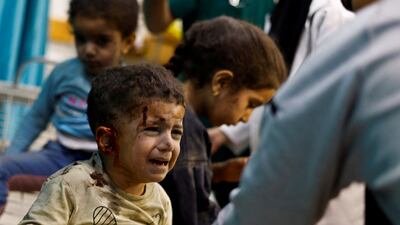
Palestinian children wounded in Israeli strikes amid the Israel-Gaza war wait for treatment at Nasser Hospital. Reuters -
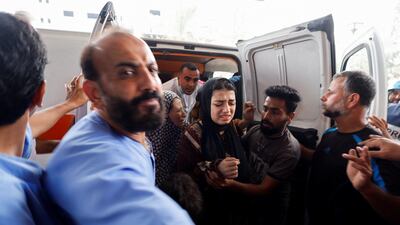
Wounded Palestinians are assisted out of an ambulance to receive treatment at Nasser Hospital in Khan Younis. Reuters -
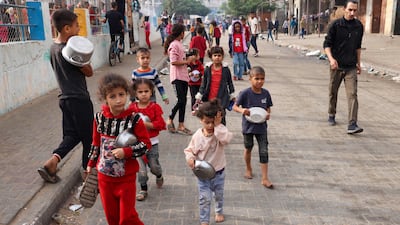
Displaced Palestinian children gather for breakfast at a refugee camp in Rafah. AFP -
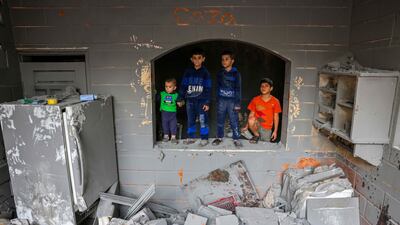
Children inside a damaged building following strikes on Rafah in the southern Gaza Strip. AFP -
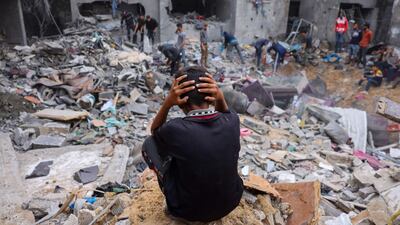
People salvage belongings from a damaged building following strikes on Rafah. AFP -
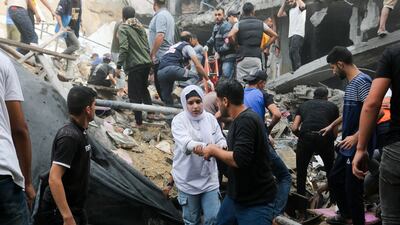
A girl is assisted as Palestinians search for casualties after an Israeli strike on a house, in Rafa in the southern Gaza Strip. Reuters -
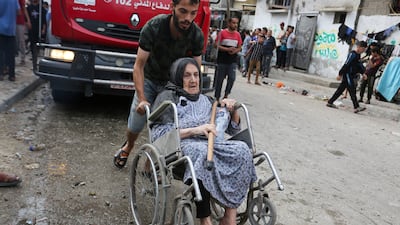
A Palestinian woman is evacuated at the site of an Israeli strike on a house, in Rafah. Reuters -
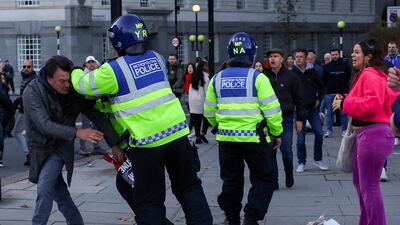
Police officers push back a counter protester who snatched a pro-Palestinian placard from a woman during a demonstration in solidarity with Gazans, London. Reuters -
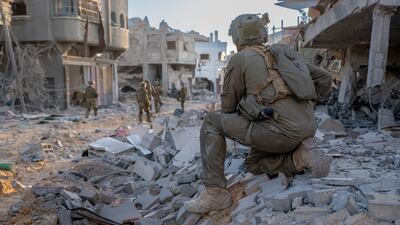
Israeli soldiers inside the Gaza Strip, amid the continuing ground operation. Reuters -
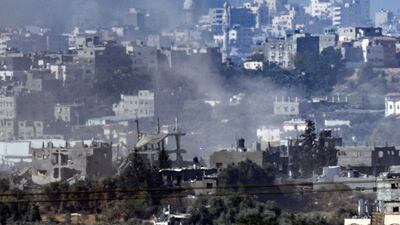
An Israeli flag can be seen inside the Gaza Strip, from the Israeli side of the border. Reuters -
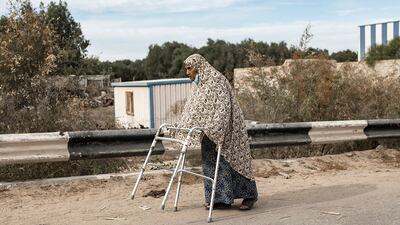
A Palestinian woman evacuates her home, heading to the southern Gaza Strip. EPA -
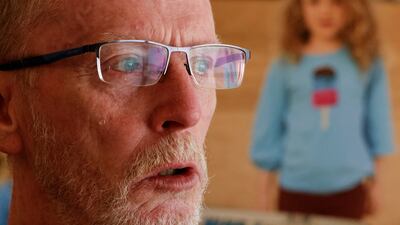
Thomas Hand, the father of Irish-Israeli Emily Hand, 8, who was announced dead following the October 7 attack, then later confirmed as one of the hostages held in Gaza, speaks from his hotel where he was evacuated to in Israel. Reuters -
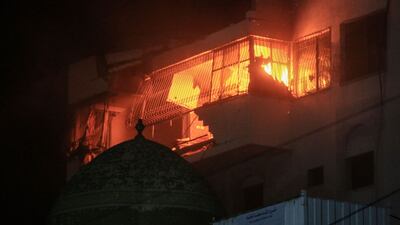
A residential building on fire following Israeli air strikes in Gaza city. Bloomberg -
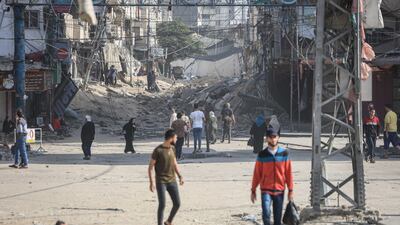
The rubble from destroyed residential buildings fills a street in Gaza city. Bloomberg -
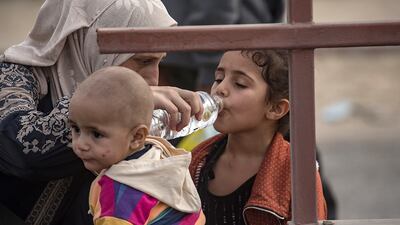
A Palestinian child drinks water as they evacuate to the southern Gaza Strip. EPA -
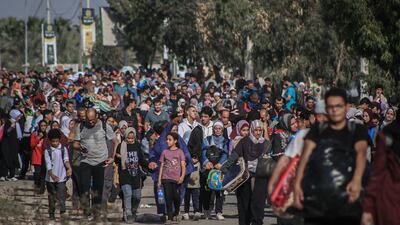
Palestinians displaced from Gaza city head towards the south. Bloomberg -
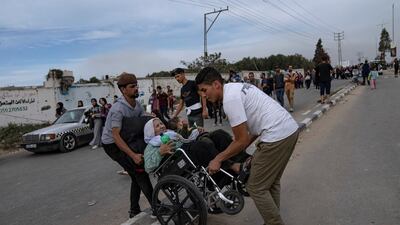
Palestinians flee to the southern Gaza Strip. AP -
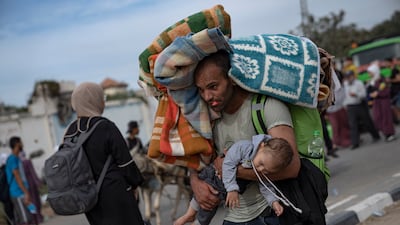
Palestinians flee to the southern Gaza Strip on Salah al-Din Street in Bureij, Gaza Strip. AP -
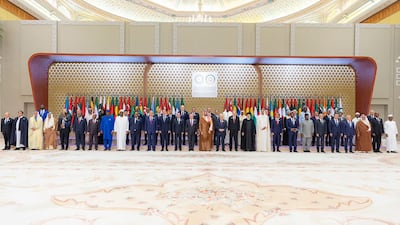
A group picture ahead of an emergency meeting of the Arab League and the Organisation of Islamic Co-operation in Riyadh. AFP


The “collapse” of Gaza’s energy system due to the blockade meant that water sanitation plants were not running and bakeries had stopped working.
“People are walking around with jerry cans, desperate to find water,” said Sam Rose, director of planning at the UN’s aid agency for Palestinians.
Gaza’s three mobile phone network providers will shut down operations on Thursday due to a lack of fuel, and the already limited connectivity meant there was “very little” information about what was happening in northern Gaza, Mr Rose said.
Agency staff in Gaza were unable to pursue their work due to the continuing bombardment, lack of fuel and dwindling resources, said Shaina Low, the Norwegian Refugee Council's adviser in Jerusalem.
“I’ve run out of vocabulary to describe how much worse it can get,” Ms Low told MPs.
She called for an “immediate ceasefire” that would allow aid workers to enter Gaza and do their work.
“It’s not that we can’t do anything without a ceasefire but it’s not sustainable. We can’t be working under bombardment,” Ms Low said.
Asked whether a “humanitarian pause” would be more achievable than a ceasefire, Ms Low pleaded with MPs not to get “bogged down in terminology”.
“We need not hours but days to organise and facilitate responses,” she said.
Ms Ward described a grim situation in which two thirds of Gaza’s medical centres had shut down and 198 clinicians had been killed by bombardment.
“Three weeks ago we warned that the lives of premature babies were at risk,” she said.
Three babies had died since then, and about 40 were taken out of their incubators because they had stopped working, Ms Ward said.
Al Shifa Hospital, which Israeli forces have encircled claiming it conceals an important Hamas base, had about 600 patients and 700 medical workers inside.
Cancer patients who previously accessed chemotherapy in Israel or the West Bank were no longer able to continue their treatment, and there were 1,400 patients needing kidney dialysis, for which facilities were not available in Gaza.
Ms Ward estimated that 5,500 babies had been born in Gaza since the conflict began, and said mothers with complicated pregnancies normally sought specialist care outside of the Palestinian territory.
The UK’s response to the conflict would have implications for the long term, witnesses at the hearing said.
Ms Ahmed described the UK’s “rightful” condemnation of Hamas and “silence” on Israel as a “double standard”.
“The fact that there has not been some calling out of Israel’s war crimes is disturbing,” she said.
The international community’s “silence” had given Israel a “green light” for its brutal response in Gaza, in which more than 11,000 people have been killed by Israeli bombardment, including more than 4,500 children, according to the Gaza Health Ministry.
Ms Ahmed feared this would undermine the UK’s other foreign policy positions, such as it condemnation of Russia and Russian President Vladimir Putin’s war crimes in Ukraine.
Mr Rose echoed this, highlighting the “sense of abandonment” felt by Palestinians, after the Palestine-Israel issue became “dormant” in UK politics.
“There’s a sense of abandonment from the West,” he said.
He said this would affect the “reputation of these governments in years to come in Gaza and the wider Middle East".

