


A new plan to put the UK at the forefront of pioneering research and development in the space sector has been unveiled by the Space Agency.
The Space Exploration Technology Roadmap aims to put the UK’s growing space sector in a stronger position to collaborate with international partners including Nasa, the European Space Agency and Japan’s space agency Jaxa.
The road map identifies a number of gaps to be addressed as well as areas of existing strength which should be built upon for the UK to fully benefit from the increasing commercialisation of space exploration and the global space economy, which is estimated to reach $1 trillion by 2040.
The road map will be informed by consultation with the space sector to identify the most appropriate technologies for the UK to focus on.
Further consultation and collaboration with UK organisations in the space sector will help develop detailed analysis on each specific technology area, while regular reviews of the road map will ensure it keeps pace with new technological and commercial developments, as well as the UK’s growing ambitions in space.
One of the new technologies is artificial intelligence, which can enhance the capability and efficiency of missions.
Autonomous navigation helps spacecraft explore planets and moons without the need for direct, continuous control by human crews back on Earth or in orbit.
The technology is also important for the growing number of commercial satellites in low Earth orbit.
Virgin Galactic’s first commercial space tourism flight takes off – in pictures
-
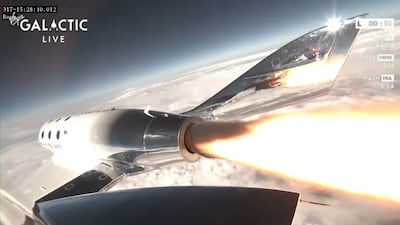
Virgin Galactic's VSS Unity spaceplane blasts its engines shortly after separating from the mothership on Thursday. It carried three Italian passengers and three crew members to the edge of space. All photos: Virgin Galactic -

The passengers move around in microgravity. -

Italian Air Force member Coll Walter Villadei holds up the Italian flag while in microgravity. -

The three Italian passengers and one Virgin Galactic employee seen enjoying microgravity aboard the VSS Unity spaceplane after it reached the edge of space. -

The Virgin Galactic mothership releases the VSS Unity spaceplane, so it can climb to the edge of space. -
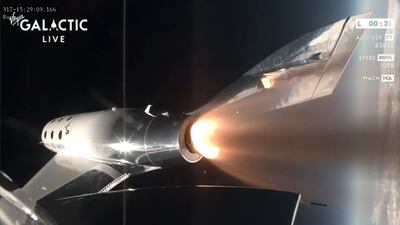
The spaceplane climbed to an apogee of 85.1 kilometers, allowing the crew to experience about four minutes of weightlessness. -
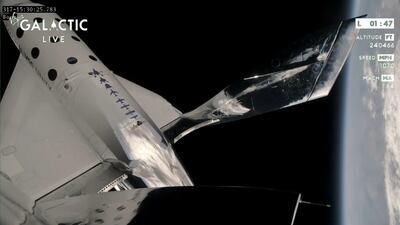
The VSS Unity spaceplane climbs to the boundary of space. -
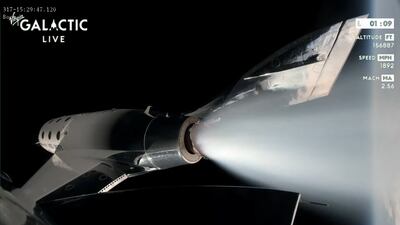
The engine on the VSS Unity spaceplane turns off as it reaches the edge of space. -
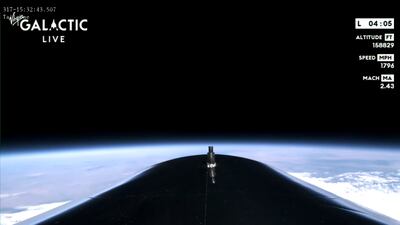
A stunning view of Earth against the darkness of space from a camera aboard the Virgin Galactic spaceplane. -

The VSS Unity spaceplane starts descending back to Earth after taking passengers 85.1 km above the New Mexico desert. -

The VSS Unity spaceplane lands back on a runway in a New Mexico desert after its suborbital space tourism flight. -

It was a successful first commercial space tourism flight by Virgin Galactic.


Nuclear power will also provide a reliable and lasting source of energy for activities such as construction, power, heating and life support as humans return to the Moon and develop the infrastructure to travel to Mars.
Major projects featured in the road map include Lunar Pathfinder, a spacecraft designed, owned and operated by Surrey Satellite Technology to trailblaze the European Space Agency’s Moonlight project to create a network of satellites that would provide communication and navigation services for exploration on the Moon.
The UK-led Rosalind Franklin Rover, due for launch to Mars in 2028, is also highlighted, along with Nammo’s satellite propulsion system and the University of Glasgow’s novel pulse elevator technology that can be used to extract solid materials with less impact than traditional drilling.
“Discovery is fundamental to the work of the UK Space Agency, and we are entering a new era of space exploration where governments and commercial operators are working closer than ever before,” UK Space Agency chief executive Paul Bate said.
“By setting out this road map, we are giving clarity to industry and researchers across the space sector, and positioning the UK as a partner of choice for future space exploration missions to the Moon, Mars and beyond.”

