


Reducing the size of the army “beggars belief” and the lack of “properly functioning” reserve forces is a “national embarrassment”, Lord Nick Houghton said during an appearance before the House of Commons Defence Committee on Tuesday.
Lord Houghton, who was chief of the defence staff between 2013 and 2016, went on to criticise the decision to cut regular troop numbers.
“It beggars belief to me that we have a reduced size of army,” he said.
“We have witnessed the first real formalised warfare above the threshold of war in Ukraine and Russia, and within weeks, both sides have sort of run out of troops.
“They have mobilised their nations, they have had to call on reserves and yet we as a nation, have no strategic methodology for mobilising the reserves.
“We don’t have a properly functioning reserve.
“To me, it’s a national embarrassment but they don’t appear to want to do anything about it.”
The size of the British Army has been a source of political argument in recent months, with Labour calling for a halt to the cuts announced in the last defence command paper, published in 2021.
In the past decade, the number of regular soldiers has fallen from 97,000 to 76,000 and will soon fall to 73,000.
British Army’s new Apache attack helicopters undergo test flights – in pictures
-
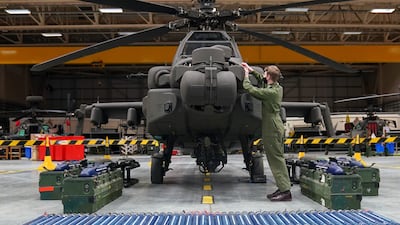
One of the British Army's new AH-64E Apache attack helicopters goes on display at Wattisham Airfield, in Suffolk, eastern England. All photos: PA -
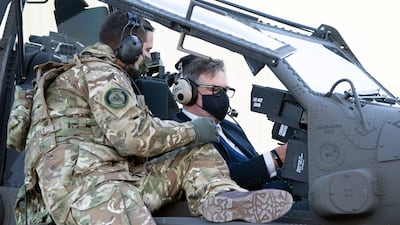
UK Minister for Defence Procurement Jeremy Quinn MP gets a tour of the cockpit of the AH-64E Apache, which is made by US aviation company Boeing. -
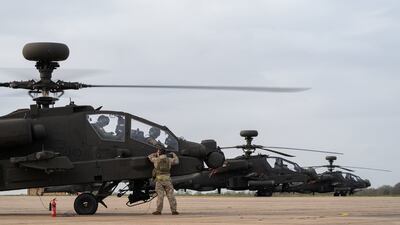
The AH-64E, which detect 256 potential targets simultaneously and prioritise threats in seconds, is undergoing test flights with the British Army. -
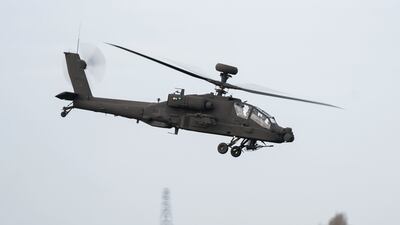
Boeing has delivered 14 AH-64E Apaches to Wattisham. The manufacturer says the AH-64E will be in production until at least 2028, and serve as the world’s primary attack helicopter into the 2060s. -

30mm ammunition and 70mm rockets for the AH-64E. -
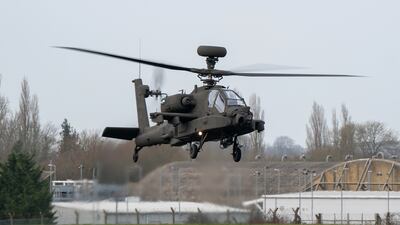
The new Apache can detect targets up to a range of 16 kilometres.


But Lord Houghton, who spent 40 years in the army and served in Northern Ireland and Iraq, said the UK’s military capability had not been “eroded to the point where we should worry”, while acknowledging there were problems, including with recruitment and equipment.
The concerns were echoed by Gen Sir Tim Radford, the Deputy Supreme Allied Commander Europe, the second in command of Nato’s military arm.
He said that the UK's army was "too small" and was in danger of "not holding on" to its military reputation.
“It would be wrong to say [we’re] living off the past, but we’ve got to be really careful that we don’t slip too low, Gen Sir Tim told The Telegraph.
“We’re in a fortunate position here. We’ve got a position of influence right across Nato. I worry that if we don’t invest and we don’t build up our industrial base and we don’t lead as we should, we might lose that position.”
In August 2022, the navy’s new £3 billion ($3.8 billion) aircraft carrier HMS Prince of Wales broke down off the Isle of Wight – the ship is still being repaired.
Lord Houghton added that the Royal Air Force was suffering from a pilot shortage while the armed forces in general were struggling in the “global battle for talent”.
The committee, which is conducting an inquiry into armed forces readiness, also heard that stocks held for “major warfare” had been affected by austerity in 2010 and, although Lord Houghton had warned about the potential for war with Russia in 2013, little had been done.
“One of the ways in which we were able to cope with less money was to take a risk against the warfighting consumables or stocks that we held for major warfighting,” he said.
“Now, arguably, you could say that at the time – 2010 – that was a fair risk to take. Clearly, in the judgment of the government of the day, it was a fair risk to take.
“By the time I was writing my first letter to the prime minister on arrival [as chief of the defence staff], from memory, I was warning him then that the threats of the possibility that we might be called upon to cross the threshold of formalised warfare against an aggressive Russia were no longer latent but patent … and they were acknowledged.
“Was anything done about it? Not really.”
He said one of the reasons was that the British defence industry was not run as a co-operative enterprise but on the basis of fixed contracts, meaning companies did not maintain the capacity to produce more stocks at short notice.

