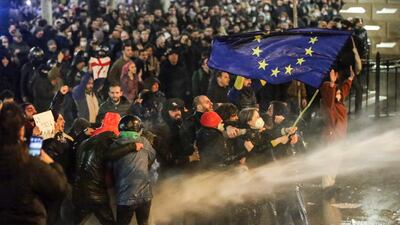
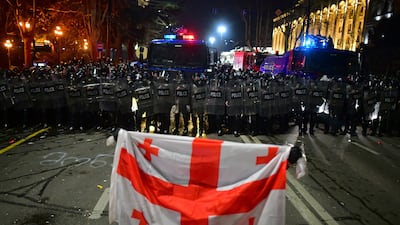
Protesters brandishing a European Union flag brace as they are sprayed by a water canon during clashes with riot police near the Georgian parliament in Tbilisi on March 7, 2023. - Georgian police used tear gas and water cannon against protesters Tuesday as thousands of demonstrators took to the streets in the capital Tbilisi to oppose a controversial "foreign agents" bill. (Photo by STRINGER / AFP)
Protesters brandishing a European Union flag brace as they are sprayed by a water canon during clashes with riot police near the Georgian parliament in Tbilisi on March 7, 2023. - Georgian police used

Georgia backs down after nights of violent protests


Gillian Duncan
  • English
  • Arabic

Georgia has promised to revoke a new pro-Russia law on "foreign agents" after two nights of mass rallies, during which police fire tear gas at thousands of demonstrators.

Protestors banded together to protect a woman waving a European Union flag as police targeted her with a water cannon in Tbilisi.

Concern has been growing that the former Soviet nation, which aspires to join the EU and Nato, is taking an authoritarian turn and maintaining links with Moscow.

The legislation, which had been prepared by ruling party Georgian Dream, is seen as reminiscent of Russian legislation used to silence critics.

Georgian Dream said in a statement the bill had been "represented in a bad light and in a misleading way", adding that it would launch public consultations to "better explain" the law's purpose after announcing its withdrawal.

Experts say only a tiny portion of Georgia’s population is pro-Russian.

Plans to join Nato and the EU are enshrined in Georgia's constitution and are supported by at least 80 per cent of the population, according to opinion polls.

Georgian opposition parties vowed on Thursday to continue protesting despite the ruling party's promise to revoke the legislation.

"For as long as there are no guarantees that Georgia is firmly on a pro-western course, these processes will not stop," a group of opposition parties said in a joint statement, announcing another rally on Thursday evening and demanding the release of dozens of detained protesters.

A European Union delegation in Georgia immediately cheered the halt, saying they "encourage all political leaders in Georgia to resume pro-EU reforms".

Protests in Georgia - in pictures

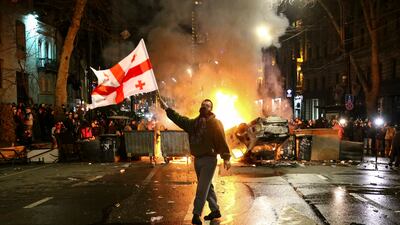
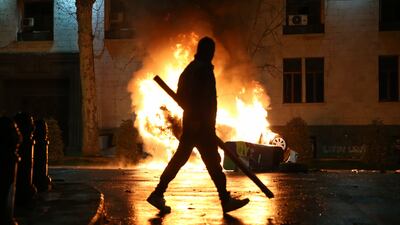
  • One protestor holds the Georgian flag in front of a burning barricade. AP
    One protestor holds the Georgian flag in front of a burning barricade. AP
  • Protesters holding a European Union flag are sprayed by a water cannon near the Georgian parliament in Tbilisi. AFP
    Protesters holding a European Union flag are sprayed by a water cannon near the Georgian parliament in Tbilisi. AFP
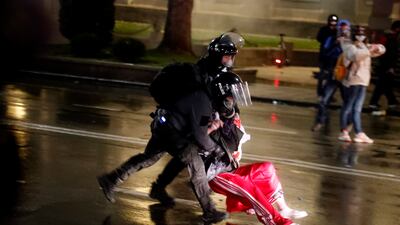
  • Georgian police detain a woman as she takes part in the protests. EPA
    Georgian police detain a woman as she takes part in the protests. EPA
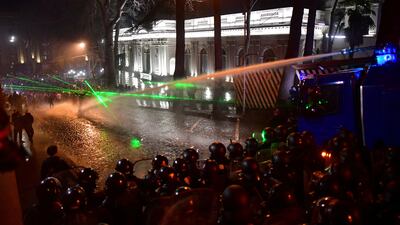
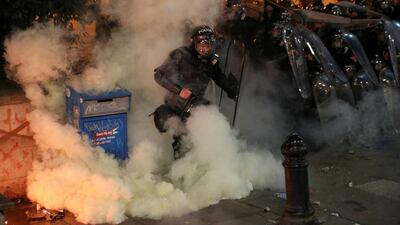
  • Police use a water cannon to disperse demonstrators in Tbilisi. Reuters
    Police use a water cannon to disperse demonstrators in Tbilisi. Reuters
  • Police cars have been set on fire during the demonstrations. AP
    Police cars have been set on fire during the demonstrations. AP
  • Violence has regularly broken out. Reuters
    Violence has regularly broken out. Reuters
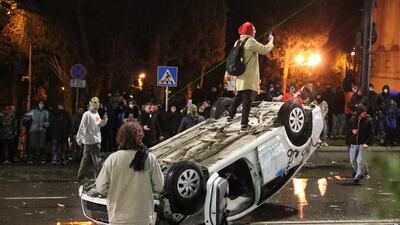
  • Several cars have been overturned. Reuters
    Several cars have been overturned. Reuters
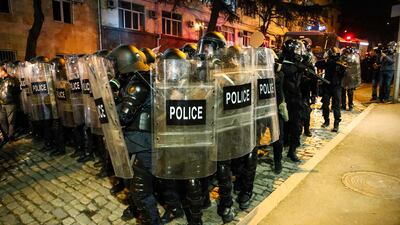
  • Riot police have been drafted in. AFP
    Riot police have been drafted in. AFP
  • Many protestors have brought national flags. Reuters
    Many protestors have brought national flags. Reuters

Huge crowds had gathered in front of the parliament building in central Tbilisi on Wednesday, holding EU and Georgian flags, and chanting "no to the Russian law".

The protesters demanded authorities drop the bill on "transparency of foreign funding", which critics said mirrors a law used in Russia to shut down media and dissenting groups.

Elene Ksovreli, 16, said Georgians did not want to see their future threatened.

"We will not allow them to make Russia define our future," she told AFP. "We, young people, are here to protect our everything."

Another demonstrator, 72-year-old Aza Akhvlediani, called the country's government "stupid".

"I know what's happening in Moscow. They stop every passerby and do whatever they please to them. I think the Georgian government wants the same," she said.

In response to the developing situation, Washington urged the government to show restraint and allow peaceful protests, while Ukrainian President Volodymyr Zelenskyy called for "democratic success" in "friendly Georgia".

Protesters were also out on Tuesday after ruling party members approved the draft law on "foreign agents" in its first reading.

Clashes ensued with police using tear gas and water cannon against the demonstrators.

Police said more than 70 demonstrators had been detained and 50 police officers injured during the protests on Tuesday.

Tom de Waal, a senior fellow at Carnegie Europe, said that both the bill and crackdown were a serious challenge in the politically turbulent country.

"It's a big moment for Georgia, still a democracy, but definitely a struggling one," he said on Twitter.

In Russia, the Kremlin has extensively used the "foreign agent" label against opponents, journalists and human rights activists accused of leading foreign-funded political activities.

Georgian authorities have faced mounting international criticism over a perceived backsliding on democracy, seriously damaging Tbilisi's ties with Brussels.

Georgian Prime Minister Irakli Garibashvili has defended his balanced policy as being aimed at ensuring "peace and stability".

But President Salome Zourabichvili, who vowed to veto the law it if crosses her desk, said earlier this week she was on the side of the protesters.

"You represent a free Georgia, a Georgia which sees its future in the West, and won't let anyone take this future away," she said in an address recorded in the United States, where she was on an official visit at the time.

"Today is a dark day for Georgia's democracy," the US embassy in Georgia said after the initial reading of the bill.

Russia and Georgia fought a five-day war in 2008.

Georgia applied for EU membership together with Ukraine and Moldova, days after Russia invaded Ukraine in February last year.

EU leaders granted formal candidate status to Kyiv and Chisinau in June, but said Tbilisi must implement several reforms first.

Georgia's treatment of jailed former president Mikheil Saakashvili, whose health has drastically deteriorated in prison, has also drawn international condemnation.

Late last month, European Union member states issued a formal diplomatic warning to Georgia's leaders over Mr Saakashvili's health.


Heather, the Totality
Matthew Weiner,
Canongate 

Ten tax points to be aware of in 2026

1. Domestic VAT refund amendments: request your refund within five years

If a business does not apply for the refund on time, they lose their credit.

2. E-invoicing in the UAE

Businesses should continue preparing for the implementation of e-invoicing in the UAE, with 2026 a preparation and transition period ahead of phased mandatory adoption. 

3. More tax audits

Tax authorities are increasingly using data already available across multiple filings to identify audit risks. 

4. More beneficial VAT and excise tax penalty regime

Tax disputes are expected to become more frequent and more structured, with clearer administrative objection and appeal processes. The UAE has adopted a new penalty regime for VAT and excise disputes, which now mirrors the penalty regime for corporate tax.

5. Greater emphasis on statutory audit

There is a greater need for the accuracy of financial statements. The International Financial Reporting Standards standards need to be strictly adhered to and, as a result, the quality of the audits will need to increase.

6. Further transfer pricing enforcement

Transfer pricing enforcement, which refers to the practice of establishing prices for internal transactions between related entities, is expected to broaden in scope. The UAE will shortly open the possibility to negotiate advance pricing agreements, or essentially rulings for transfer pricing purposes. 

7. Limited time periods for audits

Recent amendments also introduce a default five-year limitation period for tax audits and assessments, subject to specific statutory exceptions. While the standard audit and assessment period is five years, this may be extended to up to 15 years in cases involving fraud or tax evasion. 

8. Pillar 2 implementation 

Many multinational groups will begin to feel the practical effect of the Domestic Minimum Top-Up Tax (DMTT), the UAE's implementation of the OECD’s global minimum tax under Pillar 2. While the rules apply for financial years starting on or after January 1, 2025, it is 2026 that marks the transition to an operational phase.

9. Reduced compliance obligations for imported goods and services

Businesses that apply the reverse-charge mechanism for VAT purposes in the UAE may benefit from reduced compliance obligations. 

10. Substance and CbC reporting focus

Tax authorities are expected to continue strengthening the enforcement of economic substance and Country-by-Country (CbC) reporting frameworks. In the UAE, these regimes are increasingly being used as risk-assessment tools, providing tax authorities with a comprehensive view of multinational groups’ global footprints and enabling them to assess whether profits are aligned with real economic activity. 

Contributed by Thomas Vanhee and Hend Rashwan, Aurifer


Key facilities
  • Olympic-size swimming pool with a split bulkhead for multi-use configurations, including water polo and 50m/25m training lanes
  • Premier League-standard football pitch
  • 400m Olympic running track
  • NBA-spec basketball court with auditorium
  • 600-seat auditorium
  • Spaces for historical and cultural exploration
  • An elevated football field that doubles as a helipad
  • Specialist robotics and science laboratories
  • AR and VR-enabled learning centres
  • Disruption Lab and Research Centre for developing entrepreneurial skills
The biog

Name: Samar Frost

Born: Abu Dhabi

Hobbies: Singing, music and socialising with friends

Favourite singer: Adele

TWISTERS

Director: Lee Isaac Chung

Starring: Glen Powell, Daisy Edgar-Jones, Anthony Ramos

Rating: 2.5/5

Key figures in the life of the fort

Sheikh Dhiyab bin Isa (ruled 1761-1793) Built Qasr Al Hosn as a watchtower to guard over the only freshwater well on Abu Dhabi island.

Sheikh Shakhbut bin Dhiyab (ruled 1793-1816) Expanded the tower into a small fort and transferred his ruling place of residence from Liwa Oasis to the fort on the island.

Sheikh Tahnoon bin Shakhbut (ruled 1818-1833) Expanded Qasr Al Hosn further as Abu Dhabi grew from a small village of palm huts to a town of more than 5,000 inhabitants.

Sheikh Khalifa bin Shakhbut (ruled 1833-1845) Repaired and fortified the fort.

Sheikh Saeed bin Tahnoon (ruled 1845-1855) Turned Qasr Al Hosn into a strong two-storied structure.

Sheikh Zayed bin Khalifa (ruled 1855-1909) Expanded Qasr Al Hosn further to reflect the emirate's increasing prominence.

Sheikh Shakhbut bin Sultan (ruled 1928-1966) Renovated and enlarged Qasr Al Hosn, adding a decorative arch and two new villas.

Sheikh Zayed bin Sultan (ruled 1966-2004) Moved the royal residence to Al Manhal palace and kept his diwan at Qasr Al Hosn.

Sources: Jayanti Maitra, www.adach.ae

MATCH INFO

Norwich City 1 (Cantwell 75') Manchester United 2 (Aghalo 51' 118') After extra time.

Man of the match Harry Maguire (Manchester United)

Updated: March 09, 2023, 11:23 AM