


Years of planning for the UK’s first space mission ended in failure on Monday night after suffering an “anomaly” during the flight.
After taking off from Cornwall, the Virgin Orbit plane flew to an altitude of 10,600km over the Atlantic where it jettisoned a rocket containing nine small satellites towards space.
However, the rocket, which was carrying a variety of civil and defence applications, subsequently failed to orbit.
The plane returned to Spaceport Cornwall safely as engineers tried to figure out what went wrong.
Virgin Orbit shared the news on Twitter shortly after 11.45pm.
“We appear to have an anomaly that has prevented us from reaching orbit. We are evaluating the information,” tweeted the company.
“As we find out more, we’re removing our previous tweet about reaching orbit. We’ll share more info when we can.”
Speaking in the early hours of Tuesday, Virgin Orbit Chief Executive Dan Hart said the team was “very proud” of the many successes of the mission.
But he was mindful the team failed to provide customers with the “launch service they deserve”.
What went wrong?
Speaking on Tuesday morning, Ian Annett, Deputy Chief Executive of the UK Space Agency, said the team was “not quite sure” what happened to prevent the rocket achieving orbit.
“Virgin Orbit will be conducting a full review of the data over the next few days or so to determine exactly what went wrong,” he told Radio 4’s Today show.
Cosmic Girl successfully took off and reached the drop area, where the 22-metre rocket was deployed and ignited successfully, he said.
“But there seemed to be a problem with the second stage. Or an anomaly with the second stage,” he added.
“We need to look at that data. But this demonstrates how difficult getting into orbit with satellites actually is.
“We have demonstrated so much of it has been successful from last night. But we get up, we go back and we try again. That’s what defines us.”
What next?
Mr Annett said the team now plans to look at the data, think about how it goes forward and look ahead to the next launch.
“This happens in the space industry as well and we go back and go again and that’s what defines us,” he said.
“We would expect to see more satellite launches from the UK within the next year.
“There are so many complexities around this, whether it be regulations and air space. But certainly over the next 12 months we would expect to see us successfully putting satellites into orbit.”
LauncherOne intended to mark the start of a new development for the UK’s space ambitions to send scores of satellites into low-Earth orbit every year.
Spaceport Cornwall prepares for launch — in pictures
-
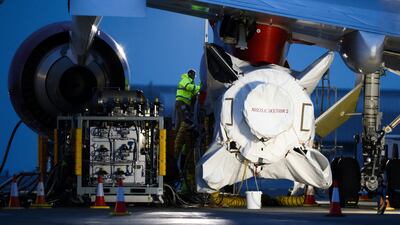
Virgin Orbit's LauncherOne rocket, attached to the wing of Cosmic Girl, a Boeing 747, is prepared for the UK's first space launch from Spaceport Cornwall in Newquay on Monday. Reuters -
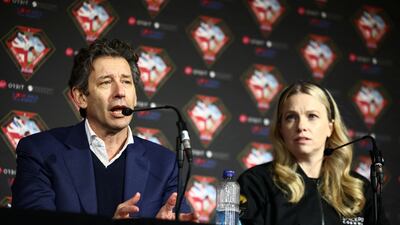
Chief executive of Virgin Orbit Dan Hart and the head of Spaceport Cornwall Melissa Thorpe in south-west England for the launch. Reuters -
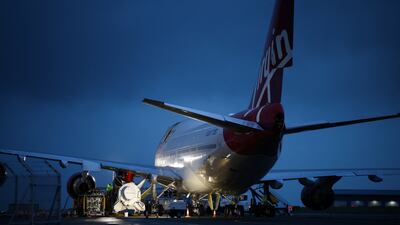
The first rocket launch to take place on British soil will begin a mission called 'Start Me Up'. Reuters -
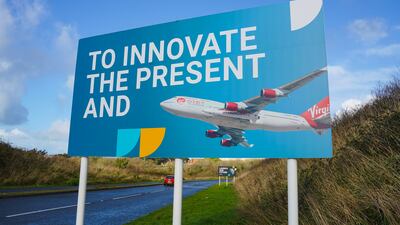
A sign outside the Spaceport. Getty -
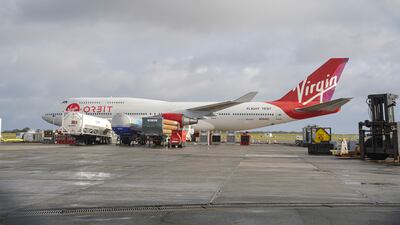
Cosmic Girl on the edge of the runway. The aircraft will take off before launching the rocket from mid-air. Getty -
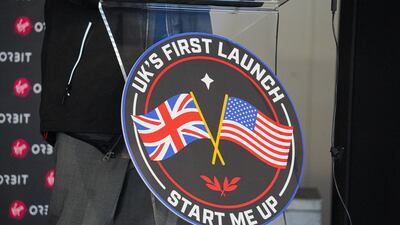
A mission badge at the launch site. Getty -
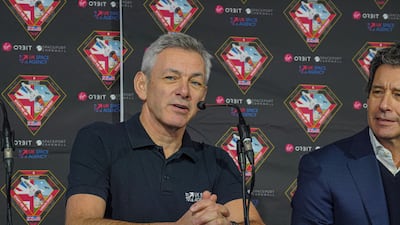
Ian Annett, deputy chief executive of the UK Space Agency, in Cornwall for the launch. Getty


The launch was the culmination of an eight-year programme that has been driven by Spaceport Cornwall and the government to give Britain a sovereign space capability and allow it to become a player in the international race to harness the potential of the cosmos for life on Earth.
The programme has attracted international customers from the Middle East to Europe and the US, and could lead to further engagement, particularly with the UAE’s space programme.
The plane, named Cosmic Girl, took off on Monday night from Cornwall with hundreds watching and more than 75,000 viewing a live stream.
Named in tribute to the Rolling Stones’ 1981 hit, the Start Me Up mission involved a repurposed Virgin Atlantic Boeing 747 aircraft and Virgin Orbit’s LauncherOne rocket.
It was originally hoped the launch could take place before Christmas but owing to technical and regulatory issues it had to be pushed into 2023.

