


It’s a typical morning in the bustling west London suburb of Chiswick as smartly dressed men and women carrying coffee cups and briefcases head to work in plush offices along a drive lined with pine trees.
But the heavy presence of armed police and armoured vehicles is enough to arouse suspicion that something is off.
The broadcast studio of Iran International is heavily guarded by the Metropolitan Police after two senior journalists received chilling death threats from the Islamic Revolutionary Guard Corps, while their colleagues were also sent warnings.
Officers toting guns stand near the entrance to the Persian-language TV channel’s office while Multi-Role Armoured Vehicles (M-RAVs) are parked at the entrance to the business park.
‘It’s like working in a warzone’
The National visited Iran International to speak with Aliasghar Ramezanpour, executive editor of the channel.
Inside the newsroom, there is a sense of normality as journalists dutifully type on computers and members of the sports desk keep an eye on the World Cup on a TV screen.
But underneath it all there is shock and sadness not only over the threats but due to Tehran’s violent crackdowns on protesters.
“Most of the people here are feeling that they are working in a kind of war zone,” Mr Ramezanpour said.

“Their first task is sticking to freedom of speech and maintaining the guideline that we have for accurate and balanced stories about what's happening in Iran.
“We used to see some threats from Iran's government in last few years in their media, in social media, but having threats here in London was a kind of surprise and shocking.
“And the worst thing is that this kind of threat is not just a personal thing. It has a reflection on everyone in the family and others.”
‘People are too scared to come to work'
Hamad Deen who works at a pop-up kebab stall opposite the business park said business has been badly affected by the major anti-terror operation which has unfolded in the area.
“The number of customers we have has fallen by half,” he said as he watched a colleague scrape Doner kebab meat off a vertical rotisserie. “When the police arrived last week we didn’t know what was happening. We asked a man we were serving and he told us there are a lot of people in his office who won’t come in. They are terrified.
“Another man working in the same building as Iran International said his office is empty.
“We are not scared, not yet. We don’t think we will have to close but we don’t know how long this will continue.”
It takes a lot to faze Mr Ramezanpour, a veteran journalist who studied at the University of Tehran, worked for several Iranian news outlets and served as deputy minister of culture in the early 2000s during a period of high hopes for reform. He left his homeland due to censorship, which he said made it impossible to work as a journalist.
After arriving in the UK in 2007, he helped set up BBC Persian in 2009 before co-founding Iran International in 2017.
Around 100 journalists work in the London newsroom where stories and programmes offer viewers in Iran and abroad an uncensored take on domestic and international affairs.
While Mr Ramezanpour feels at home in his adopted city and sees himself as a Londoner, the reality facing the media executive is anything but average.
Earlier this year, his relatives in Iran were summoned to a meeting by security services linked to the Revolutionary Guard. They were shown photographs of the journalist going about his daily business in London and told that his movements were being observed.
“That was quite shocking actually when I knew that they had that kind of picture,” he admitted. “They told them ’London is sometimes a dark city, it is not always safe.’”
Since the death of Mahsa Amini, arrested by Iran’s morality police for not wearing a hijab properly, the channel has taken on a new meaning. The channel has carried rolling coverage of mass anti-government protests, and in the process drawn down the wrath of Tehran.
Police have visited Mr Ramezanpour four times in six months to relay the threats made against him and his colleagues. Officers made clear they were aware of “significant and imminent” threats to the lives of two senior journalists. Other members of staff have received threats on social media.
This, he said, came as a “big shock” to everyone.
“These kind of threats are not just about one or two people, they go to many people, their families,” he said.
“And right now, even our journalists here, because of concerns that they have about the security of their family, they don’t call them in Iran. They don’t feel comfortable to talk when they think that someone in Iran is listening to what they're saying and maybe they go after their family.
“In some cases they have arrested the families of our journalists.
“They are under psychological and mental pressure.
“Some of our presenters have been have received threats but they are on air, they are working as usual.

“The police came to my home and they told me that they had received some information. Obviously they said that they can't talk about the details, but they told me that it's kind of considerable threat.”
The Met has offered him “some protection”, which he has graciously accepted, but he admitted it is “not enough” to make him feel fully secure.
“You never know what’s happening,” he said.
'Iran has reached a turning point'
With 35 years’ of experience in the media under his belt, Mr Ramezanpour believes the situation in his native country has reached a point of no return.
Since the death of Ms Amini in September, huge protests have swept across the secluded country as Iranians demand an end to the hardline interpretation of Sharia under Supreme Leader Ayatollah Ali Khamenei.
He believes Iran International’s coverage of the events and foreign leaders’ condemnation of the heavy-handed crackdowns have whipped up fury in Tehran that has led to the threats against journalist.
“I see it as a kind of turning point in Iran’s development and as a kind of turning point in our way of covering Iran,” he said. “We changed the way of our coverage. Maybe that’s one of the reasons why the government is so angry with us. We have constant rolling news bulletins about Iran.”
He estimates up to 50 million in Iran watch the channel. Many viewers see it “as a kind of window to what’s happening in Iran and what’s happening outside Iran”, he said.
Earlier this month, Iran International announced it was "shocked and deeply concerned by the credible threats to life its journalists have received from the IRGC".
James Cleverly, the UK's foreign secretary, summoned Iran's most senior diplomat in the UK.
Iran dismissed accusations it had directed threats towards journalists in Britain as ridiculous.
“The UK will always stand up to threats from foreign nations," Mr Cleverly said. "We do not tolerate threats to life and intimidation of any kind towards journalists, or any individual, living in the UK.
“The Iranian regime has responded to widespread internal protests with the suppression of freedom of expression and the targeting of media outlets operating in Iran. More than 40 journalists have been arrested and detained.”
In a statement, the Met said the security operation was "in response to potential threats projected from Iran against a number of UK-based individuals."
The force said the presence of armoured vehicles outside the offices of Iran International "is a precautionary measure" and the public is asked "to be alert but not alarmed".
Iran protests in wake of Mahsa Amini's death - in pictures
-
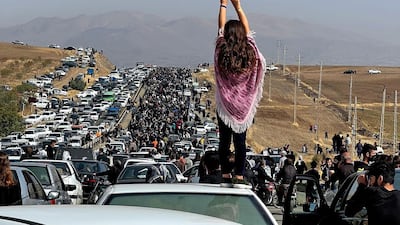
An unveiled woman stands on top of a vehicle as thousands make their way towards Aichi cemetery in Saqez, Mahsa Amini's home town, to mark 40 days since her death. AFP -
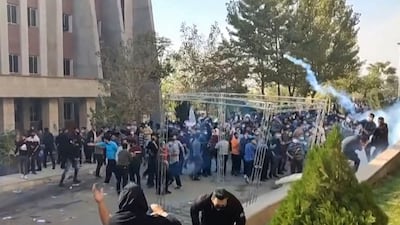
Protesters attempt to dodge projectiles fired at them during clashes at Iran's Islamic Azad University in Tehran. AFP -
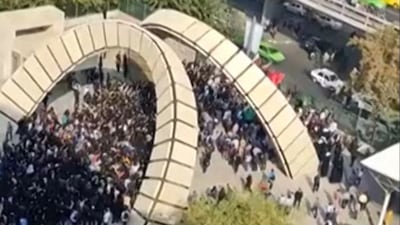
Protesters gather at Amirkabir University of Technology in Tehran. AFP -
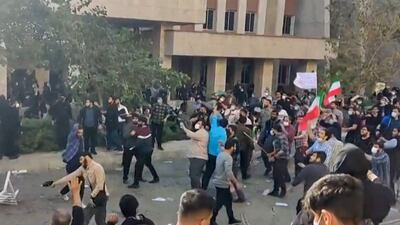
A man, bottom left, fires a weapon during the clashes at Islamic Azad University. AFP -
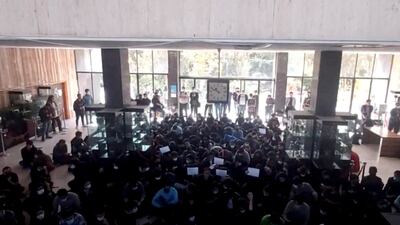
Protesters chant at a vigil for Amini at the entrance of the Khajeh Nasir Toosi University of Technology in Tehran. Reuters -
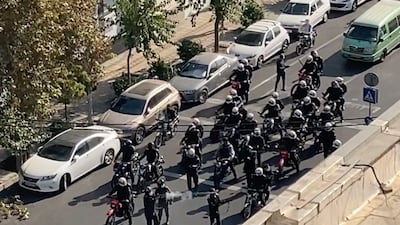
Iranian police arrive to disperse a protest marking 40 days since Amini's death. AP -
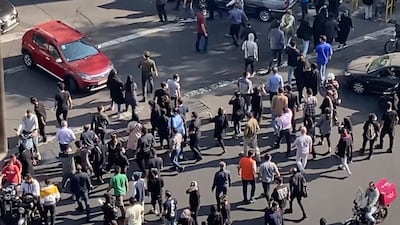
People block an intersection during a protest to mark 40 days since Amini's death. AP -
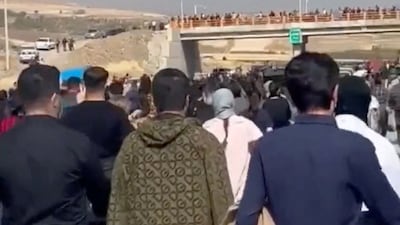
People march down the motorway towards Aichi cemetery near Saqez, where Amini is buried. Reuters -
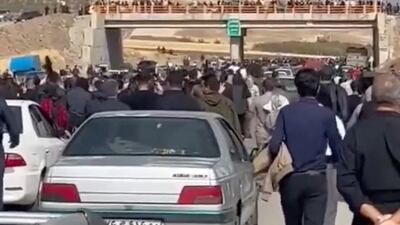
People march towards Aichi cemetary. Reuters -
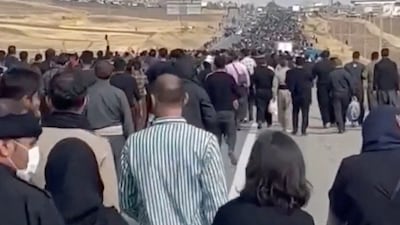
Protesters walk towards the cemetery. Reuters -

A view of demonstrators walking to the cemetery. Reuters -
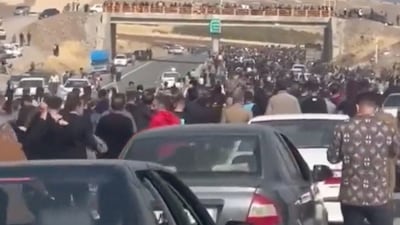
Cars line the street as people march towards the cemetery. Reuters -

Protesters march towards the cemetery 40 days after Amini's death. Reuters



