


Sniffer dogs should be used in airports and hospitals to detect early signs of a pandemic, research suggests.
Trained dogs accurately spotted passengers infected with SARS-CoV-2, the virus responsible for Covid-19, according to a study published in the journal BMJ Global Health, by Prof Anu Kantele at Helsinki University Hospital.
This method of detection is likely to be especially valuable, not only in the early stages of a pandemic when other resources might not yet be available, but also to help contain an continuing pandemic, the researchers suggest.
Dogs have a very keen sense of smell, and can pick up a scent at levels as low as one part per trillion, far exceeding any available mechanical techniques.
It is thought that they are able to detect distinct volatile organic compounds released during various metabolic processes in the body, including those generated by bacterial, viral and parasitic infections.
Prof Kantele told The National how dogs' skills could be used in practice. “As an example, at the airport, the dogs could sniff all incoming passengers and those the dog identifies as positive will be PCR tested.
“It takes two weeks to train a dog if the dog has previous experience as a scent dog. This could provide an extremely valuable tool early in a pandemic.”
Preliminary data suggest that dogs can detect samples from patients with Covid-19 infection with a degree of accuracy comparable to that of a standard PCR nose and throat swab test.
While promising, these lab data results needed to be replicated in real-life conditions. The researchers therefore trained four dogs to sniff out SARS-CoV-2 in the spring of 2020. Each of the dogs had previously been trained to sniff out illicit drugs, dangerous goods or cancer.
To test the dogs’ detection skills, 420 volunteers provided four skin swab samples each. The four dogs each sniffed the skin samples from 114 of the volunteers who had tested positive for SARS-CoV-2 on a PCR swab test and from 306 who had tested negative. The samples were randomly presented to each dog over seven trial sessions.
Overall, the diagnostic accuracy of all samples sniffed was 92 per cent: combined sensitivity (accuracy of detecting those with the infection) was 92 per cent and combined specificity (accuracy of detecting those without the infection) was 91 per cent.
Only minor variation was seen among the dogs.
About 28 of the positive samples came from people who had had no symptoms. Only one was incorrectly identified as negative and two weren’t sniffed, meaning that 25 of the 28 (just over 89 per cent) were correctly identified as positive. The lack of symptoms didn’t seem to affect the dogs’ performance.
The dogs were then put to work sniffing out 303 incoming passengers at Helsinki-Vantaa International Airport, Finland, between September 2020 and April 2021. Each passenger also took a PCR swab test.
The PCR and sniffer results matched in 296 of 303 real-life samples.
Because the prevalence of SARS-CoV-2 among the airport passengers was relatively low (less than 0.5 per cent), 155 samples from people who had tested positive on a PCR swab test were also presented to the dogs.
The dogs correctly identified just under 99 per cent of them as positive.
-
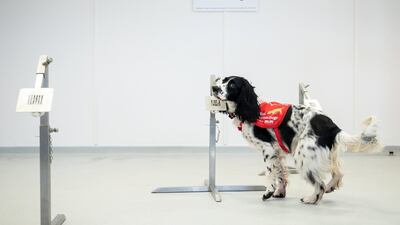
'Freya' detects a sample of malaria from a row of sample pots at the Medical Detection Dogs charity headquarters in Milton Keynes, England. The charity is currently working with the London School of Hygiene and Tropical Medicine to test whether the dogs can be re-trained to detect Covid-19. Getty Images -

An employee releases dogs from a kennel during Covid-19 detection training at the Aeroflot PJSC canine training facility in Moscow, Russia. Getty Images -
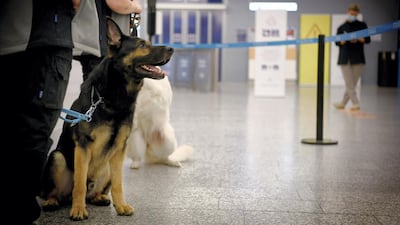
A coronavirus sniffer dog named Valo sits at Helsinki airport in Vantaa, Finland, to check arriving passengers. AFP -
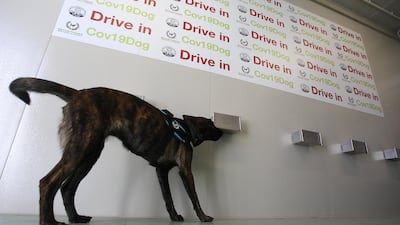
A dog is trained to detect Covid-19 at the Campus Bio-Medico University of Rome, Italy. Getty Images -
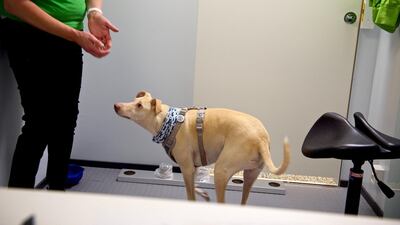
Susanna Paavilainen, executive director at Wise Nose Association, commands one of 10 sniffer dogs trained to detect coronavirus infections at Helsinki airport in Finland. Getty Images -

Members of the Bundeswehr, the German armed forces, train a dog to detect Covid-19 infections in humans at the Bundeswehr centre for dog training in Ulmen, Germany. Getty Images -
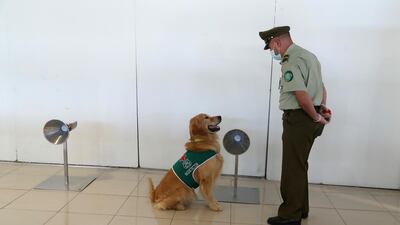
A sniffer dog trained to detect the coronavirus disease works at the international airport of Santiago, Chile. Reuters -
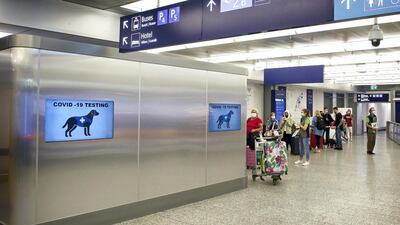
New arrivals at Helsinki airport wait in line for a free Covid-19 test by dogs. Getty Images


The high scores back the use of sniffer dogs for screening, with the aim of excluding people who don’t need a PCR swab test, say the researchers.
And they suggest that “dogs could be used both in sites of high SARS-CoV-2 prevalence, such as hospitals (to pre-screen patients and personnel), as well as in low prevalence sites, such as airports or ports (to pre-screen passengers).” This could save both considerable time and resources, they say.
The researchers acknowledge that dogs trained to sniff out other substances may mistakenly identify these substances as SARS-CoV-2 positive. The required storage period of the training and spiked samples may also have affected the viability of the volatile organic compounds, they say.
A key finding was that the dogs were less successful at correctly identifying the alpha variant as they had been trained to detect the wild type. But this just goes to show how good dogs are at distinguishing between different scents, say the researchers.
“This observation is remarkable as it proves the scent dogs’ robust discriminatory power. The obvious implication is that training samples should cover all epidemiologically relevant variants. Our preliminary observations suggest that dogs primed with one virus type can in a few hours be retrained to detect its variants.”

