


Three metal detector fans have discovered a Roman hoard worth tens of thousands of pounds while spending the weekend camping in south-west England.
The group were staying in a field near the ancient village of Pewsey, in Wiltshire, when they found the treasure trove a mere six paces from where they had pitched their tent.
Robert Abbott, 53, switched on his device after breakfast one morning and very quickly found something.
At first the computer shop owner from Essex, near London, uncovered only discarded metal tent pegs. But he dug a little deeper and hidden below was a valuable silver Roman coin called a siliqua. It is thought to be about 1,600 years old.
His friends David Allen, 59, a carpenter, and Mick Rae, 63, who works in the dairy industry, sprang into action dug up dozens more of the coins.
By the end of the weekend, they had found 161 piece of silver, including siliqua and miliarense coins dating from 340 to 402 AD.
-

A man looks at the Arch of Sptimus Severus in the ancient Roman city of Leptis Magna near the coastal Libyan city of Al Khums, 120km east of Tripoli. All photos: AFP -

Once one of the Roman Empire's most beautiful cities, Leptis Magna now lies neglected and shunned by tourists due to a decade of war. -

Some locals, however, see its potential for rebirth. -

Today, only a handful of visitors, almost all Libyans, wander among the imposing ruins at the Unesco World Heritage site – but locals dream of attracting international tourists once more. -

The remains of the semi-circular theatre and the Chalcidicum, right, beyond which lie the marketplace, the Severan Forum and Basilica, top right. A year-long lull in violence in Libya has sparked hopes the country can now move on. -

Locals hope the ancient ruins will be a huge draw for tourists. -

Azeddine Al Fakih, head of archaeology for Leptis Magna, believes the area could create thousands of jobs, welcome millions of tourists and bring in billions of dollars. -
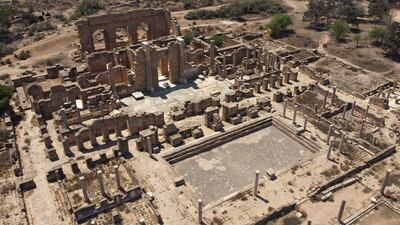
The Hadrianic baths are pictured in the centre. Leptis Magna is a treasure trove for history lovers. -
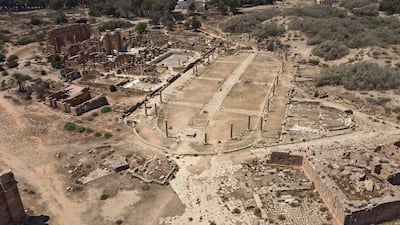
There are historic finds to be discovered at every turn in the city. Here, the Palestre (oblong area for physical exercise) is pictured. -

Fine marble columns line the theatre stage. -

A carved Gorgon head on arches surrounds the Severin forum. -
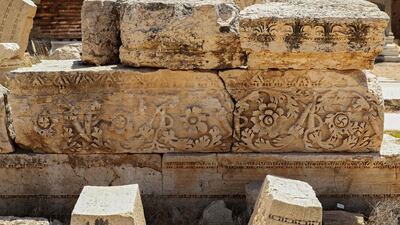
Beautiful, intricate detail can be found on buildings throughout the city.


They stored the loot in their camping washing-up bowl.
“Having finished breakfast first, I turned on my machine – a Minelab Equinox 800 – and having walked around six paces from the tent, I found several tent pegs and, just under the surface, a late Roman silver siliqua in pristine condition,” said Mr Abbott.
“A few moments later, beside it, I found another one.
“Ironically, we had been camping there two weeks previous for a week-long detecting outing. What we hadn’t realised is we’d actually camped right on top of the area where the coins were found.”
The 142 coins are believed to have been buried during the last years of the Roman Empire by people trying to protect their valuables from Saxon raids.
They will go under the hammer at Noonans auction house in Mayfair, London, on May 17, having been discovered in September 2020, after the end of England’s first Covid-19 lockdown.
The hoard is expected to sell for between £30,000 ($37,700) and £40,000.
“Virtually all of the coins are in mint condition and have not even needed to be cleaned since their discovery,” said Nigel Mills, an antiquities expert at Noonans.
“The hoard was buried at a time when Roman rule in Britain under the Emperor Honorius was no longer viable with the army being recalled to protect other provinces.
“In AD 410 Britain was told to protect itself by Honorius.
“As a result, Britain has become a treasure island of late 4th century and early 5th century gold and silver Roman coin and jewellery hoards as the local population buried their valuables and then fell victim to Saxon raids.”
The friends will keep some of their find coins they found and the British Museum, which has studied the coins, will add two of them to its collection.
In recent years, metal detector enthusiasts have made major discoveries in Thetford and Hoxne, in the southern English counties of Norfolk and Suffolk, respectively.

