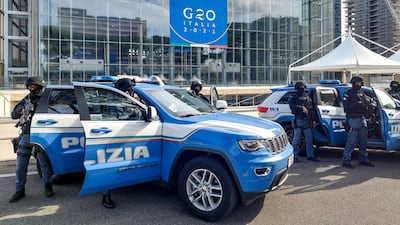
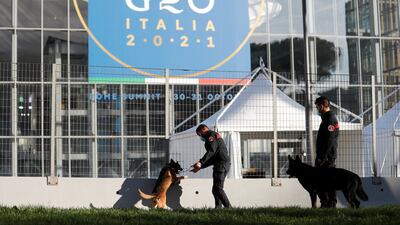
Leaders of the world's biggest economies will meet at a G20 summit in Rome this weekend, in the shadow of the looming Cop26 summit at which the rich world will be expected to lead the way out of the climate crisis.
The G20, which comprises the world’s 20 largest economies, accounts for more than 80 per cent of global carbon emissions and it is being urged, in the words of US President Joe Biden's national security adviser Jake Sullivan, to put “wind in the sails going into Cop26" by making ambitious pledges to go green.
But G20 leaders are meeting amid the additional stresses of soaring fuel prices, resurgent coronavirus outbreaks and supply chain problems that are marring the economic recovery from the pandemic.
The summit in Rome is the first face-to-face meeting of G20 leaders in two years. Heads of government including Mr Biden will then travel to Glasgow for Cop26, which involves about 200 nations.
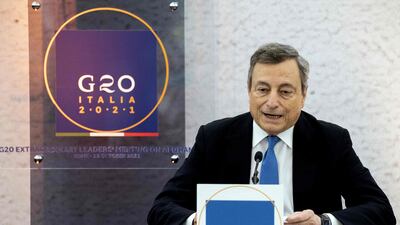
The G20 host, Italian Prime Minister Mario Draghi, will have to manage the competing views of the world's most powerful countries but without the physical presence of the leaders of China, Japan, Mexico, Russia and Saudi Arabia.
Mr Sullivan acknowledged on Thursday that Washington does not “see eye to eye with all G20 participants on everything".
“Really, in the run-up to this G20, it’s been the US and Europe together driving the bus on the significant global issues,” he said.
“And I think you’ll see the US and Europe front and centre at this G20 as we deal with the fact that neither the leaders of Russia nor China will be present in the room in Rome.”
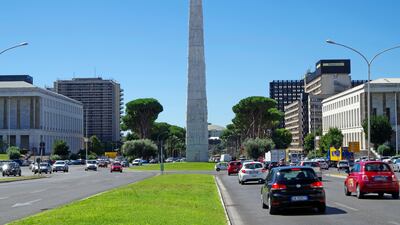
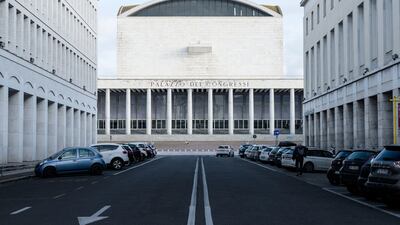
In many ways, the G20 meeting is serving as a Roman holiday preamble to the 12-day Glasgow summit, with the climate dossier taking centre stage at the new convention centre in the Italian capital.
UK Prime Minister Boris Johnson wants to use Cop26 to demonstrate British leadership in the world after Brexit. He hosted a G7 summit in June which was clouded by continuing disputes with the EU.
He acknowledged in a question-and-answer session with children last week that “we might not get the agreements that we need” on climate change.
The Prince of Wales will also join world leaders at the summit this weekend, his office announced. Prince Charles will give the opening address at the summit in Glasgow and has already warned world leaders heading to Cop26 that action is expected of them.
Meanwhile, German Chancellor Angela Merkel will be accompanied by her Finance Minister Olaf Scholz, who is on course to succeed her in the chancellery within weeks.
“The focus of the G20 discussions will be on the global economic situation, pandemic preparation, vaccine coverage, climate financing and of course agreement on a minimum corporate tax,” Mr Scholz's office said on Friday. He has spearheaded efforts to establish such a tax.
One of the trickiest talking points will concern the need for wealthy nations to honour a 2009 pledge to provide the developing world with $100 billion a year to help poorer countries adapt to climate change.
In 2015 they agreed to extend this goal through to 2025 but the target, which some low-income countries and climate activists now say is insufficient, has yet to be met.
“The time has passed for diplomatic niceties. If governments, especially G20 governments, do not stand up and lead this effort, we are headed for terrible human suffering,” UN Secretary General Antonio Guterres said last week.
Rich countries are also split over a specific date to end fossil fuel subsidies, halt international financing of coal projects and phase out coal power altogether.
Mr Draghi, who said talks will also focus on the Covid-19 recovery, said global warming could not be limited without the involvement of the world’s largest economies.
He wants G20 nations at the summit to commit to limiting global warming to 1.5°C, compared with pre-industrial levels.
“We want to achieve a G20 commitment about the need to keep 1.5°C within reach and we want to develop long-term strategies that are consistent with 1.5°C.”
European Commission President Ursula von der Leyen said a show of leadership at both the G20 and Cop26 was required.
“The commitments that will be taken in Rome on climate change will somehow be also, of course, a pacemaker for the Cop26. What we need is, first of all, leadership. We need leadership for credible commitments for decarbonisation to reach the goal of net zero midcentury,” she said.
“But we also need sufficient commitments to really cut the emissions this decade. Science is very clear on that. Science tells us it's urgent. We are not on track right now. It's man-made, climate change. So, because it's man-made, we can do something but we have to act. We have to better deliver.”
Mr Johnson, who has given a relatively downbeat assessment of Cop26's chances of success, has been lobbying leaders to extend their climate ambitions.
Fears over rising energy prices and stretched supply chains are likely to be addressed at the G20, as well as the need for reform of the World Trade Organisation, and G20 leaders are expected to sign off on a minimum global tax rate of 15 per cent for major corporations.
They are also expected to discuss Afghanistan, weeks after a meeting of the leaders saw many pledge additional economic assistance to the country.

Top tips
Create and maintain a strong bond between yourself and your child, through sensitivity, responsiveness, touch, talk and play. “The bond you have with your kids is the blueprint for the relationships they will have later on in life,” says Dr Sarah Rasmi, a psychologist.
Set a good example. Practise what you preach, so if you want to raise kind children, they need to see you being kind and hear you explaining to them what kindness is. So, “narrate your behaviour”.
Praise the positive rather than focusing on the negative. Catch them when they’re being good and acknowledge it.
Show empathy towards your child’s needs as well as your own. Take care of yourself so that you can be calm, loving and respectful, rather than angry and frustrated.
Be open to communication, goal-setting and problem-solving, says Dr Thoraiya Kanafani. “It is important to recognise that there is a fine line between positive parenting and becoming parents who overanalyse their children and provide more emotional context than what is in the child’s emotional development to understand.”
Ten tax points to be aware of in 2026
1. Domestic VAT refund amendments: request your refund within five years
If a business does not apply for the refund on time, they lose their credit.
2. E-invoicing in the UAE
Businesses should continue preparing for the implementation of e-invoicing in the UAE, with 2026 a preparation and transition period ahead of phased mandatory adoption.
3. More tax audits
Tax authorities are increasingly using data already available across multiple filings to identify audit risks.
4. More beneficial VAT and excise tax penalty regime
Tax disputes are expected to become more frequent and more structured, with clearer administrative objection and appeal processes. The UAE has adopted a new penalty regime for VAT and excise disputes, which now mirrors the penalty regime for corporate tax.
5. Greater emphasis on statutory audit
There is a greater need for the accuracy of financial statements. The International Financial Reporting Standards standards need to be strictly adhered to and, as a result, the quality of the audits will need to increase.
6. Further transfer pricing enforcement
Transfer pricing enforcement, which refers to the practice of establishing prices for internal transactions between related entities, is expected to broaden in scope. The UAE will shortly open the possibility to negotiate advance pricing agreements, or essentially rulings for transfer pricing purposes.
7. Limited time periods for audits
Recent amendments also introduce a default five-year limitation period for tax audits and assessments, subject to specific statutory exceptions. While the standard audit and assessment period is five years, this may be extended to up to 15 years in cases involving fraud or tax evasion.
8. Pillar 2 implementation
Many multinational groups will begin to feel the practical effect of the Domestic Minimum Top-Up Tax (DMTT), the UAE's implementation of the OECD’s global minimum tax under Pillar 2. While the rules apply for financial years starting on or after January 1, 2025, it is 2026 that marks the transition to an operational phase.
9. Reduced compliance obligations for imported goods and services
Businesses that apply the reverse-charge mechanism for VAT purposes in the UAE may benefit from reduced compliance obligations.
10. Substance and CbC reporting focus
Tax authorities are expected to continue strengthening the enforcement of economic substance and Country-by-Country (CbC) reporting frameworks. In the UAE, these regimes are increasingly being used as risk-assessment tools, providing tax authorities with a comprehensive view of multinational groups’ global footprints and enabling them to assess whether profits are aligned with real economic activity.
Contributed by Thomas Vanhee and Hend Rashwan, Aurifer
RESULTS
6.30pm: Al Maktoum Challenge Round-1 Group 1 (PA) Dh119,373 (Dirt) 1,600m
Winner: Brraq, Adrie de Vries (jockey), Jean-Claude Pecout (trainer)
7.05pm: Handicap (TB) Dh102,500 (D) 1,200m
Winner: Taamol, Connor Beasley, Ali Rashid Al Raihe.
7.40pm: Handicap (TB) Dh105,000 (Turf) 1,800m
Winner: Eqtiraan, Connor Beasley, Ali Rashid Al Raihe.
8.15pm: UAE 1000 Guineas Trial (TB) Dh183,650 (D) 1,400m
Winner: Soft Whisper, Pat Cosgrave, Saeed bin Suroor.
9.50pm: Handicap (TB) Dh105,000 (D) 1,600m
Winner: Hypothetical, Mickael Barzalona, Salem bin Ghadayer.
9.25pm: Handicap (TB) Dh95,000 (T) 1,000m
Winner: Etisalat, Sando Paiva, Ali Rashid Al Raihe
The%20specs%20
%3Cp%3E%3Cstrong%3EEngine%3A%20%3C%2Fstrong%3E2.0-litre%204cyl%20turbo%0D%3Cbr%3E%3Cstrong%3EPower%3A%20%3C%2Fstrong%3E261hp%20at%205%2C500rpm%0D%3Cbr%3E%3Cstrong%3ETorque%3A%20%3C%2Fstrong%3E400Nm%20at%201%2C750-4%2C000rpm%0D%3Cbr%3E%3Cstrong%3ETransmission%3A%20%3C%2Fstrong%3E7-speed%20dual-clutch%20auto%0D%3Cbr%3E%3Cstrong%3EFuel%20consumption%3A%20%3C%2Fstrong%3E10.5L%2F100km%0D%3Cbr%3E%3Cstrong%3EOn%20sale%3A%20%3C%2Fstrong%3ENow%0D%3Cbr%3E%3Cstrong%3EPrice%3A%20%3C%2Fstrong%3EFrom%20Dh129%2C999%20(VX%20Luxury)%3B%20from%20Dh149%2C999%20(VX%20Black%20Gold)%3C%2Fp%3E%0A
Mercer, the investment consulting arm of US services company Marsh & McLennan, expects its wealth division to at least double its assets under management (AUM) in the Middle East as wealth in the region continues to grow despite economic headwinds, a company official said.
Mercer Wealth, which globally has $160 billion in AUM, plans to boost its AUM in the region to $2-$3bn in the next 2-3 years from the present $1bn, said Yasir AbuShaban, a Dubai-based principal with Mercer Wealth.
“Within the next two to three years, we are looking at reaching $2 to $3 billion as a conservative estimate and we do see an opportunity to do so,” said Mr AbuShaban.
Mercer does not directly make investments, but allocates clients’ money they have discretion to, to professional asset managers. They also provide advice to clients.
“We have buying power. We can negotiate on their (client’s) behalf with asset managers to provide them lower fees than they otherwise would have to get on their own,” he added.
Mercer Wealth’s clients include sovereign wealth funds, family offices, and insurance companies among others.
From its office in Dubai, Mercer also looks after Africa, India and Turkey, where they also see opportunity for growth.
Wealth creation in Middle East and Africa (MEA) grew 8.5 per cent to $8.1 trillion last year from $7.5tn in 2015, higher than last year’s global average of 6 per cent and the second-highest growth in a region after Asia-Pacific which grew 9.9 per cent, according to consultancy Boston Consulting Group (BCG). In the region, where wealth grew just 1.9 per cent in 2015 compared with 2014, a pickup in oil prices has helped in wealth generation.
BCG is forecasting MEA wealth will rise to $12tn by 2021, growing at an annual average of 8 per cent.
Drivers of wealth generation in the region will be split evenly between new wealth creation and growth of performance of existing assets, according to BCG.
Another general trend in the region is clients’ looking for a comprehensive approach to investing, according to Mr AbuShaban.
“Institutional investors or some of the families are seeing a slowdown in the available capital they have to invest and in that sense they are looking at optimizing the way they manage their portfolios and making sure they are not investing haphazardly and different parts of their investment are working together,” said Mr AbuShaban.
Some clients also have a higher appetite for risk, given the low interest-rate environment that does not provide enough yield for some institutional investors. These clients are keen to invest in illiquid assets, such as private equity and infrastructure.
“What we have seen is a desire for higher returns in what has been a low-return environment specifically in various fixed income or bonds,” he said.
“In this environment, we have seen a de facto increase in the risk that clients are taking in things like illiquid investments, private equity investments, infrastructure and private debt, those kind of investments were higher illiquidity results in incrementally higher returns.”
The Abu Dhabi Investment Authority, one of the largest sovereign wealth funds, said in its 2016 report that has gradually increased its exposure in direct private equity and private credit transactions, mainly in Asian markets and especially in China and India. The authority’s private equity department focused on structured equities owing to “their defensive characteristics.”
Jetour T1 specs
Engine: 2-litre turbocharged
Power: 254hp
Torque: 390Nm
Price: From Dh126,000
Available: Now
First Person
Richard Flanagan
Chatto & Windus
Company%20Profile
%3Cp%3E%3Cstrong%3ECompany%20name%3A%3C%2Fstrong%3E%20Cargoz%3Cbr%3E%3Cstrong%3EDate%20started%3A%3C%2Fstrong%3E%20January%202022%3Cbr%3E%3Cstrong%3EFounders%3A%3C%2Fstrong%3E%20Premlal%20Pullisserry%20and%20Lijo%20Antony%3Cbr%3E%3Cstrong%3EBased%3A%3C%2Fstrong%3E%20Dubai%3Cbr%3E%3Cstrong%3ENumber%20of%20staff%3A%3C%2Fstrong%3E%2030%3Cbr%3E%3Cstrong%3EInvestment%20stage%3A%3C%2Fstrong%3E%20Seed%3C%2Fp%3E%0A
Our House, Louise Candlish,
Simon & Schuster
MATCH INFO
Real Madrid 2
Vinicius Junior (71') Mariano (90 2')
Barcelona 0