

As the Hong Kong protests neared the 100-day mark on September 8, a group of demonstrators gathered outside the American consulate waving the US flag and singing The Star-Spangled Banner.
One person carried a sign reading: "President Trump, please liberate Hong Kong".
Later, a group handed consulate staff a letter calling for the speedy passage of the Hong Kong Human Rights and Democracy Act, a piece of legislation currently being looked at in Washington.
The bill, sponsored by Florida Senator Marco Rubio, would strengthen the existing Hong Kong Policy Act. This existing bill commits Washington to treat Hong Kong differently from the rest of China, both politically and economically, as long as the city remains "sufficiently autonomous”.
The new law will add to this by requiring the Secretary of State to certify Hong Kong’s autonomy annually and give the government the ability to impose sanctions and travel bans on those responsible for undermining this.
Leaders of the House Foreign Affairs Committee said they are due to “mark-up” – debate and vote on – the bill next week.
A spokeswoman for the Senate Foreign Relations Committee said they are also working on its version of the legislation, hoping to also hold its mark-up next week.
The United Kingdom handed Hong Kong back to China in 1997 with an agreement to protect the special status of the city under a “one country, two systems” formula. This guarantees freedoms, including an independent legal system. The deal would protect Hong Kong’s special status for 50 years – or until 2047.
Throughout the summer, Hong Kong residents have been demonstrating against the city’s leaders over what they say is an erosion of the city’s special status.
It began in June when leader Carrie Lam tried to pass an extradition agreement with Beijing that critics said would give the mainland the power to demand the arrest and deportation of anyone they chose. The demands widened into anger against the administration in Hong Kong.
While protesters hope the bill will bolster their cause, it has not been welcomed by some of the island’s pro-Beijing politicians and officials who see it as American interference.
“The embrace of Hong Kong’s struggle is the embrace of the idea that America should never hesitate to say that democracy and liberty is morally superior to autocracy & totalitarianism,” Marco Rubio tweeted.
Politicians in the US sympathetic to the protesters' demands are working to support the bill’s passage – including House speaker Nancy Pelosi.
Mr Rubio said in a recent interview that he believes the legislation could pass without opposition in either the House or the Senate.
Prominent Hong Kongers and activists have been travelling to Washington to lobby the legislation and speak about the movement’s demands.
On Tuesday, one of the movement’s most recognisable faces gave evidence to the US Congressional-Executive Commission on China.
-

A protester walks before a barricade they set on fire in the Wan Chai district in Hong Kong. Chaos engulfed Hong Kong's financial heart on August 31 as police fired tear gas and water cannon at petrol bomb-throwing protesters. AFP -

A protester throws a molotov cocktail towards police in the Admiralty area of Hong Kong. AFP -

Police fire tear gas at Causeway Bay district in Hong Kong on August 31. AFP -

Police run past debris set alight by protesters in the Causeway Bay area of Hong Kong. AFP -

A woman holds a cross in front of the Mongkok Police Station as riot police holding shields stand guard during a standoff with protesters after an anti-government rally in Hong Kong. Getty Images -

Protesters stand before a barricade they set on fire in the Wan Chai district in Hong Kong. AFP -

Protesters react after police fired tear near the government headquarters of Hong Kong. AFP -

Protesters react after police fired tear near the government headquarters of Hong Kong. AFP -

Police fire a water cannon towards protesters near the government headquarters in Hong Kong. AFP -

Protesters react after police fired tear gas outside the government headquarters in Hong Kong. AFP -

Riot police patrol outside the airport in Hong Kong. AP


"I hope, the US government could reveal its foreign policy to China to prioritise human rights issues, especially now we are not only suffering in a political but also a humanitarian crisis,” Joshua Wong said.
"This is not a plea for so-called foreign interference. This is a plea for democracy," singer and activist Denise Ho, who joined Mr Wong, told legislators.
Beijing criticised the pair’s appearance, warning against efforts to “disrupt Hong Kong with foreign support”.
“At the same time, we have to warn certain people, who engage in anti-China activities in order to disrupt Hong Kong with foreign support, that all their efforts are futile and destined to fail,” Foreign Ministry spokesman Geng Shuang said on Wednesday.
He also warned the US not to meddle in internal affairs.
The authorities in Hong Kong have also pushed back against the pair’s claims about human right’s violations and police brutality, saying they are “serious and unfounded.”
-
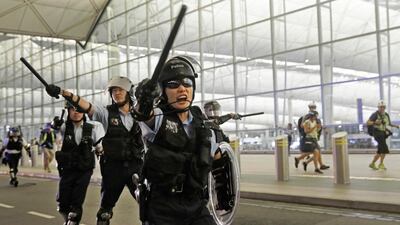
Policemen with batons and shields shout at protesters during a demonstration at the airport in Hong Kong. AP Photo -
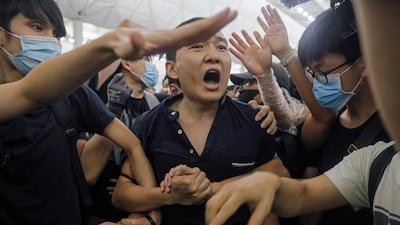
Protesters detain a man, who they claimed was a Chinese undercover agent during a demonstration at the airport in Hong Kong. AP Photo -
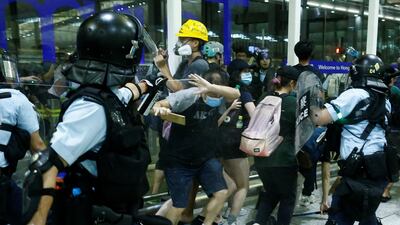
A police officer sprays pepper spray at anti-government protesters during clashes at the airport in Hong Kong. Reuters -
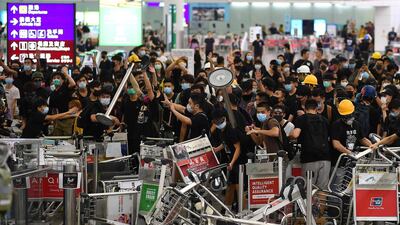
Pro-democracy protestors block the entrance to the airport terminals with luggage trollies after a scuffle with police at Hong Kong's international airport. AFP -
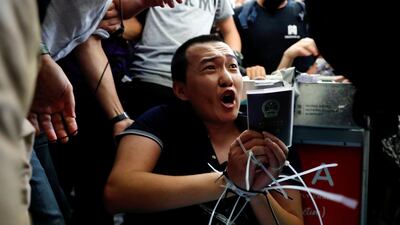
Fu Guohao, a reporter with Chinese media Global Times website, is tied up by protesters during a mass demonstration at the Hong Kong international airport. Reuters -
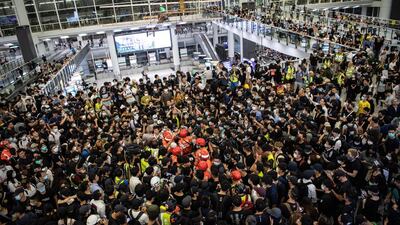
Anti-government protesters surround a man they accuse of being a mainland Chinese police officer during a sit-in against police violence in Hong Kong Chek Lap Kok International Airport. EPA -

Police clash with anti-government protesters at the airport in Hong Kong. Reuters -

Hundreds of flights were cancelled or suspended at Hong Kong's airport on August 13 as pro-democracy protesters staged a second disruptive sit-in at the sprawling complex, defying warnings from the city's leader who said they were heading down a "path of no return". AFP -

Policemen arrest a protester during a clash at the airport in Hong Kong. AP Photo -
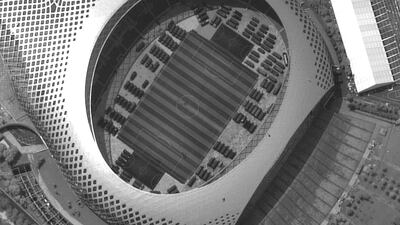
A satellite image captured on Monday, August 12, 2019, appears to show Chinese security force vehicles inside the Shenzen Bay Sports Center in the southern Chinese city of Shenzhen, bordering Hong Kong. Provided by Satellite image ©2019 Maxar Technologies via AP -
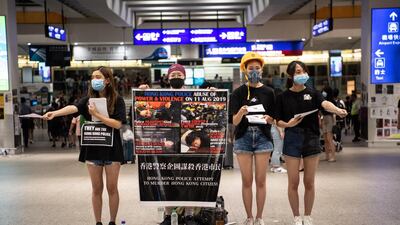
Protesters hand out flyers during a sit-in against police violence in Hong Kong Chek Lap Kok International Airport. EPA -
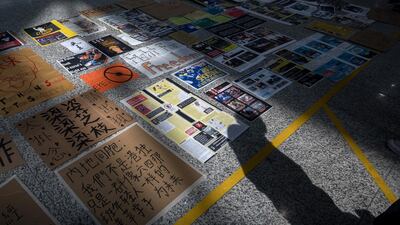
Placards and signs sit on the arrival hall floor at Hong Kong International Airport. Bloomberg -
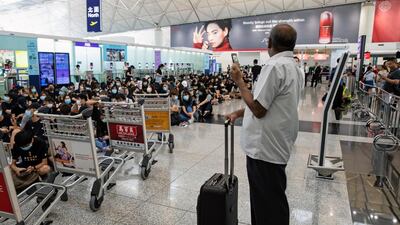
A passenger stands with his luggage as demonstrators block a departure hall during the protest at the Hong Kong International Airport. Bloomberg -

Travellers speak to Cathay Pacific Airways employees at the company's check-in counter at the Hong Kong International Airport. Bloomberg -

Airport staff help travellers near the departure gate at the airport in Hong Kong. AP Photo -

Travellers check in on their flights at the airport in Hong Kong. AP Photo -
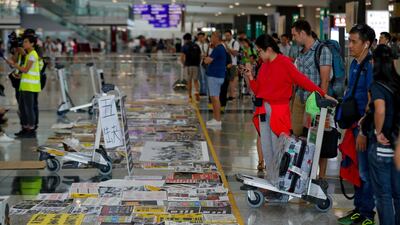
Travellers look at placards and posters placed by protesters at the airport in Hong Kong. AP Photo -
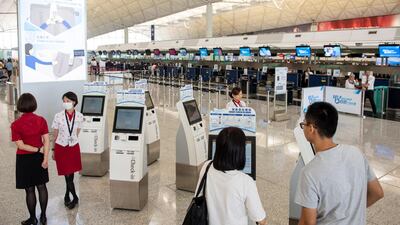
Passengers line up at check-in counters at Hong International Airport. EPA -

People walk at Hong Kong International Airport, in Hong Kong, China. EPA -

Travellers queue and wait in front of check-in counters at Hong Kong International Airport. Bloomberg


A police spokesman said that human rights in Hong Kong were protected under the Basic Law, and that police had handled anti-government protests in the city over the past three months with restraint, the South China Morning Post reported.
Some Hong Kongers say the bill would be a good start but are worried about how potential sanctions – if they are ever applied – could impact their city.
"If sanctions are really imposed, these officials will be publicly shamed internationally and, as such, punished in this way," one young resident of Hong Kong told The National.
"However, I am not convinced whether imposing sanctions on government officials, for example freezing their assets in US or not allowing them to go to US, would be a major help to the situation in Hong Kong because it might not matter to the official whether he/she can go to US or not," she added.
On Tuesday a new pressure group in Washington, the Hong Kong Democracy Council, was launched to give the largely leaderless movement back home a voice in the US.
"We are unified in the belief that the US has a moral and political obligation to preserve Hong Kong's basic freedoms and autonomy while protecting vital US national security and economic interests, including the 85,000 Americans based in Hong Kong," said Samuel Chu, HKDC’s managing director.
“We are committed to being the 'umbrella' group who will provide an independent platform for all pro-democracy, pro-Hong Kong voices in the US and in Hong Kong,” he added.
But China has denied allegations that it's meddling in Hong Kong and accused foreign powers – especially Britain and the US – of fuelling the unrest.
Like the demonstrators waving the US flag, so too have others waved the Union Flag of the UK.
The American bill enjoys bipartisan support across both houses, but it is unclear how it will be received by President Donald Trump.
Mr Trump and Chinese President Xi Jinping are currently in talks to find an end their protracted trade war.
The US President has suggested China should "humanely" settle the months-long protests before a trade deal is reached.
There is a chance that Mr Trump may also seek to neuter the bill so as not to rock relations with Beijing.
But Mr Rubio is convinced the bill will be signed into law by the president.
“The White House has indicated that they would sign it,” he told The Atlantic. In any case, Mr Rubio said, the bill is likely to pass with enough votes to make a presidential veto impossible.
But there are fears in Hong Kong that the bill will have an unintended consequence that could erode the special status of the city. The bill could lead the US to revoke Hong Kong’s special trading status, which could – in turn – devastate the city’s economy.
"I am worried China will let this happen," the young Hong Konger said. "I hope that the Chinese government realises that Hong Kong is a region that is part of China but also has its own unique characteristics, as it is a common law legal system and a free market.
"I hope that China will not erode Hong Kong’s autonomy."

