

US President Joe Biden's administration is conducting a review into possible war crimes committed in Ethiopia’s Tigray region, a senior official told Congress on Thursday.
“We have a fact-based review under way that is being conducted very quickly and the secretary of state will have the final determination,” Robert Godec, acting assistant secretary of state for African affairs, told the Senate foreign relations committee.
Washington takes “extremely seriously" comments by UN Commissioner for Human Rights Michelle Bachelet on "atrocities that may well amount to war crimes or crimes against humanity”, Mr Godec said.
He said it also took great notice of comments by the patriarch of the Ethiopian Orthodox Church, Abune Mathias, “who has termed the conflict a ‘genocide’ against the Tigrayan people".
Fighting in the region is approaching its eighth month and the humanitarian situation continues to deteriorate.
Ethiopian and Eritrean troops, along with allied militias, began an offensive in November against the Tigray People's Liberation Front.
The fighting has displaced about two million people and left 5.2 million in urgent need, the UN says.
Human rights organisations such as Doctors without Borders and Amnesty International have documented cases of sexual violence, extrajudicial killings and massacres, as well as the use of starvation as a weapon.
“We are acutely aware of the need to determine whether the conduct meets the legal standard for atrocities or war crimes,” Mr Godec said.
The chairman of the committee, Bob Menendez, said: “We believe in fact these are war crimes. We cannot turn blindly away when such things happen in the world.”
Cameron Hudson, a senior fellow with the Atlantic Council's Africa Centre, said a war crimes conclusion by the US government would go a long way in increasing pressure on Ethiopian Prime Minister Abiy Ahmed.
"The idea of the US leading a 'fact-based' examination of war crimes, as it has done in places like Darfur and Myanmar, suggests an effort to push back on Ethiopia's official narrative about what started the conflict in Tigray and what is happening there now," Mr Hudson told The National.
Mr Ahmed, a Nobel laureate, has called the military push by his government “a law-enforcement operation".
“By challenging that official narrative, Washington is putting itself on a collision course with Addis Ababa that is likely to result in efforts to impose a UN arms embargo and possibly an International Criminal Court investigation,” Mr Hudson said.
The Biden administration has changed its tone on Tigray in recent weeks.
After months of quiet diplomacy and calls for Eritrean troops to withdraw, the US imposed sanctions last week and a presidential statement was made on Wednesday night.
“With President Joe Biden's statement, the US has now signalled a new approach to Ethiopia, one that not only reflects the lies and crimes being committed in Tigray, but that now calls into question the overall legitimacy of coming elections [on June 21], Abiy's mandate and the integrity of the Ethiopian state,” Mr Hudson said.
-

Tigrayan refugees wait in line to receive food from Muslim Aid at Hamdeyat Transition Center near the Sudan-Ethiopia border, eastern Sudan, on Wednesday. AP -

Janez Lenarcic, fifth right, the European Commissioner for Crisis Management, arrives to visit Um Raquba camp for Ethiopian refugees who fled the Tigray conflict, in eastern Sudan's Gedaref state on December 3, 2020. AFP -
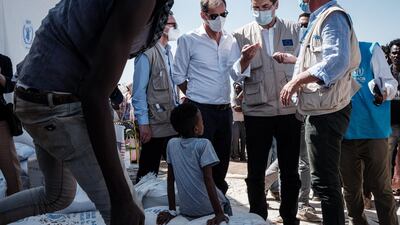
Janez Lenarcic, second right, the European Commissioner for Crisis Management, arrives to visit Um Raquba reception camp for Ethiopian refugees who fled the Tigray conflict, in eastern Sudan's Gedaref state on December 3, 2020. AFP -
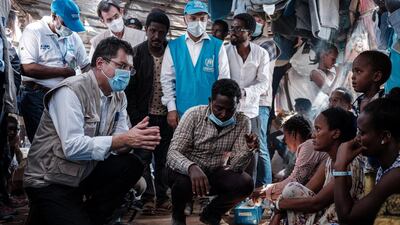
Janez Lenarcic, left, the European Commissioner for Crisis Management, speaks with Ethiopian refugees who fled the Tigray conflict during his visit to Um Raquba reception camp in Sudan on December 3, 2020. AFP -
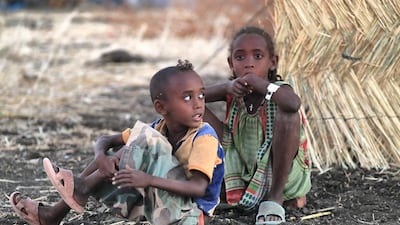
Ethiopian children sit outside their family's tent at Um Raquba refugee camp in Gedaref, eastern Sudan, on January 6, 2021. AFP -
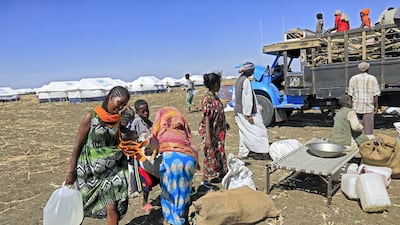
Ethiopian refugees, who fled the Tigray conflict, gather their belongings upon their arrival at the Tenedba camp in Mafaza, eastern Sudan on January 8, 2021. AFP -
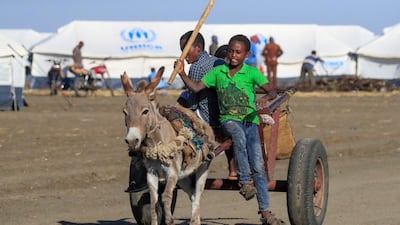
Ethiopian refugees, who fled the Tigray conflict, at the Tenedba camp in Mafaza, eastern Sudan on January 8, 2021. AFP -
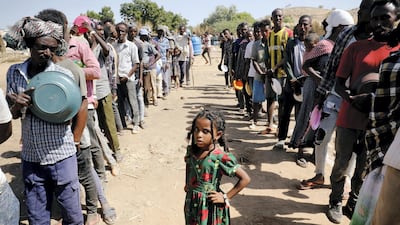
Ethiopian refugees wait in line for a meal at Sudan's Um Raquba camp which houses Ethiopian refugees who fled the fighting in the Tigray region, November 28, 2020. Reuters -
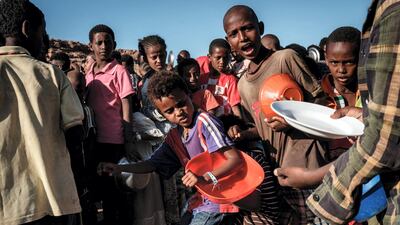
Ethiopian refugee children who fled the Tigray conflict have a play-fight as they wait for food from Muslim Aid at the Um Raquba camp in eastern Sudan's Gedaref state on December 12, 2020. AFP -
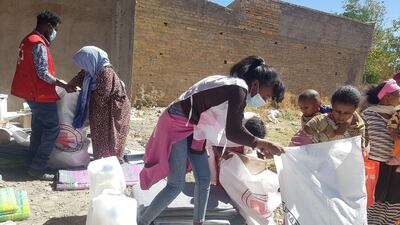
Red Cross workers and volunteers distribute supplies to civilians in the Tigray region of Ethiopia, January 6, 2021. Reuters


Mr Biden called for a ceasefire and the withdrawal of Eritrean forces.
“All parties, in particular the Ethiopian and Eritrean forces, must allow immediate, unimpeded humanitarian access to the region in order to prevent widespread famine,” he said.
Sarah Charles, assistant to the administrator of the US Agency for International Development Bureau for Humanitarian Assistance, said told Congress the situation was increasing the risk of famine in the region.
“By blocking food assistance deliveries and preventing farmers from accessing their agricultural land to plant and harvest, the armed actors are actively exacerbating the risk of famine in Tigray,” Ms Charles said.
She told of intentional attacks on humanitarian staff to block aid from arriving in the region, including the killing of a USAid partner staff member and seven other humanitarian workers during the conflict.
Jeffrey Feltman, US envoy to the Horn of Africa, will be returning to the region on a second trip next week and his itinerary will include stops in Gulf countries including the UAE.
“The Emiratis have been involved in negotiations previously and successfully," Mr Godec said.
"They have played an important role and what is critical is they use all the influence that they got to end the conflict."

