Hundreds of protesters gathered outside the US State Department in Washington on Thursday to demand an end to the humanitarian crisis in Ethiopia’s Tigray region, where the UN has documented hundreds of cases of gender-based violence and other human rights abuses.
The protest at the agency took place on the same day an Ethiopian governmental delegation was due to arrive.
Other Tigray demonstrations were held across the US this week in New York, Colorado and Florida, among others.
The Ethiopian government under Prime Minister Abiy Ahmed, with the help of Eritrean troops and allied militias, launched a military offensive against the Tigray People's Liberation Front in November.
Since then, more than two million civilians have been internally displaced and 5.2 million people in Tigray are in urgent need of food aid.
Mahlet Woldemariam, who left work to join Thursday's protest, said she wanted to bring attention to the worsening situation in the region.
“There’s a genocide ongoing, friends and family are at the brink of death because of weaponised starvation, women are being raped,” she said.
Ms Woldermariam told The National that the Ethiopian government, aided by militias, had looted and ransacked her uncles' farms in Tigray in a campaign of weaponised starvation.
The UN now estimates 350,000 people in Tigray are facing famine, including 30,000-plus children that are now considered malnourished.
Human rights organisations such as Oxfam, Doctors Without Borders and Amnesty International have reported aid restrictions as well as attacks on medical facilities and food sources in the region.
These organisations have also reported incidents of sexual violence, extrajudicial killings and massacres.
Thursday's protest was attended by members of the Ethiopian Orthodox Church, who said Christians in the region have suffered greatly during the conflict.
Kiflemariam Gebreselassie, an Orthodox priest, told The National he was protesting against attacks that have occurred on priests in Tigray.
-

Demonstrators gather in Washington to protest Ethiopian actions in Tigray. Joshua Longmore/The National -
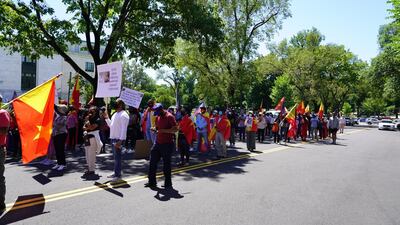
Protesters gather at the State Department in Washington to demostrate against arrival of Ethiopian government delegation. Joshua Longmore/The National -

The Ethiopian government delegation was to meet the US Horn of Africa envoy, Jeffrey Feltman. Joshua Longmore/The National -
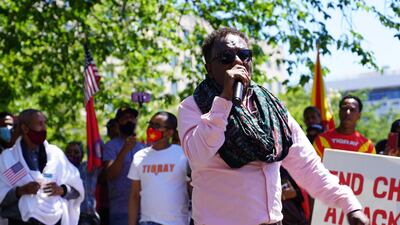
Protesters say the Ethiopian government, Eritrean troops and allied militias are carrying out a 'genocide' in Tigray. Joshua Longmore/The National -
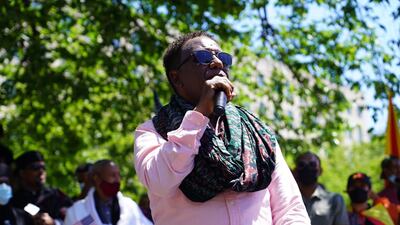
Members of the Ethiopian Orthodox Church say priests have been attacked in Tigray. Joshua Longmore/The National -
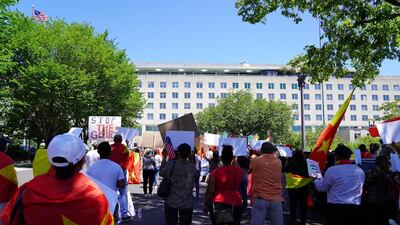
Similar protests have taken place in New York, Colorado and Florida this week. Joshua Longmore/The National


Abune Mathias, patriarch of the Ethiopian Orthodox Church, said last month he believes a "genocide" is happening in the region.
Michael McCaul, the top Republican congressman on the House Foreign Affairs Committee, on Wednesday also raised the question as to whether conditions in Tigray amounted to a genocide.
In its latest report on the region, the UN Office for the Co-ordination of Humanitarian Affairs on Thursday stated that “the security and access situation in Tigray remains complex and extremely fluid, with active hostilities impeding people’s access to aid and the movement of aid workers".
The UN agency said “more than 500 cases of gender-based violence, including rape" were reported in May, with “about 70" cases perpetrated against girls under 18.
The US and EU have been pressuring Mr Abiy's government to remove all aid restrictions, ensure the withdrawal of Eritrean forces and enforce a ceasefire.
At the State Department, the US special envoy for the Horn of Africa, Jeffrey Feltman, met the Ethiopian delegation, which included Special Adviser to the Prime Minister Mamo Mehretu and Tekeda Alemu, the former state minister of foreign affairs.
Mr Abiy has yet to follow through with his commitment from last February to ensure the withdrawal of Eritrean forces from Tigray.

