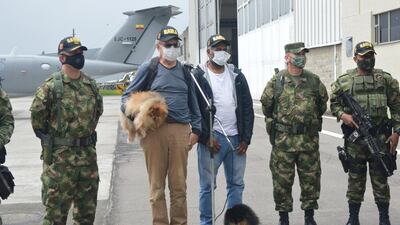
Two travellers from Switzerland and Brazil who were kidnapped along with their pet dogs by dissident rebels in Colombia have been rescued by the military after three months in captivity.
Daniel Max Guggenheim and Jose Iban Alburqueque and their two Pomeranians were freed after soldiers got wind of their location and chased after the man who was guarding them.
The men were described as healthy but said they endured a hellish ordeal that included long hours in cold temperatures and the ridicule of rebels who poked fun at them for traveling together.
“It’s something one suffers more in the heart than the body,” Mr Guggenheim said as he clutched one of his dogs after being brought to a military airport in the capital, Bogota. “It has given me nightmares.”

In mid-March, when Colombia started instituting a nationwide quarantine, the two men were in the Pacific port city of Buenaventura, an area with a long history of drug violence that has begun to attract tourists in more recent years. They decided to make their way back to Bogota using a smartphone to help determine the fastest route.
The journey took them through Corinto, in the Cauca department, where they decided to stop and rest, Mr Guggenheim said. Shortly after continuing onward, they were stopped by two men on motorcycles.
One put a gun to a window of their vehicle.
“You’ve arrived at the cemetery,” he told them.
The rebels identified themselves as dissidents of the former Revolutionary Armed Forces of Colombia — the group that signed a peace accord in 2016 — and took them to a nearby area where coffee beans were being dried. The rebels took the keys of their car and began rummaging through their suitcases.
Eventually the men were taken to a home where they were held in a room for four days. The rebels demanded tens of millions in pesos, but Mr Guggenheim said he had just $3,600 (Dh13,220). Unsatisfied, the rebels called Mr Guggenheim’s daughter, asking for more.
In all the men were held in 11 different locations, Mr Guggenheim said. While they were often cold, he said they were given food and never physically harmed. The rebels even went to a nearby town to buy dry food for their dogs, one of which is a 13-year-old purebred Pomeranian that Mr Guggenheim has had since a puppy.
“We survived,” he said, talking through a face mask. “It’s been more than a month and a half since we spoke to our families. It was hard.”
Most of 11,000 Colombian rebels who signed the peace accord to end Latin America’s longest-running conflict are now living as civilians, but a small number who defected or never joined the agreement are still battling the government.
The Pacific coast region including Buenaventura has seen a rise in violence as the Farc dissidents, the National Liberation Army guerrilla group and drug gangs compete for lucrative trafficking routes.
Mr Guggenheim said he harbours no ill will toward Colombia.
“A million thanks to Colombia,” he said. “I love the country in spite of everything."

