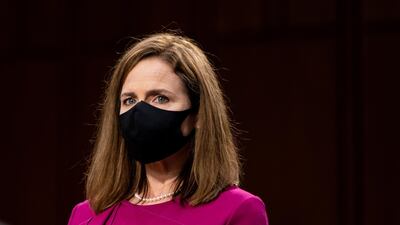
Judge Amy Coney Barrett attends first day of her Senate confirmation hearing to the Supreme Court on Capitol Hill in Washington, DC, USA, 12 October 2020. EPA

Amy Coney Barrett's Supreme Court confirmation hearings begin, despite coronavirus risk


  • English
  • Arabic

The risk of Covid-19 hung over Monday's opening of Amy Coney Barrett's US Supreme Court confirmation hearings, with the Senate hearing room including her children and at least one politician who tested positive.

President Donald Trump formally nominated Ms Barrett at a packed White House ceremony on September 26.

Days later, Mr Trump and several White House advisers tested positive for the respiratory disease that has killed almost 220,000 people in the US.

Senator Kamala Harris, a judiciary committee member and the vice presidential nominee on the Democratic ticket challenging Mr Trump in the November 3 election, said the hearing should have been postponed after the recent spate of infections.

Republican Senator Mike Lee, one of two Senate judiciary committee members to test positive, attended the hearing in person on Monday.

"I feel great," Mr Lee, wearing a blue surgical mask, said as he entered the hearing room on Monday, nine days after disclosing his positive test, which normally would mean a quarantine period of 10 to 14 days.

Mr Lee took off his mask to deliver his opening statement to an audience that included some of the oldest members of the Senate, and Ms Barrett's husband, children and siblings.

Democrats and many public health experts have condemned Mr Trump for his handling of a pandemic that has killed more people in the US than any other country.

Ms Harris, who spoke by videolink, said the panel had been reckless as Republicans moved to confirm Ms Barrett before the election.

"This committee has ignored common-sense requests to keep people safe – including not requiring testing for all members – despite a coronavirus outbreak among senators of this very committee," she said.

Mr Trump's nomination of Ms Barrett to replace the late liberal judge Ruth Bader Ginsburg just weeks before the election enraged Democrats.

The Republicans had refused to consider a nominee from Democratic president Barack Obama about 10 months before the 2016 election.

Senator Lindsey Graham, the committee's Republican chairman and a close ally of Mr Trump, insisted that enough had been done to protect those at the hearing.

"We've set up a room in a fashion where we can safely do our business," Mr Graham said.

His Senate re-election debate was cancelled on Friday after he refused to be tested for coronavirus.

Opinion polls show that Mr Graham is in a tight race to win a fourth term as a South Carolina senator.

He said he had been tested a week before the debate, repeating that every safety precaution had been taken.

"I'm not going to be told to be tested by political opponents," Mr Graham said.

"I'm going to be tested as an individual when the CDC [US Centres for Disease Control and Prevention] requires it."

The other Republican committee member to test positive after the September 26 event, Thom Tillis, was not at the hearing.

Mr Tillis had announced that he would be among senators taking part online on Monday, but was expected to appear in person later in the week.

Ms Barrett removed her mask at least once while Mr Lee was speaking, to take a sip of water.

The vast hearing room in the Hart Senate Office Building is the largest in the sprawling Capitol complex, where 20,000 people work and thousands more visit on a normal weekday.

Ms Barrett's children were also at the September 26 event.

The Indiana private school they attend reported less than two weeks after the Rose Garden ceremony that at least two pupils and a teacher had tested positive.

The Washington Post  reported Ms Barrett tested positive this year but has since recovered.

The White House has declined comment.

Tank warfare

Lt Gen Erik Petersen, deputy chief of programs, US Army, has argued it took a “three decade holiday” on modernising tanks. 

“There clearly remains a significant armoured heavy ground manoeuvre threat in this world and maintaining a world class armoured force is absolutely vital,” the general said in London last week.

“We are developing next generation capabilities to compete with and deter adversaries to prevent opportunism or miscalculation, and, if necessary, defeat any foe decisively.”

Who's who in Yemen conflict

Houthis: Iran-backed rebels who occupy Sanaa and run unrecognised government

Yemeni government: Exiled government in Aden led by eight-member Presidential Leadership Council

Southern Transitional Council: Faction in Yemeni government that seeks autonomy for the south

Habrish 'rebels': Tribal-backed forces feuding with STC over control of oil in government territory

Classification of skills

A worker is categorised as skilled by the MOHRE based on nine levels given in the International Standard Classification of Occupations (ISCO) issued by the International Labour Organisation. 

A skilled worker would be someone at a professional level (levels 1 – 5) which includes managers, professionals, technicians and associate professionals, clerical support workers, and service and sales workers.

The worker must also have an attested educational certificate higher than secondary or an equivalent certification, and earn a monthly salary of at least Dh4,000. 

Paatal Lok season two

Directors: Avinash Arun, Prosit Roy 

Stars: Jaideep Ahlawat, Ishwak Singh, Lc Sekhose, Merenla Imsong

Rating: 4.5/5

Mobile phone packages comparison
The lowdown

Rating: 4/5

Ten tax points to be aware of in 2026

1. Domestic VAT refund amendments: request your refund within five years

If a business does not apply for the refund on time, they lose their credit.

2. E-invoicing in the UAE

Businesses should continue preparing for the implementation of e-invoicing in the UAE, with 2026 a preparation and transition period ahead of phased mandatory adoption. 

3. More tax audits

Tax authorities are increasingly using data already available across multiple filings to identify audit risks. 

4. More beneficial VAT and excise tax penalty regime

Tax disputes are expected to become more frequent and more structured, with clearer administrative objection and appeal processes. The UAE has adopted a new penalty regime for VAT and excise disputes, which now mirrors the penalty regime for corporate tax.

5. Greater emphasis on statutory audit

There is a greater need for the accuracy of financial statements. The International Financial Reporting Standards standards need to be strictly adhered to and, as a result, the quality of the audits will need to increase.

6. Further transfer pricing enforcement

Transfer pricing enforcement, which refers to the practice of establishing prices for internal transactions between related entities, is expected to broaden in scope. The UAE will shortly open the possibility to negotiate advance pricing agreements, or essentially rulings for transfer pricing purposes. 

7. Limited time periods for audits

Recent amendments also introduce a default five-year limitation period for tax audits and assessments, subject to specific statutory exceptions. While the standard audit and assessment period is five years, this may be extended to up to 15 years in cases involving fraud or tax evasion. 

8. Pillar 2 implementation 

Many multinational groups will begin to feel the practical effect of the Domestic Minimum Top-Up Tax (DMTT), the UAE's implementation of the OECD’s global minimum tax under Pillar 2. While the rules apply for financial years starting on or after January 1, 2025, it is 2026 that marks the transition to an operational phase.

9. Reduced compliance obligations for imported goods and services

Businesses that apply the reverse-charge mechanism for VAT purposes in the UAE may benefit from reduced compliance obligations. 

10. Substance and CbC reporting focus

Tax authorities are expected to continue strengthening the enforcement of economic substance and Country-by-Country (CbC) reporting frameworks. In the UAE, these regimes are increasingly being used as risk-assessment tools, providing tax authorities with a comprehensive view of multinational groups’ global footprints and enabling them to assess whether profits are aligned with real economic activity. 

Contributed by Thomas Vanhee and Hend Rashwan, Aurifer

All%20We%20Imagine%20as%20Light
%3Cp%3E%3Cstrong%3EDirector%3A%20%3C%2Fstrong%3EPayal%20Kapadia%3C%2Fp%3E%0A%3Cp%3E%3Cstrong%3EStarring%3A%3C%2Fstrong%3E%20Kani%20Kusruti%2C%20Divya%20Prabha%2C%20Chhaya%20Kadam%3C%2Fp%3E%0A%3Cp%3E%3Cstrong%3ERating%3A%3C%2Fstrong%3E%204%2F5%3C%2Fp%3E%0A
The five pillars of Islam

1. Fasting 

2. Prayer 

3. Hajj 

4. Shahada 

5. Zakat
