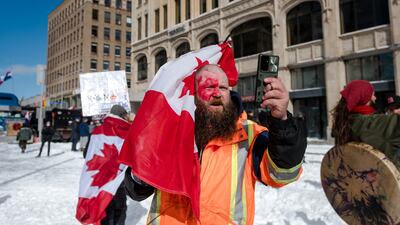
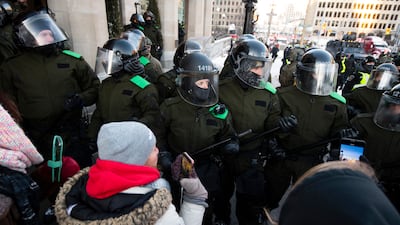
Canada's Prime Minister Justin Trudeau enacted the Emergencies Act after hundreds of vehicles blockaded the streets of Ottawa for three weeks. Reuters

Trudeau lifts emergency powers after end of lorry blockade


  • English
  • Arabic

The Canadian government is lifting the emergency powers it enacted more than a week ago to bring street protests under control, with Prime Minister Justin Trudeau saying the unprecedented authority is no longer needed.

His government invoked the never-before-used Emergencies Act after hundreds of lorries and other heavy vehicles blockaded the centre of Canada’s capital of Ottawa for three weeks. The demonstration sparked offshoots that shut down key border crossings, including the Ambassador Bridge to Detroit.

“Today, after careful consideration, we’re ready to confirm that the situation is no longer an emergency,” Mr Trudeau said alongside his attorney general and other top ministers on Wednesday.

“We are confident that existing laws and bylaws are now sufficient to keep people safe.”

The legislation gave authorities the financial tools to cut off funding to the protesters and compel towing firms to clear out the vehicles, among other measures.

Canadian banks froze about C$7.8 million ($6.1m) in a little more than 200 accounts under the emergency powers, government officials told members of Parliament on Tuesday.

At the weekend, police sourced from across the country cleared Ottawa’s streets of vehicles and protesters, although some demonstrators relocated to encampments outside the city. Mr Trudeau said police now believe they have the situation under control.

The Emergencies Act allows authorities to declare certain areas no-go zones, allows police to freeze drivers’ and their supporters' personal and corporate bank accounts, and compels towing companies to haul away vehicles.

The prime minister announced he was invoking the emergency powers on February 14 and they were formally enacted the next day. The 34-year-old legislation gave federal officials sweeping authority to handle an emergency that they said lower levels of government couldn’t handle under existing laws.

The Canadian Civil Liberties Association and other groups have already challenged the use of the emergency law in court, arguing the driver-led protest against vaccine mandates and other Covid-19 restrictions doesn’t meet the threshold.

Mr Trudeau, however, had been coming under increasing public pressure to take action after Ottawa’s municipal police force showed itself to be either unwilling or incapable of cracking down on demonstrations and removing vehicles from the streets.

Ottawa’s police chief resigned the day the emergency powers came into effect.

Agencies contributed to this report

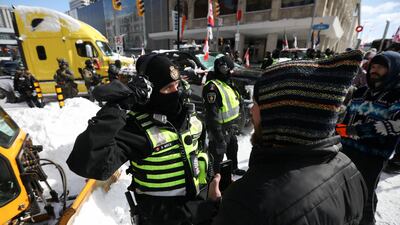
  • A man stands in front of a police officer as lorry drivers and supporters continue to protest against Covid-19 vaccine mandates, in Ottawa, Canada. Reuters
    A man stands in front of a police officer as lorry drivers and supporters continue to protest against Covid-19 vaccine mandates, in Ottawa, Canada. Reuters
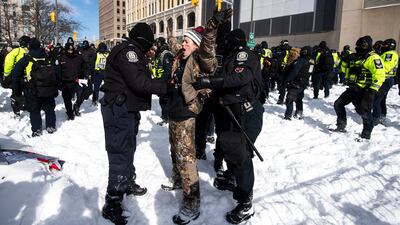
  • A protester sings 'O Canada' as she is arrested after trying to push through a line of police officers. AP
    A protester sings 'O Canada' as she is arrested after trying to push through a line of police officers. AP
  • A protest lorry is towed. AFP
    A protest lorry is towed. AFP
  • Police hold a line as they work to bring a protest to an end. AP
    Police hold a line as they work to bring a protest to an end. AP
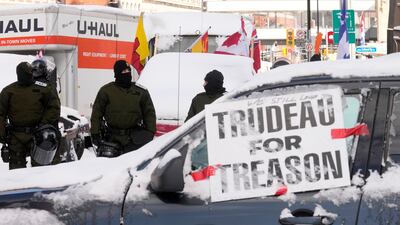
  • Police make an arrest. AP
    Police make an arrest. AP
  • A protester kneels in front of police officers. Reuters
    A protester kneels in front of police officers. Reuters
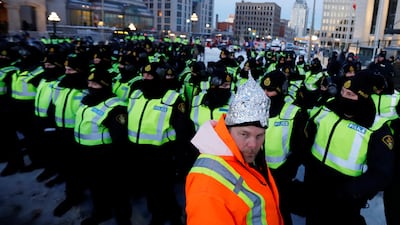
  • A demonstrator wears a tinfoil hat in front of a row of police. Reuters
    A demonstrator wears a tinfoil hat in front of a row of police. Reuters
  • A protester films on his phone during a police stand-off with demonstrators. AFP
    A protester films on his phone during a police stand-off with demonstrators. AFP
  • A protester is helped away after injuring his knee when a police line surged forward. AP
    A protester is helped away after injuring his knee when a police line surged forward. AP
  • Police clutch their batons as they move protesters back. AP
    Police clutch their batons as they move protesters back. AP
  • A demonstrator confronts police. AFP
    A demonstrator confronts police. AFP

Left Bank: Art, Passion and Rebirth of Paris 1940-1950

Agnes Poirer, Bloomsbury

Benefits of first-time home buyers' scheme
  • Priority access to new homes from participating developers
  • Discounts on sales price of off-plan units
  • Flexible payment plans from developers
  • Mortgages with better interest rates, faster approval times and reduced fees
  • DLD registration fee can be paid through banks or credit cards at zero interest rates
UAE currency: the story behind the money in your pockets
The burning issue

The internal combustion engine is facing a watershed moment – major manufacturer Volvo is to stop producing petroleum-powered vehicles by 2021 and countries in Europe, including the UK, have vowed to ban their sale before 2040. The National takes a look at the story of one of the most successful technologies of the last 100 years and how it has impacted life in the UAE. 

Read part four: an affection for classic cars lives on

Read part three: the age of the electric vehicle begins

Read part one: how cars came to the UAE


The bio

Favourite book: Peter Rabbit. I used to read it to my three children and still read it myself. If I am feeling down it brings back good memories.

Best thing about your job: Getting to help people. My mum always told me never to pass up an opportunity to do a good deed.

Best part of life in the UAE: The weather. The constant sunshine is amazing and there is always something to do, you have so many options when it comes to how to spend your day.

Favourite holiday destination: Malaysia. I went there for my honeymoon and ended up volunteering to teach local children for a few hours each day. It is such a special place and I plan to retire there one day.

Ten tax points to be aware of in 2026

1. Domestic VAT refund amendments: request your refund within five years

If a business does not apply for the refund on time, they lose their credit.

2. E-invoicing in the UAE

Businesses should continue preparing for the implementation of e-invoicing in the UAE, with 2026 a preparation and transition period ahead of phased mandatory adoption. 

3. More tax audits

Tax authorities are increasingly using data already available across multiple filings to identify audit risks. 

4. More beneficial VAT and excise tax penalty regime

Tax disputes are expected to become more frequent and more structured, with clearer administrative objection and appeal processes. The UAE has adopted a new penalty regime for VAT and excise disputes, which now mirrors the penalty regime for corporate tax.

5. Greater emphasis on statutory audit

There is a greater need for the accuracy of financial statements. The International Financial Reporting Standards standards need to be strictly adhered to and, as a result, the quality of the audits will need to increase.

6. Further transfer pricing enforcement

Transfer pricing enforcement, which refers to the practice of establishing prices for internal transactions between related entities, is expected to broaden in scope. The UAE will shortly open the possibility to negotiate advance pricing agreements, or essentially rulings for transfer pricing purposes. 

7. Limited time periods for audits

Recent amendments also introduce a default five-year limitation period for tax audits and assessments, subject to specific statutory exceptions. While the standard audit and assessment period is five years, this may be extended to up to 15 years in cases involving fraud or tax evasion. 

8. Pillar 2 implementation 

Many multinational groups will begin to feel the practical effect of the Domestic Minimum Top-Up Tax (DMTT), the UAE's implementation of the OECD’s global minimum tax under Pillar 2. While the rules apply for financial years starting on or after January 1, 2025, it is 2026 that marks the transition to an operational phase.

9. Reduced compliance obligations for imported goods and services

Businesses that apply the reverse-charge mechanism for VAT purposes in the UAE may benefit from reduced compliance obligations. 

10. Substance and CbC reporting focus

Tax authorities are expected to continue strengthening the enforcement of economic substance and Country-by-Country (CbC) reporting frameworks. In the UAE, these regimes are increasingly being used as risk-assessment tools, providing tax authorities with a comprehensive view of multinational groups’ global footprints and enabling them to assess whether profits are aligned with real economic activity. 

Contributed by Thomas Vanhee and Hend Rashwan, Aurifer

COMPANY%20PROFILE%20
%3Cp%3E%3Cstrong%3EName%3A%3C%2Fstrong%3E%20Haltia.ai%0D%3Cbr%3E%3Cstrong%3EStarted%3A%3C%2Fstrong%3E%202023%0D%3Cbr%3E%3Cstrong%3ECo-founders%3A%3C%2Fstrong%3E%20Arto%20Bendiken%20and%20Talal%20Thabet%0D%3Cbr%3E%3Cstrong%3EBased%3A%3C%2Fstrong%3E%20Dubai%2C%20UAE%0D%3Cbr%3E%3Cstrong%3EIndustry%3A%3C%2Fstrong%3E%20AI%0D%3Cbr%3E%3Cstrong%3ENumber%20of%20employees%3A%3C%2Fstrong%3E%2041%0D%3Cbr%3E%3Cstrong%3EFunding%3A%3C%2Fstrong%3E%20About%20%241.7%20million%0D%3Cbr%3E%3Cstrong%3EInvestors%3A%3C%2Fstrong%3E%20Self%2C%20family%20and%20friends%26nbsp%3B%3C%2Fp%3E%0A
Who's who in Yemen conflict

Houthis: Iran-backed rebels who occupy Sanaa and run unrecognised government

Yemeni government: Exiled government in Aden led by eight-member Presidential Leadership Council

Southern Transitional Council: Faction in Yemeni government that seeks autonomy for the south

Habrish 'rebels': Tribal-backed forces feuding with STC over control of oil in government territory

Updated: February 23, 2022, 9:52 PM