

After three days of record-breaking temperatures, the Canadian village of Lytton was engulfed in a wildfire on Wednesday, sending residents fleeing for safety.
The 250 residents of the British Columbia village were told on Wednesday evening to evacuate the area immediately.
“It's dire. The whole town is on fire,” Mayor Jan Polderman told CBC News.
“It took, like, a whole 15 minutes from the first sign of smoke to, all of a sudden, there being fire everywhere.”
Videos shared by fleeing residents on social media showed thick plumes of black smoke rising above the village as several structures were engulfed in flames.

In the race to flee the village, many were disconnected from their family and friends. Power outages and downed telephone towers have hindered communications. Online, community groups were filled with posts from people searching for loved ones as people scrambled to account for recently evacuated family and friends.
In the aftermath of a record-smashing heatwave, a number of out of control wildfires are spreading across the province of British Columbia.
“The temperatures recorded this week are unprecedented — lives have been lost and the risk of wildfires is at a dangerously high level,” said Canadian Prime Minister Justin Trudeau.
"We've been seeing more and more of this type of extreme weather event in the past years. So realistically, we know that this heatwave won't be the last," said Mr Trudeau.
At least five other British Columbia districts have received evacuation alerts this week as the risk of wildfires has been significantly raised by the devastating heatwave.
The British Columbia Wildfire Service reported 96 new fires this week, with 54 active wildfires reported over the last two days.
“The fire situation is extremely dangerous right now. Emergency crews are doing everything they can to support the people of Lytton,” British Columbia Premier John Horgan said on Twitter.
Mr Horgan said the heatwave was having "disastrous consequences for families and for communities."
British Columbia's coroner's office said it had recorded 486 deaths between Friday and Wednesday, compared with 165 on average.
-
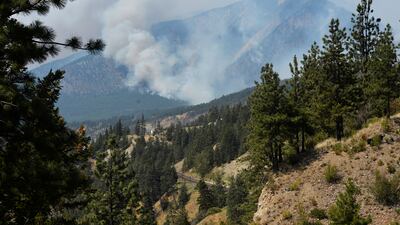
A wildfire burns outside of the town of Lytton, where a wildfire raged through and forced everyone to evacuate, in British Columbia, Canada, July 1, 2021. -
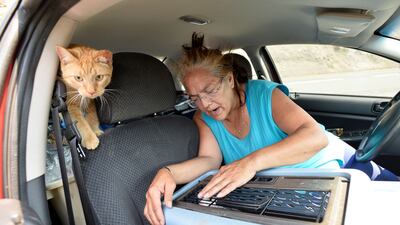
Martha Van Dyke of Lytton sits in her car with her cats, Tigger and Kona, after a wildfire that raged through her town forced residents to evacuate, outside of Lytton, British Columbia. -

Structures destroyed by a wildfire are seen in Lytton, British Columbia. -

A wildfire burns outside of the town of Lytton. -

The roughly 1,000 residents of Lytton had to abandon their homes with just a few minutes notice Wednesday evening, after searing the previous day under a record high of 121. 2 F (49. 6 C). -

The sign for the town of Lytton, where a wildfire raged through and forced residents to evacuate, is seen in Lytton, British Columbia. -
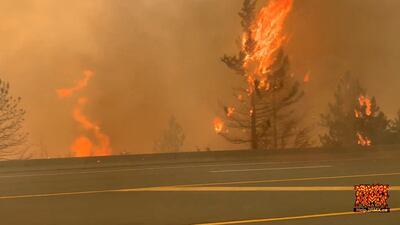
Trees burn along a street during a wildfire in Lytton, British Columbia, June 30, 2021 in this still image obtained from a social media video. -
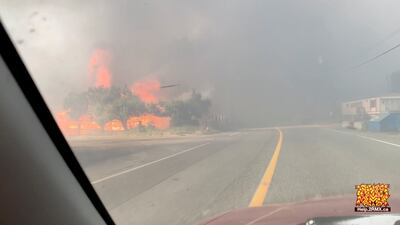
Flames are seen along a street during a wildfire in Lytton, British Columbia in this still image obtained from a social media video. -
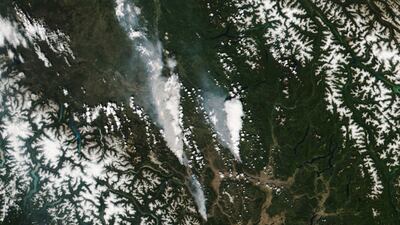
A handout satellite image made available by the National Aeronautics and Space Administration (NASA) shows the McKay Creek fire, left; the Sparks Lake fire, right; and smaller fire, visible just south of the town of Lytton, British Columbia. -
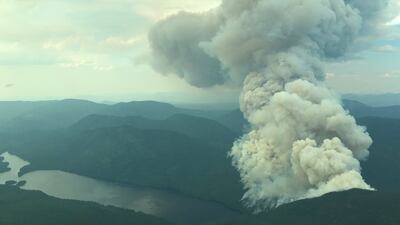
The plume of smoke from wildfire C31056, near McKinley Lake and about 35 kilometres east of Horsefly, British Columbia. -

Two plumes of smoke from the Long Loch wildfire (K51040) and the Derrickson Lake wildfire (K51041), British Columbia. -

A wildfire is seen from an airplane, in Lytton, British Columbia. -
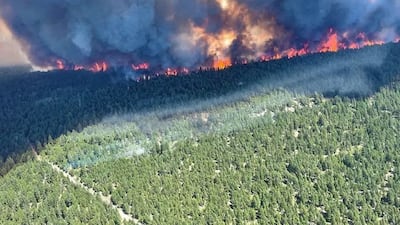
The Sparks Lake wildfire, British Columbia, is seen from the air on June 29, 2021.


"We believe that heat is very likely a factor in many of those deaths, but that is to be confirmed," said chief coroner Lisa Lapointe in a briefing.
Temperatures in Lytton, British Columbia — about 250 kilometres north-east of Vancouver — shattered the record for the highest temperature ever recorded in Canada for three consecutive days. On Tuesday, temperatures peaked at 49.5°C, the country's weather service, Environment Canada reported.
But temperatures are expected to continue rising in the coming days.
“An exceptionally strong ridge of high pressure over British Columbia will continue to bring record-breaking temperatures over the next couple of days,” Environment Canada said on Thursday morning.

