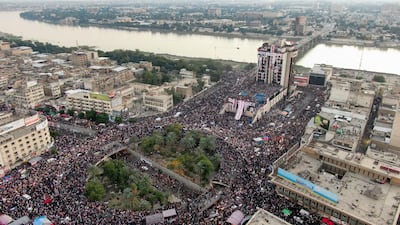
Baghdad's Tahrir Square, where Kurdish pharmacist Sheelan Dara reportedly attended demonstrations demanding the removal of the political class. AFP

Sheelan Dara: Iraqi authorities arrest man over gruesome murder


  • English
  • Arabic

Authorities in Baghdad announced on Thursday that they arrested a man suspected of killing a young Kurdish pharmacist who civil activists said was a supporter of the Iraqi uprising, and her parents.

Prime Minister Mustafa Al Kadhimi thanked on Twitter the Kurdistan Regional Government in northern Iraq “for their co-operation for getting to the perpetrator in record speed”.

The unidentified suspect on Tuesday broke into the home of Sheelan Dara in Al Mansour, Baghdad’s premier neighbourhood, strangled her and stabbed her parents to death, police said.

We have seen so many incidents like this. The authorities should make public the details

Sarah Al Mawla, head of the Human Rights Committee at the Iraqi Bar Association, said Dara was also sexually assaulted.

"She was killed after she was raped and the whole house was robbed," Ms Al Mawla said from Baghdad by WhatsApp, adding that Dara's murder was not political.

Initial reports by Iraqi official media suggested that the suspect who was arrested had accomplices.

Unlike previous killings and summary executions of activists, the authorities said that theft appeared to have been the motive behind Dara’s murder and pointed to valuables being stolen from the house.

A pharmacist, Dara attended demonstrations in Baghdad’s Tahrir Square demanding the removal of all of the country’s main politicians, Iraqi rights advocate Inas Jabbar said.

This would have identified Dara with the downtrodden Arab Shiites who comprise the bulk of the protest movement.

"Sheelan was a single child. It looks that she was killed because she and her family were well-off. Regardless, the authorities should make public the details," she told The National.

“We have seen so many incidents like this and the perpetrators and the results of investigations remained unknown,” Ms Jabbar said.

The non-violent uprising started in October 2019, demanding removal of the entire political class. The authorities and pro-Iranian Shiite militias crushed the demonstrators early this year, using killings and abductions.

But the appointment of Mr Al Kadhimi, a secular reformist supported by the United States, in May helped revive the demonstrations.

Despite vows by Mr Kadhimi to curb rampant crime, Dara’s murder was the latest in incessant attacks in the past few months on supporters of the protest movement.

Within the span of a week last month, three young civilian figures were killed. Among them was Riham Yaqoob, a doctor shot in her car in the city of Basra.

The Daras were one of relatively few Kurdish families in Baghdad.

The city largely emptied of its minority populations as Shiite and Sunni militants terrorised the more liberal components of Iraqi society after the 2003 invasion that toppled former leader Saddam Hussein.

Since 2003, hundreds of thousands of Kurds fled Baghdad, mostly to northern Iraq.

Living in...

This article is part of a guide on where to live in the UAE. Our reporters will profile some of the country’s most desirable districts, provide an estimate of rental prices and introduce you to some of the residents who call each area home.

Mercer, the investment consulting arm of US services company Marsh & McLennan, expects its wealth division to at least double its assets under management (AUM) in the Middle East as wealth in the region continues to grow despite economic headwinds, a company official said.

Mercer Wealth, which globally has $160 billion in AUM, plans to boost its AUM in the region to $2-$3bn in the next 2-3 years from the present $1bn, said Yasir AbuShaban, a Dubai-based principal with Mercer Wealth.

Within the next two to three years, we are looking at reaching $2 to $3 billion as a conservative estimate and we do see an opportunity to do so,” said Mr AbuShaban.

Mercer does not directly make investments, but allocates clients’ money they have discretion to, to professional asset managers. They also provide advice to clients.

“We have buying power. We can negotiate on their (client’s) behalf with asset managers to provide them lower fees than they otherwise would have to get on their own,” he added.

Mercer Wealth’s clients include sovereign wealth funds, family offices, and insurance companies among others.

From its office in Dubai, Mercer also looks after Africa, India and Turkey, where they also see opportunity for growth.

Wealth creation in Middle East and Africa (MEA) grew 8.5 per cent to $8.1 trillion last year from $7.5tn in 2015, higher than last year’s global average of 6 per cent and the second-highest growth in a region after Asia-Pacific which grew 9.9 per cent, according to consultancy Boston Consulting Group (BCG). In the region, where wealth grew just 1.9 per cent in 2015 compared with 2014, a pickup in oil prices has helped in wealth generation.

BCG is forecasting MEA wealth will rise to $12tn by 2021, growing at an annual average of 8 per cent.

Drivers of wealth generation in the region will be split evenly between new wealth creation and growth of performance of existing assets, according to BCG.

Another general trend in the region is clients’ looking for a comprehensive approach to investing, according to Mr AbuShaban.

“Institutional investors or some of the families are seeing a slowdown in the available capital they have to invest and in that sense they are looking at optimizing the way they manage their portfolios and making sure they are not investing haphazardly and different parts of their investment are working together,” said Mr AbuShaban.

Some clients also have a higher appetite for risk, given the low interest-rate environment that does not provide enough yield for some institutional investors. These clients are keen to invest in illiquid assets, such as private equity and infrastructure.

“What we have seen is a desire for higher returns in what has been a low-return environment specifically in various fixed income or bonds,” he said.

“In this environment, we have seen a de facto increase in the risk that clients are taking in things like illiquid investments, private equity investments, infrastructure and private debt, those kind of investments were higher illiquidity results in incrementally higher returns.”

The Abu Dhabi Investment Authority, one of the largest sovereign wealth funds, said in its 2016 report that has gradually increased its exposure in direct private equity and private credit transactions, mainly in Asian markets and especially in China and India. The authority’s private equity department focused on structured equities owing to “their defensive characteristics.”

The specs: 2017 Ford F-150 Raptor

Price, base / as tested Dh220,000 / Dh320,000

Engine 3.5L V6

Transmission 10-speed automatic

Power 421hp @ 6,000rpm

Torque 678Nm @ 3,750rpm

Fuel economy, combined 14.1L / 100km

The biog

Title: General Practitioner with a speciality in cardiology

Previous jobs: Worked in well-known hospitals Jaslok and Breach Candy in Mumbai, India

Education: Medical degree from the Government Medical College in Nagpur

How it all began: opened his first clinic in Ajman in 1993

Family: a 90-year-old mother, wife and two daughters

Remembers a time when medicines from India were purchased per kilo
