
Myanmar police shot and killed one protester on Sunday and wounded several as they cracked down in a bid to end weeks of demonstrations against a February 1 military coup, a politician and media said.
Police opened fire in the town of Dawei, killing one and wounding several, politician Kyaw Min Htike told Reuters from the southern town. The Dawei Watch media outlet also said one person was killed and more than a dozen wounded.
Police and the spokesman for the ruling military council did not respond to phone calls seeking comment.
Myanmar was thrown into chaos when the army seized power and detained elected government leader Aung San Suu Kyi and much of her party leadership, alleging fraud in a November election her party won in a landslide.
The coup, which stalled Myanmar's progress towards democracy after nearly 50 years of military rule, has brought hundreds of thousands of protesters on to the streets and drawn condemnation from Western countries, with some imposing limited sanctions.
In the main city of Yangon, several people, some bleeding heavily, were helped away from protests, images posted by media showed.
It was not clear how they were hurt but media reported live fire. The Myanmar Now media group said people had been "gunned down", but it did not elaborate.
Police also threw stun grenades, used teargas and fired into the air, witnesses said.
Junta leader General Min Aung Hlaing has said authorities have been using minimal force to deal with the protests.
Nevertheless, at least three protesters have died over the days of turmoil. The army said a policeman has been killed in the unrest.
'RUNNING'
Police were out early on Sunday taking positions at main protest sites in Yangon as protesters, many clad in protective gear, began to congregate, witnesses said.
They moved swiftly to break up crowds.
"Police got out of their cars and started throwing stun grenades without warning," said Hayman May Hninsi, who was with a group of fellow teachers in Yangon. They fled to nearby buildings.
"Some teachers got hurt running."
Doctors and students in white lab coats fled as police threw stun grenades outside a medical school elsewhere in the city, posted video showed.
Police in the second city of Mandalay fired guns into the air, trapping protesting medical staff in a city hospital, a doctor there said by telephone.
-
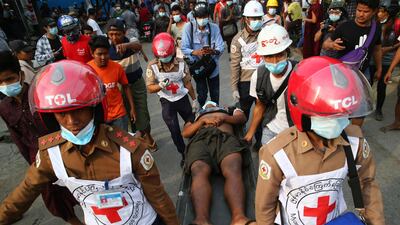
Red Cross workers carry a man on a stretcher in Mandalay, Myanmar. AP -
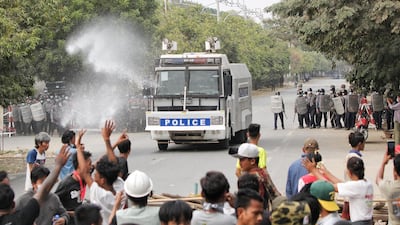
Police officers stand in front of people who protest against the military coup, in Mandalay, Myanmar. Reuters -
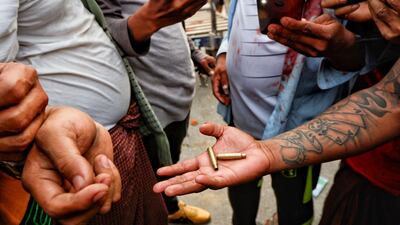
A person shows bullet shells during a protest against the military coup, in Mandalay, Myanmar. Reuters -
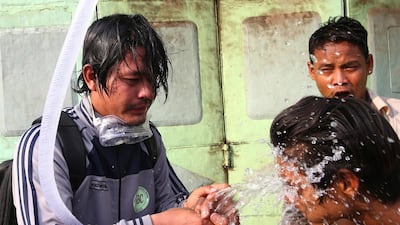
People rinse their faces with water after tear gas was used to disperse a protest in Mandalay, Myanmar. AP -
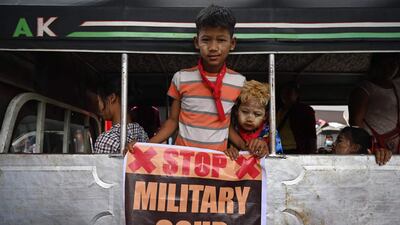
Young protesters hold a sign during a demonstration against the military coup in Yangon. AFP -
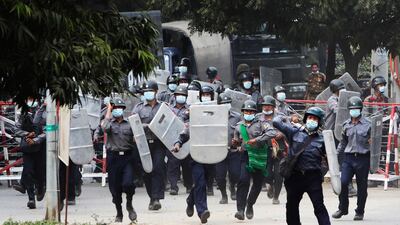
Police charge forward to disperse protesters in Mandalay, Myanmar. AP -
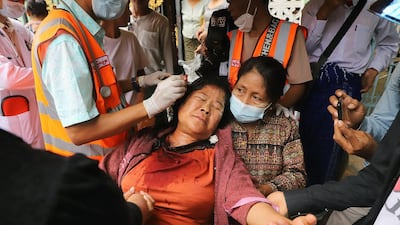
A protester has a wound on her head treated after being beaten by security forces during a demonstration against the military coup in Mandalay. AFP -
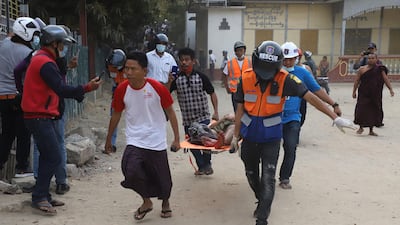
A wounded man is carried on a stretcher by a medical team after security forces opened fire on protesters during a demonstration against the military coup in Mandalay. AFP -
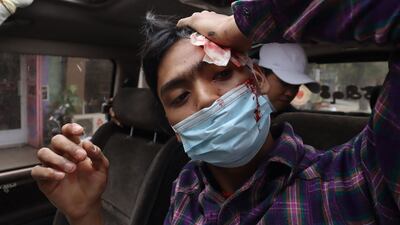
A wounded man holds a bandage to his bleeding head following a demonstration against the military coup where security forces fired on and beat protesters in Mandalay. AFP -
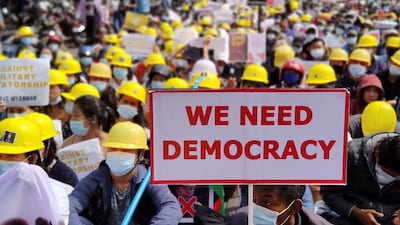
Protesters wearing hard hats and helmets hold up signs as they rally in protest against the military coup in the northern town of Myitkyina, the capital of Kachin state, Myanmar. Reuters


The crackdown appears to indicate a determination by the military to impose its authority in the face of widespread defiance, not just on the streets but more broadly, in areas such as the civil service, municipal administration, the education and health sectors and media.
Saturday brought disturbances in towns and cities nationwide as police began their bid to crush the protests with teargas, stun grenades and by shooting into the air.
State-run MRTV television said more than 470 people had been arrested on Saturday. It said police had given warnings before using stun grenades to disperse people.
'INSTIL FEAR'
Youth activist Esther Ze Naw said people were battling to overcome the fear they had lived with for a long time.
"This fear will only grow if we keep living with it and the people who are creating the fear know that. It's obvious they're trying to instil fear in us by making us run and hide," she said. "We can't accept that."
The police action came after state television announced that Myanmar's UN envoy had been fired for betraying the country after he urged the United Nations to use "any means necessary" to reverse the coup.
MRTV said he had been fired in accordance with civil service rules because he had "betrayed the country" and "abused the power and responsibilities of an ambassador".
The ambassador, Kyaw Moe Tun, was defiant.
"I decided to fight back as long as I can," Kyaw Moe Tun told Reuters in New York.
UN Special Rapporteur Tom Andrews said he was overwhelmed by the ambassador's "act of courage", adding on Twitter, "It's time for the world to answer that courageous call with action."
Myanmar's generals have traditionally shrugged off diplomatic pressure. They have promised to hold a new election but not set a date.
Ms Suu Kyi's party and supporters said the result of the November vote must be respected.
Ms Suu Kyi, 75, spent nearly 15 years under house arrest during military rule. She faces charges of illegally importing six walkie-talkie radios and of violating a natural disaster law by breaching coronavirus protocols.

