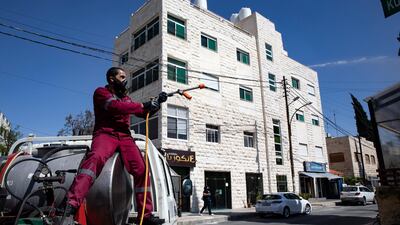
• A Moroccan health ministry worker disinfects a street in the capital Rabat on March 22, 2020. - A public health state of emergency went into effect in the Muslim-majority country late on March 20, and security forces and the army have been deployed on the streets to combat the spread of COVID-19 coronavirus disease. People have been ordered to stay at home, and restrictions on public transport and travel between cities are also in place. AFP
    A Moroccan health ministry worker disinfects a street in the capital Rabat on March 22, 2020. - A public health state of emergency went into effect in the Muslim-majority country late on March 20, and security forces and the army have been deployed on the streets to combat the spread of COVID-19 coronavirus disease. People have been ordered to stay at home, and restrictions on public transport and travel between cities are also in place. AFP
  • A Moroccan health ministry worker disinfects a man walking a dog and carrying a mat in the capital Rabat on March 22, 2020. - A public health state of emergency went into effect in the Muslim-majority country late on March 20, and security forces and the army have been deployed on the streets to combat the spread of COVID-19 coronavirus disease. People have been ordered to stay at home, and restrictions on public transport and travel between cities are also in place. (Photo by FADEL SENNA / AFP)
    A Moroccan health ministry worker disinfects a man walking a dog and carrying a mat in the capital Rabat on March 22, 2020. - A public health state of emergency went into effect in the Muslim-majority country late on March 20, and security forces and the army have been deployed on the streets to combat the spread of COVID-19 coronavirus disease. People have been ordered to stay at home, and restrictions on public transport and travel between cities are also in place. (Photo by FADEL SENNA / AFP)
  • Members of the Moroccan Interior Ministry Auxiliary Forces ask owners of a restaurant to close down, in Marrakesh on March 16, 2020. - Many holiday makers who came to visit Morocco are now finding themselves confined as the government is gradually restricting all activities in the kingdom and closing down universities, schools, cinemas, museums, bars, restaurants and even mosques, all in a bid to stem the spread of COVID-19 coronavirus disease (Photo by FADEL SENNA / AFP)
    Members of the Moroccan Interior Ministry Auxiliary Forces ask owners of a restaurant to close down, in Marrakesh on March 16, 2020. - Many holiday makers who came to visit Morocco are now finding themselves confined as the government is gradually restricting all activities in the kingdom and closing down universities, schools, cinemas, museums, bars, restaurants and even mosques, all in a bid to stem the spread of COVID-19 coronavirus disease (Photo by FADEL SENNA / AFP)
  • Passengers wait for their flights at the Marrakesh Airport on March 15, 2020. - Several special flights departed Morocco taking thousands of stranded Europeans home as the kingdom announced it was suspending all regular air traffic due to the coronavirus, authorities and airports said. Morocco said it had decided to suspend all international commercial flights "until further notice", extending a ban that had previously been applied to around 30 nations, including Italy, France and Spain. (Photo by - / AFP)
    Passengers wait for their flights at the Marrakesh Airport on March 15, 2020. - Several special flights departed Morocco taking thousands of stranded Europeans home as the kingdom announced it was suspending all regular air traffic due to the coronavirus, authorities and airports said. Morocco said it had decided to suspend all international commercial flights "until further notice", extending a ban that had previously been applied to around 30 nations, including Italy, France and Spain. (Photo by - / AFP)
  • TOPSHOT - A patient who recovered from the Covid-19 disease caused by the novel coronavirus kisses the ground as another rejoices with the medical staff as they leave a hospital in the city of Sale, north of the Moroccan capital Rabat on April 12, 2020. / AFP / FADEL SENNA
    TOPSHOT - A patient who recovered from the Covid-19 disease caused by the novel coronavirus kisses the ground as another rejoices with the medical staff as they leave a hospital in the city of Sale, north of the Moroccan capital Rabat on April 12, 2020. / AFP / FADEL SENNA
  • Members of the medical staff at Moroccos's military field hospital in Nouaceur, South of Casablanca, check on equipment on April 18, 2020 as they prepare to receive patients of the coronavirus pandemic. Military hospitals have been reordered to maximise bed capacity, he said, adding that two field hospitals had been deployed to the coastal Casablanca region. Morocco had recorded 2,670 confirmed cases of coronavirus and 137 deaths, while over 280 have officially recovered. The North African kingdom has closed its borders and imposed a lockdown, enforced by security forces, to stem the spread of the disease. / AFP / FADEL SENNA
    Members of the medical staff at Moroccos's military field hospital in Nouaceur, South of Casablanca, check on equipment on April 18, 2020 as they prepare to receive patients of the coronavirus pandemic. Military hospitals have been reordered to maximise bed capacity, he said, adding that two field hospitals had been deployed to the coastal Casablanca region. Morocco had recorded 2,670 confirmed cases of coronavirus and 137 deaths, while over 280 have officially recovered. The North African kingdom has closed its borders and imposed a lockdown, enforced by security forces, to stem the spread of the disease. / AFP / FADEL SENNA
  • An ad spreading awareness against coronavirus is seen in Rabat, Morocco, Wednesday, April 22, 2020. The new coronavirus causes mild or moderate symptoms for most people, but for some, especially older adults and people with existing health problems, it can cause more severe illness or death. (AP Photo/Mosa'ab Elshamy)
    An ad spreading awareness against coronavirus is seen in Rabat, Morocco, Wednesday, April 22, 2020. The new coronavirus causes mild or moderate symptoms for most people, but for some, especially older adults and people with existing health problems, it can cause more severe illness or death. (AP Photo/Mosa'ab Elshamy)
  • A man walks past closed shops before the start of the holy month of Ramadan in the usually bustling Medina of Rabat, during a health state of emergency and home confinement orders, in Rabat, Morocco, Thursday, April 23, 2020. The new coronavirus causes mild or moderate symptoms for most people, but for some, especially older adults and people with existing health problems, it can cause more severe illness or death. (AP Photo/Mosa'ab Elshamy)
    A man walks past closed shops before the start of the holy month of Ramadan in the usually bustling Medina of Rabat, during a health state of emergency and home confinement orders, in Rabat, Morocco, Thursday, April 23, 2020. The new coronavirus causes mild or moderate symptoms for most people, but for some, especially older adults and people with existing health problems, it can cause more severe illness or death. (AP Photo/Mosa'ab Elshamy)
  • An employee of a Moroccan startup company pilots a drone equipped with disinfectant liquid, in a street of Harhoura near the capital Rabat on April 23, 2020, to be used during the novel coronavirus pandemic crisis. / AFP / FADEL SENNA
    An employee of a Moroccan startup company pilots a drone equipped with disinfectant liquid, in a street of Harhoura near the capital Rabat on April 23, 2020, to be used during the novel coronavirus pandemic crisis. / AFP / FADEL SENNA
  • A drone equipped with disinfectant liquid, operated by a Moroccan startup company, is flown above a street of Harhoura near the capital Rabat on April 23, 2020, to be used during the novel coronavirus pandemic crisis. / AFP / FADEL SENNA
    A drone equipped with disinfectant liquid, operated by a Moroccan startup company, is flown above a street of Harhoura near the capital Rabat on April 23, 2020, to be used during the novel coronavirus pandemic crisis. / AFP / FADEL SENNA
  • A Moroccan artist works on a mural thanking essential workers amid the COVID-19 pandemic, in the city of Sale north of the capital, on April 26, 2020. / AFP / FADEL SENNA
    A Moroccan artist works on a mural thanking essential workers amid the COVID-19 pandemic, in the city of Sale north of the capital, on April 26, 2020. / AFP / FADEL SENNA
  • epa08371017 Shaima (L), a Moroccan woman wearing protective clothing, volunteers to buy the necessary supplies from the shops and distribute them to the needy in Rabat, Morocco, 18 April 2020. Rabat is under curfew after the Moroccan authorities announced a state of health emergency nearly a month ago to stem the widespread of the SARS-CoV-2 coronavirus which causes the Covid-19 disease. EPA/JALAL MORCHIDI
    epa08371017 Shaima (L), a Moroccan woman wearing protective clothing, volunteers to buy the necessary supplies from the shops and distribute them to the needy in Rabat, Morocco, 18 April 2020. Rabat is under curfew after the Moroccan authorities announced a state of health emergency nearly a month ago to stem the widespread of the SARS-CoV-2 coronavirus which causes the Covid-19 disease. EPA/JALAL MORCHIDI
  • epa08370887 A Moroccan man Salah, dressed as a clown, performs for children via live broadcast in the Internet in Rabat, Morocco, 17 April 2020 (issued 18 April 2020). Salah's broadcast aims to entertain children in light of the curfew in the country knows after the Moroccan authorities declared a state of health emergency nearly a month ago to stem the widespread of the SARS-CoV-2 coronavirus which causes the Covid-19 disease. EPA/JALAL MORCHIDI
    epa08370887 A Moroccan man Salah, dressed as a clown, performs for children via live broadcast in the Internet in Rabat, Morocco, 17 April 2020 (issued 18 April 2020). Salah's broadcast aims to entertain children in light of the curfew in the country knows after the Moroccan authorities declared a state of health emergency nearly a month ago to stem the widespread of the SARS-CoV-2 coronavirus which causes the Covid-19 disease. EPA/JALAL MORCHIDI
  • Members of the medical staff at Moroccos's military field hospital in the region of Benslimane take positions as they remain on stand-by amid the novel coronavirus pandemic crisis, on April 17, 2020. / AFP / FADEL SENNA
    Members of the medical staff at Moroccos's military field hospital in the region of Benslimane take positions as they remain on stand-by amid the novel coronavirus pandemic crisis, on April 17, 2020. / AFP / FADEL SENNA
  • Moroccan health workers scan passengers arriving from Italy for coronavirus COVID-19 at Casablanca Mohammed V International Airport on March 3, 2020. (Photo by FADEL SENNA / AFP)
    Moroccan health workers scan passengers arriving from Italy for coronavirus COVID-19 at Casablanca Mohammed V International Airport on March 3, 2020. (Photo by FADEL SENNA / AFP)
  • A woman walks past a Moroccan military armoured personnel carrier (APC) driving along a road, instructing people to remain at home, in the capital Rabat on March 22, 2020. - A public health state of emergency went into effect in the Muslim-majority country late on March 20, and security forces and the army have been deployed on the streets to combat the spread of COVID-19 coronavirus disease. People have been ordered to stay at home, and restrictions on public transport and travel between cities are also in place. (Photo by FADEL SENNA / AFP)
    A woman walks past a Moroccan military armoured personnel carrier (APC) driving along a road, instructing people to remain at home, in the capital Rabat on March 22, 2020. - A public health state of emergency went into effect in the Muslim-majority country late on March 20, and security forces and the army have been deployed on the streets to combat the spread of COVID-19 coronavirus disease. People have been ordered to stay at home, and restrictions on public transport and travel between cities are also in place. (Photo by FADEL SENNA / AFP)

Moroccan doctors fight on against virus despite isolation and fear


  • English
  • Arabic

When Moroccan nurse Mofadal Ahyane lost his first patient to Covid-19, he had a recurring nightmare.

He dreamt his patient was in agony and slipped from his body, which gradually transformed into Mr Ahyane’s father, then brother, then a friend.

“The death of that man will never leave me as long as I live,” Mr Ahyane said.

His voice cracked as he recalled how doctors and nurses at a hospital in the northern city of Tetouan tried in vain to save the man’s life.

The virus has upended life for Morocco’s medical staff. They work at better facilities than medics across much of Africa but are often short of the equipment available in European hospitals, which have also been overwhelmed during the pandemic.

Medical professionals across Morocco spoke of heartbreak, fear and the challenges of working safely.

Two Moroccan doctors have died after becoming infected with the virus, officials said.

The country, which is under a strict lockdown, has more than 4,700 confirmed cases and about 170 deaths, according to Johns Hopkins University.

Since early March, the Moroccan government has steadily introduced virus control measures that have turned vibrant cities into near ghost towns.

Health minister Khalid Ait Boutaleb said that without the preventive measures, Morocco would have faced 6,000 coronavirus-related deaths.

Moroccan police officers man a checkpoint during night curfew as a precaution against the novel coronavirus in the country's capital Rabat. AFP

Still, the virus has caused havoc in the personal lives of some healthcare workers, temporarily tearing them from their families as medics self-isolate at the end of the day to keep their loved ones safe.

Iman Benali, a radiology nurse at Casablanca’s Sidi Moumen Hospital, has been away from her husband and 6-year-old child since early March.

Some nurses at the hospital had to stop breastfeeding their children when duty called, Ms Benali said.

Her long days end in isolation at a hotel, where 70 other medical professionals stay.

Housekeepers at the hote are also forced to leave their families behind to stay in hotel rooms because of their contact with medics.

Ms Benali said the sacrifices she shared with colleagues created a special bond.

Coronavirus across the Middle East 

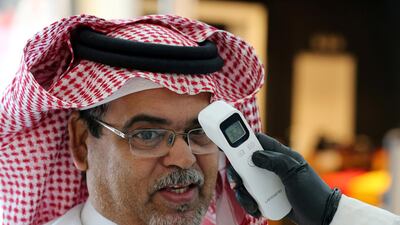
  • A security guard checks the temperature of a man at a shopping mall after the Saudi government eased a curfew and allowed stores to open. Reuters
    A security guard checks the temperature of a man at a shopping mall after the Saudi government eased a curfew and allowed stores to open. Reuters
  • After some seven weeks of lockdown, then full curfews on weekends, hairdressers, textile, shoes and some other businesses of Jordan were allowed on the last week of April to reopen their shops. EPA
    After some seven weeks of lockdown, then full curfews on weekends, hairdressers, textile, shoes and some other businesses of Jordan were allowed on the last week of April to reopen their shops. EPA
  • Lebanese nationals who were stranded abroad due to the coronavirus Covid-19 pandemic arrive from Cairo at Beirut international airport. EPA
    Lebanese nationals who were stranded abroad due to the coronavirus Covid-19 pandemic arrive from Cairo at Beirut international airport. EPA
  • Lebanese nationals who were stranded abroad due to the coronavirus pandemic arrive from Cairo at Beirut international airport, Lebanon. EPA
    Lebanese nationals who were stranded abroad due to the coronavirus pandemic arrive from Cairo at Beirut international airport, Lebanon. EPA
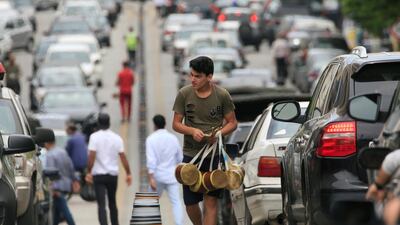
  • A street vendor walks along a road during a countrywide lockdown to prevent the spread of the coronavirus disease in Sidon, Lebanon. Reuters
    A street vendor walks along a road during a countrywide lockdown to prevent the spread of the coronavirus disease in Sidon, Lebanon. Reuters
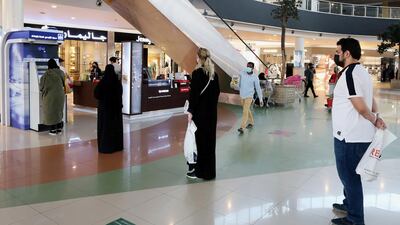
  • People line up while social distancing to use an ATM at a shopping mall in Saudi Arabia. Reuters
    People line up while social distancing to use an ATM at a shopping mall in Saudi Arabia. Reuters
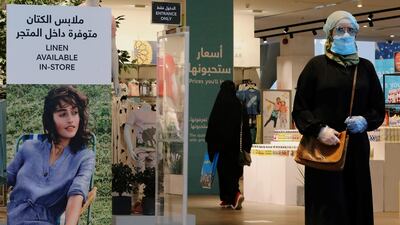
  • A woman wearing a protective mask walks at a shopping mall after the Saudi government eased a curfew and allowed stores to open, following the outbreak of the coronavirus disease. Reuters
    A woman wearing a protective mask walks at a shopping mall after the Saudi government eased a curfew and allowed stores to open, following the outbreak of the coronavirus disease. Reuters
  • A woman stands on a social distancing marker at a shopping mall after the Saudi government eased a curfew. Reuters
    A woman stands on a social distancing marker at a shopping mall after the Saudi government eased a curfew. Reuters
  • Mayor of the municipality of Tunis Souad Abderrahim distributes free masks in front of the central market in Tunis. EPA
    Mayor of the municipality of Tunis Souad Abderrahim distributes free masks in front of the central market in Tunis. EPA
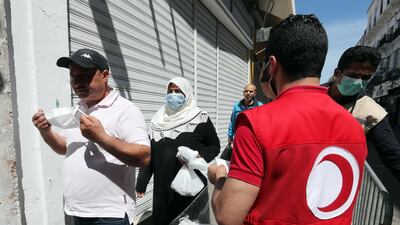
  • A Tunisian Red Crescent member distributes free masks in front of the central market in Tunis. EPA
    A Tunisian Red Crescent member distributes free masks in front of the central market in Tunis. EPA
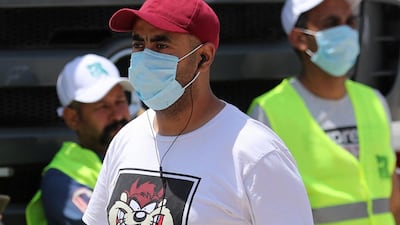
  • Men wearing protective face masks are pictured in downtown Cairo, amidst concerns about the spread of the coronavirus disease. Reuters
    Men wearing protective face masks are pictured in downtown Cairo, amidst concerns about the spread of the coronavirus disease. Reuters
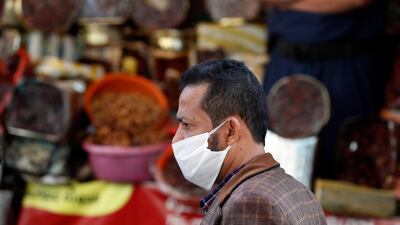
  • A Yemeni wearing a protective face mask passes the shops of dates, a popular appetizer for breaking the fast during Ramadan, at a market in Sanaa. EPA
    A Yemeni wearing a protective face mask passes the shops of dates, a popular appetizer for breaking the fast during Ramadan, at a market in Sanaa. EPA
  • A Yemeni wears a protective face mask while attending a meeting on coronavirus awareness amid the ongoing coronavirus Covid-19 pandemic in Sanaa. EPA
    A Yemeni wears a protective face mask while attending a meeting on coronavirus awareness amid the ongoing coronavirus Covid-19 pandemic in Sanaa. EPA

“We watch out for each other out of compassion, but also out of fear for our own health,” she said.

“If a hospital worker gets contaminated, it means the entire hospital workforce may be contaminated.”

At Moulay Abdellah Hospital in Morocco’s Atlantic coastal city of Sale, Dr Youssef Dhabi said he believed the deaths of his colleagues were a driving force for caregivers.

“If the deceased doctors were given a chance to return to work, they would take it instantly. You’d find them in their protective gear, treating patients,” he said.

A healthcare worker assists a Covid-19 patient at one of the intensive care units of the Moulay Abdellah hospital in Sale, Morocco. AP

During his 12-hour shift, Mr Ahyane rarely eats because he fears contamination. “You wonder, are your hands clean enough to eat?” he said.

Dr Houcine Benazouz doesn’t even consider eating. Since early March, he has been running between departments at the hospital in Tetouan.

At night, he stays in a white, impersonal hotel room far from the comfort of his loved ones.

“It has to be the hardest choice I made, leaving my wife and children behind me,” he said.

Nabil Zouini, who works with a testing task force in his home town of Meknes, hasn’t been home for more than a month and said his daughter, 3, couldn’t understand why he wasn't at home.

He said he spoke to her regularly via video chats. “She smiles at me every night and asks me: ‘Dad, are you coming back home tomorrow?’” Mr Zouini said. “If I say no, she cries.”

He wears a new mask and gown every time he encounters a suspected Covid-19 case, but is never certain he is safe from infection.

“The hardest part is taking the gown off. We have to do it in a way that we don’t touch the outside of the suit, which is fully contaminated," he said.

"We can only take off the suit from the inside out.”

He said he changed gowns at least 10 times a day.

It’s beginning to feel as though the ancient ramparts of Meknes are closing in, he said.

“The psychological turmoil is incredibly hard. Many of us will be scarred by what we see," he said.

Mr Zouini described an eerie emptiness in the streets of the city, an image that clashed with the normal ambience of Meknes, which once drew tourists from across the world.

“As I drive to homes of suspected cases, my eyes flash for a second and I see the cafes, the playgrounds buzzing with life … before I’m brought back to reality,” he said.

Using a typical Moroccan expression that may speak to all the country’s health workers, Mr Zouini said: “I say to myself, we can’t meet each other today, but we will hug tomorrow.”


Star%20Wars%3A%20Episode%20I%20%E2%80%93%20The%20Phantom%20Menace
%3Cp%3E%3Cstrong%3EDeveloper%3A%3C%2Fstrong%3E%20Big%20Ape%20Productions%3Cbr%3E%3Cstrong%3EPublisher%3A%3C%2Fstrong%3E%20LucasArts%3Cbr%3E%3Cstrong%3EConsoles%3A%3C%2Fstrong%3E%20PC%2C%20PlayStation%3Cbr%3E%3Cstrong%3ERating%3A%3C%2Fstrong%3E%202%2F5%3C%2Fp%3E%0A
COMPANY PROFILE
Name: Airev
Started: September 2023
Founder: Muhammad Khalid
Based: Abu Dhabi
Sector: Generative AI
Initial investment: Undisclosed
Investment stage: Series A
Investors: Core42
Current number of staff: 47
 
Tips to keep your car cool
  • Place a sun reflector in your windshield when not driving
  • Park in shaded or covered areas
  • Add tint to windows
  • Wrap your car to change the exterior colour
  • Pick light interiors - choose colours such as beige and cream for seats and dashboard furniture
  • Avoid leather interiors as these absorb more heat
Company%20profile
%3Cp%3EName%3A%20Tabby%3Cbr%3EFounded%3A%20August%202019%3B%20platform%20went%20live%20in%20February%202020%3Cbr%3EFounder%2FCEO%3A%20Hosam%20Arab%2C%20co-founder%3A%20Daniil%20Barkalov%3Cbr%3EBased%3A%20Dubai%2C%20UAE%3Cbr%3ESector%3A%20Payments%3Cbr%3ESize%3A%2040-50%20employees%3Cbr%3EStage%3A%20Series%20A%3Cbr%3EInvestors%3A%20Arbor%20Ventures%2C%20Mubadala%20Capital%2C%20Wamda%20Capital%2C%20STV%2C%20Raed%20Ventures%2C%20Global%20Founders%20Capital%2C%20JIMCO%2C%20Global%20Ventures%2C%20Venture%20Souq%2C%20Outliers%20VC%2C%20MSA%20Capital%2C%20HOF%20and%20AB%20Accelerator.%3Cbr%3E%3C%2Fp%3E%0A
The burning issue

The internal combustion engine is facing a watershed moment – major manufacturer Volvo is to stop producing petroleum-powered vehicles by 2021 and countries in Europe, including the UK, have vowed to ban their sale before 2040. The National takes a look at the story of one of the most successful technologies of the last 100 years and how it has impacted life in the UAE. 

Read part four: an affection for classic cars lives on

Read part three: the age of the electric vehicle begins

Read part one: how cars came to the UAE


%20Ramez%20Gab%20Min%20El%20Akher
%3Cp%3E%3Cstrong%3ECreator%3A%3C%2Fstrong%3E%20Ramez%20Galal%3C%2Fp%3E%0A%3Cp%3E%3Cstrong%3EStarring%3A%3C%2Fstrong%3E%20Ramez%20Galal%3C%2Fp%3E%0A%3Cp%3E%3Cstrong%3EStreaming%20on%3A%20%3C%2Fstrong%3EMBC%20Shahid%3C%2Fp%3E%0A%3Cp%3E%3Cstrong%3ERating%3A%20%3C%2Fstrong%3E2.5%2F5%3C%2Fp%3E%0A
Apple product price list

iPad Pro

11" - $799 (64GB)
12.9" - $999 (64GB)

MacBook Air 

$1,199

Mac Mini

$799

Victims%20of%20the%202018%20Parkland%20school%20shooting
%3Cp%3EAlyssa%20Alhadeff%2C%2014%3C%2Fp%3E%0A%3Cp%3EScott%20Beigel%2C%2035%0D%3C%2Fp%3E%0A%3Cp%3EMartin%20Duque%2C%2014%3C%2Fp%3E%0A%3Cp%3ENicholas%20Dworet%2C%2017%3C%2Fp%3E%0A%3Cp%3EAaron%20Feis%2C%2037%3C%2Fp%3E%0A%3Cp%3EJaime%20Guttenberg%2C%2014%0D%3C%2Fp%3E%0A%3Cp%3EChris%20Hixon%2C%2049%0D%3C%2Fp%3E%0A%3Cp%3ELuke%20Hoyer%2C%2015%3C%2Fp%3E%0A%3Cp%3ECara%20Loughran%2C%2014%0D%3C%2Fp%3E%0A%3Cp%3EGina%20Montalto%2C%2014%0D%3C%2Fp%3E%0A%3Cp%3EJoaquin%20Oliver%2C%2017%0D%3C%2Fp%3E%0A%3Cp%3EAlaina%20Petty%2C%2014%0D%3C%2Fp%3E%0A%3Cp%3EMeadow%20Pollack%2C%2018%3C%2Fp%3E%0A%3Cp%3EHelena%20Ramsay%2C%2017%0D%3Cbr%3E%0D%3C%2Fp%3E%0A%3Cp%3EAlex%20Schachter%2C%2014%0D%3C%2Fp%3E%0A%3Cp%3ECarmen%20Schentrup%2C%2016%0D%3C%2Fp%3E%0A%3Cp%3EPeter%20Wang%2C%2015%3Cbr%3E%3C%2Fp%3E%0A
The specs

Engine: 4.0-litre V8 twin-turbocharged and three electric motors

Power: Combined output 920hp

Torque: 730Nm at 4,000-7,000rpm

Transmission: 8-speed dual-clutch automatic

Fuel consumption: 11.2L/100km

On sale: Now, deliveries expected later in 2025

Price: expected to start at Dh1,432,000

The schedule

December 5 - 23: Shooting competition, Al Dhafra Shooting Club

December 9 - 24: Handicrafts competition, from 4pm until 10pm, Heritage Souq

December 11 - 20: Dates competition, from 4pm

December 12 - 20: Sour milk competition

December 13: Falcon beauty competition

December 14 and 20: Saluki races

December 15: Arabian horse races, from 4pm

December 16 - 19: Falconry competition

December 18: Camel milk competition, from 7.30 - 9.30 am

December 20 and 21: Sheep beauty competition, from 10am

December 22: The best herd of 30 camels

SERIES INFO

Afghanistan v Zimbabwe, Abu Dhabi Sunshine Series

All matches at the Zayed Cricket Stadium, Abu Dhabi

Test series

1st Test: Zimbabwe beat Afghanistan by 10 wickets
2nd Test: Wednesday, 10 March – Sunday, 14 March

Play starts at 9.30am

T20 series

1st T20I: Wednesday, 17 March
2nd T20I: Friday, 19 March
3rd T20I: Saturday, 20 March

TV
Supporters in the UAE can watch the matches on the Rabbithole channel on YouTube

World record transfers

1. Kylian Mbappe - to Real Madrid in 2017/18 - €180 million (Dh770.4m - if a deal goes through)
2. Paul Pogba - to Manchester United in 2016/17 - €105m
3. Gareth Bale - to Real Madrid in 2013/14 - €101m
4. Cristiano Ronaldo - to Real Madrid in 2009/10 - €94m
5. Gonzalo Higuain - to Juventus in 2016/17 - €90m
6. Neymar - to Barcelona in 2013/14 - €88.2m
7. Romelu Lukaku - to Manchester United in 2017/18 - €84.7m
8. Luis Suarez - to Barcelona in 2014/15 - €81.72m
9. Angel di Maria - to Manchester United in 2014/15 - €75m
10. James Rodriguez - to Real Madrid in 2014/15 - €75m

FIXTURES

All kick-off times UAE ( 4 GMT)

Friday
Sevilla v Levante (midnight)

Saturday
Athletic Bilbao v Real Sociedad (7.15pm)
Eibar v Valencia (9.30pm)
Atletico Madrid v Alaves (11.45pm)

Sunday
Girona v Getafe (3pm)
Celta Vigo v Villarreal (7.15pm)
Las Palmas v Espanyol (9.30pm)
Barcelona v Deportivo la Coruna (11.45pm)

Monday
Malaga v Real Betis (midnight)

About Krews

Founder: Ahmed Al Qubaisi

Based: Abu Dhabi

Founded: January 2019

Number of employees: 10

Sector: Technology/Social media 

Funding to date: Estimated $300,000 from Hub71 in-kind support


Desert Warrior

Starring: Anthony Mackie, Aiysha Hart, Ben Kingsley

Director: Rupert Wyatt

Rating: 3/5

The specs

Engine: 3.8-litre twin-turbo V8

Power: 611bhp

Torque: 620Nm

Transmission: seven-speed automatic

Price: upon application

On sale: now

Secret Pigeon Service: Operation Colomba, Resistance and the Struggle to Liberate Europe
Gordon Corera, Harper Collins

THE BIO

Favourite place to go to in the UAE: The desert sand dunes, just after some rain

Who inspires you: Anybody with new and smart ideas, challenging questions, an open mind and a positive attitude

Where would you like to retire: Most probably in my home country, Hungary, but with frequent returns to the UAE

Favorite book: A book by Transilvanian author, Albert Wass, entitled ‘Sword and Reap’ (Kard es Kasza) - not really known internationally

Favourite subjects in school: Mathematics and science

UAE%20SQUAD
%3Cp%3EMuhammad%20Waseem%20(captain)%2C%20Aayan%20Khan%2C%20Aryan%20Lakra%2C%20Ashwanth%20Valthapa%2C%20Asif%20Khan%2C%20Aryansh%20Sharma%2C%20CP%20Rizwaan%2C%20Hazrat%20Billal%2C%20Junaid%20Siddique%2C%20Karthik%20Meiyappan%2C%20Rohan%20Mustafa%2C%20Vriitya%20Aravind%2C%20Zahoor%20Khan%20and%20Zawar%20Farid.%3C%2Fp%3E%0A
COMPANY%20PROFILE
%3Cp%3E%3Cstrong%3ECompany%20name%3A%3C%2Fstrong%3E%20Co%20Chocolat%3C%2Fp%3E%0A%3Cp%3E%3Cstrong%3EStarted%3A%3C%2Fstrong%3E%202017%3C%2Fp%3E%0A%3Cp%3E%3Cstrong%3EFounders%3A%3C%2Fstrong%3E%20Iman%20and%20Luchie%20Suguitan%3C%2Fp%3E%0A%3Cp%3E%3Cstrong%3EBased%3A%3C%2Fstrong%3E%20Dubai%2C%20UAE%3C%2Fp%3E%0A%3Cp%3E%3Cstrong%3EIndustry%3A%3C%2Fstrong%3E%20Food%3C%2Fp%3E%0A%3Cp%3E%3Cstrong%3EFunding%3A%3C%2Fstrong%3E%20%241%20million-plus%3C%2Fp%3E%0A%3Cp%3E%3Cstrong%3EInvestors%3A%3C%2Fstrong%3E%20Fahad%20bin%20Juma%2C%20self-funding%2C%20family%20and%20friends%3C%2Fp%3E%0A

Mercer, the investment consulting arm of US services company Marsh & McLennan, expects its wealth division to at least double its assets under management (AUM) in the Middle East as wealth in the region continues to grow despite economic headwinds, a company official said.

Mercer Wealth, which globally has $160 billion in AUM, plans to boost its AUM in the region to $2-$3bn in the next 2-3 years from the present $1bn, said Yasir AbuShaban, a Dubai-based principal with Mercer Wealth.

Within the next two to three years, we are looking at reaching $2 to $3 billion as a conservative estimate and we do see an opportunity to do so,” said Mr AbuShaban.

Mercer does not directly make investments, but allocates clients’ money they have discretion to, to professional asset managers. They also provide advice to clients.

“We have buying power. We can negotiate on their (client’s) behalf with asset managers to provide them lower fees than they otherwise would have to get on their own,” he added.

Mercer Wealth’s clients include sovereign wealth funds, family offices, and insurance companies among others.

From its office in Dubai, Mercer also looks after Africa, India and Turkey, where they also see opportunity for growth.

Wealth creation in Middle East and Africa (MEA) grew 8.5 per cent to $8.1 trillion last year from $7.5tn in 2015, higher than last year’s global average of 6 per cent and the second-highest growth in a region after Asia-Pacific which grew 9.9 per cent, according to consultancy Boston Consulting Group (BCG). In the region, where wealth grew just 1.9 per cent in 2015 compared with 2014, a pickup in oil prices has helped in wealth generation.

BCG is forecasting MEA wealth will rise to $12tn by 2021, growing at an annual average of 8 per cent.

Drivers of wealth generation in the region will be split evenly between new wealth creation and growth of performance of existing assets, according to BCG.

Another general trend in the region is clients’ looking for a comprehensive approach to investing, according to Mr AbuShaban.

“Institutional investors or some of the families are seeing a slowdown in the available capital they have to invest and in that sense they are looking at optimizing the way they manage their portfolios and making sure they are not investing haphazardly and different parts of their investment are working together,” said Mr AbuShaban.

Some clients also have a higher appetite for risk, given the low interest-rate environment that does not provide enough yield for some institutional investors. These clients are keen to invest in illiquid assets, such as private equity and infrastructure.

“What we have seen is a desire for higher returns in what has been a low-return environment specifically in various fixed income or bonds,” he said.

“In this environment, we have seen a de facto increase in the risk that clients are taking in things like illiquid investments, private equity investments, infrastructure and private debt, those kind of investments were higher illiquidity results in incrementally higher returns.”

The Abu Dhabi Investment Authority, one of the largest sovereign wealth funds, said in its 2016 report that has gradually increased its exposure in direct private equity and private credit transactions, mainly in Asian markets and especially in China and India. The authority’s private equity department focused on structured equities owing to “their defensive characteristics.”