
Lebanon’s biggest prison now has a Covid-19 isolation ward to treat inmates should the virus hit the overcrowded and poorly ventilated detention centre, the International Committee of the Red Cross (ICRC) said on Thursday.
Inmates and their relatives have become increasingly vocal about fears that Covid-19 would rapidly spin out of control if it hits Lebanon’s poorly maintained prisons.
“What worries us is him [my father]. As for me, today, I am staying at home. No one visits me, speaks to me or comes into my house. But he is exposed. Very exposed”, Ali Mohamed Awada told the ICRC.
His father is detained in the largest prison in the country, located just east of Beirut in the town of Roumieh.
Mr Awada said that he feared that there are no preventative measures in place to protect his father. “Roumieh is an overcrowded prison. There are elderly people and there are sick people. My father, for example has jaundice,” he said.
To mitigate the risks, the ICRC distributed personal protective equipment to prison staff as well as hygiene products to the 4200 inmates in Roumieh prison.
It also transformed an existing prison building into an isolation ward where sick detainees can be treated, in cooperation with the Lebanese internal security forces (ISF).
“Detainees are particularly vulnerable to the spread of Covid-19 as clean water can be a luxury and soap may be non-existent in many places of detention”, the ICRC said in a statement.
-
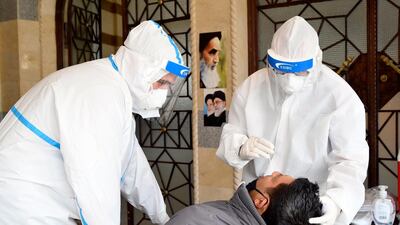
Health Ministry staff conduct random tests for the Covid-19 disease at Imam Al-Hadi Zentrum in the Ouzai area south of Beirut. EPA -
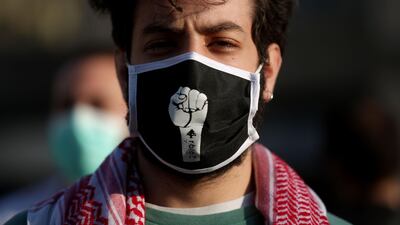
A Lebanese protester, wearing a protective mask bearing a fist, is pictured during a demonstration in the capital Beirut on April 28, 2020. AFP -
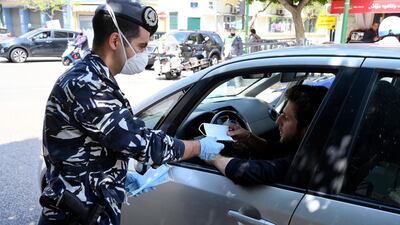
A member of the Lebanese Internal Security Forces distributes protective face masks in Hamra street. EPA -
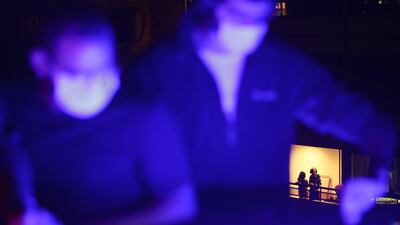
Neighbours listen to music and watch laser projections from their balconies as members of the Lebanese collective "Nuage" perform from the roof of a building to entertain confined residents in their neighbourhood of Dekwaneh. AFP -
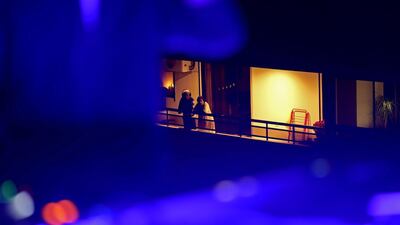
Neighbours listen to music and watch laser projections from their balconies as members of the Lebanese collective "Nuage" perform from the roof of a building to entertain confined residents in their neighbourhood of Dekwaneh. AFP -
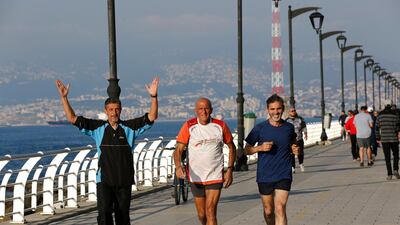
Runners smile and react to having their picture taken as they run on Beirut's corniche, along the Mediterranean Sea. AP -
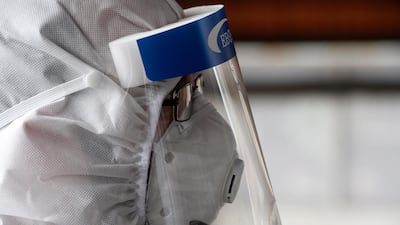
Health Ministry staff wear protective face masks and protective suits as they wait to conduct a random tests for the Covid-19. EPA -
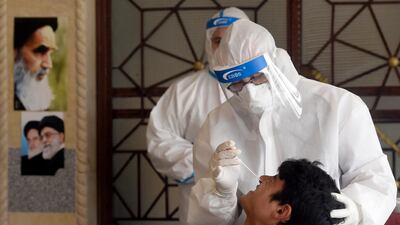
Health Ministry staff conduct random tests for the Covid-19 disease at Imam Al-Hadi Zentrum in the Ouzai area south of Beirut. EPA -

A Lebanese drummer wears a protective mask and carries a small drum as he makes his rounds waking Muslims for Suhor, the meal taken during Ramadan before sunrise prayers, amid a lockdown due to the ongoing coronavirus Covid-19 pandemic in Beirut. EPA -
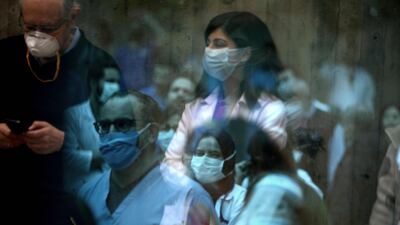
Medical staff at the Saint George Hospital University Medical Centre in charge of Covid-19 coronavirus patients reflections off a window as they listen to music played by a band thanking them for their efforts during the novel coronavirus pandemic. AFP -
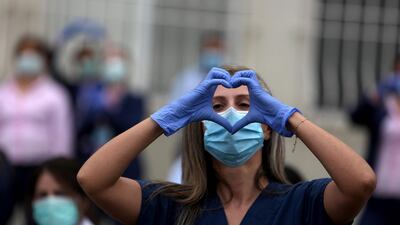
A nurse at the Lebanese hospital Notre Dame des Secours shows a heart gesture with her hands as others dance to music played by a band thanking them for their efforts. AFP -
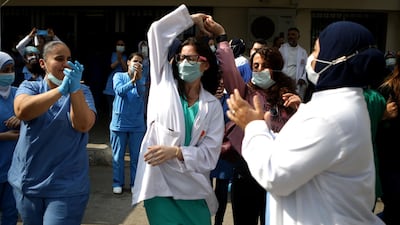
Staff of a Lebanese government hospital dance to music played by a band thanking them for their efforts. AFP -
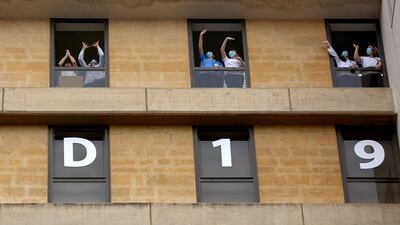
Staff members of the Lebanese American University Medical Centre-Rizk Hospital, currently dealing with COVID-19 coronavirus patients, look out from windows as they listen to music. AFP -
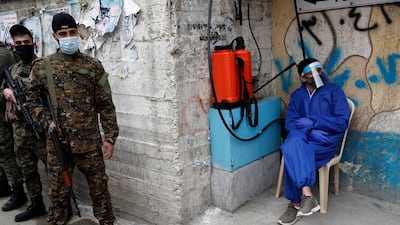
Palestinian fighters from the Fatah movement, left, wearing masks to help curb the spread of the coronavirus, stand guard next to a Palestinian worker from UNRWA who is waiting to spray disinfectant AP -
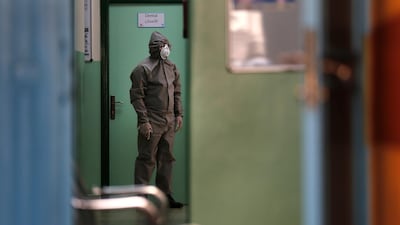
A Palestinian nurse wears protective equipment to help curb the spread of the coronavirus inside a clinic at Jalil, or Galilee Palestinian refugee camp, in Baalbek. AP -
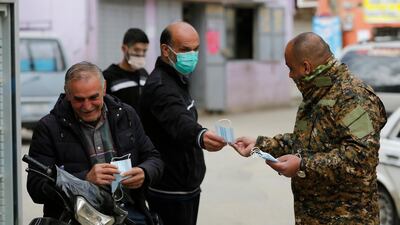
A Palestinian fighter from the Fatah movement distributes masks for people to help curb the spread of the coronavirus. AP -
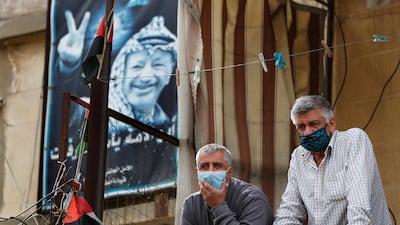
Palestinians wearing masks to help curb the spread of the coronavirus stand on their balcony watching the arrival of the Lebanese health minister at Jalil, or Galilee Palestinian refugee camp, in Baalbek. AP -
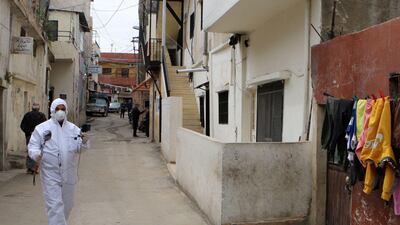
A health worker dressed in a protective outfit walks in an alley at the Wavel Palestinian refugee camp in Lebanon's eastern Bekaa Valley. AFP


Lebanese prisons on average hold 220 per cent of their intended capacity. Sources at the Justice Ministry previously told The National that Roumieh prison was originally built for 1,100 detainees.
Abdolhaliem Ahmad, a detention doctor at ICRC, said detainees are not able to practice social distancing.
“Some detainees are elderly, some suffer from chronic diseases, others have physical disabilities or have certain mental health conditions,” he said.
“At ICRC, we believe that detainees have the right to receive the same health care as the community. That is why we set up medical isolation rooms where detainees can have immediate necessary health care assistance on the premises if suspected to have contracted Covid-19,” he said.
The ICRC also installed a swab sampling room where inmates can be tested without leaving the prison.
Colonel Majed Al Ayoubi, Roumieh central prison commander, said that his staff were also worried about high risks of contamination.
“We are worried, and so are the staff members and the detainees,” he told the ICRC. “We are trying as much as we can to avoid the spread of the virus inside the building, especially (as) these buildings are old with weak infrastructure and given that the health conditions in general are poor,” he said.
In addition, the ISF implemented its own preventative measures, including restricting the number of visitors and disinfecting the buildings.
The novel coronavirus has not yet reached prisons in Lebanon and has remained contained in the small Mediterranean country, with 25 deaths and 750 people infected in total.
“There have been no cases of coronavirus in Roumieh or in other places of detention,” said Rona Halabi, ICRC spokesperson. “That is of course very good. However, it doesn’t mean that we shouldn’t be prepared to respond in case there is an outbreak,” she added.
Lebanese prisoners have rioted several times in recent weeks over coronavirus fears. Last month, thirteen soldiers were wounded in the northern city of Tripoli as families of detainees tried to storm a prison and threw stones, glass and fireworks at the army.
Justice Minister Marie-Claud Najm told The National in early April that she was working on releasing one third of Lebanon's prisoners, or roughly 3000 inmates, to free up space in prisons.

