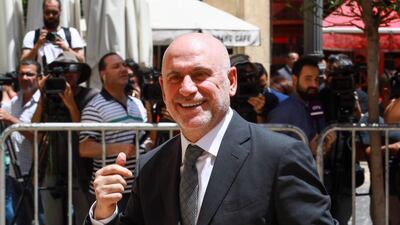
Lebanon’s former prime minister Saad Hariri said he was willing to head the next government to be decided in talks starting on October 15, 2020. Dalati Nohra via AP

Lebanon: Saad Hariri says he is in the running to head next government


  • English
  • Arabic

Lebanon's former prime minister Saad Hariri has said he is a possible candidate to head a new government to stem the country's economic collapse.

French President Emmanuel Macron last month extracted a pledge from all political sides in the former French protectorate to back speedy government formation as part of a roadmap out of the crisis, but efforts so far have failed.

"I am definitely a candidate" to head the next government, Mr Hariri said during a live interview on the MTV television channel on Thursday.

I "will not close the door on the only hope left for Lebanon to stem this collapse," he said.

President Michel Aoun is to hold parliamentary consultations on naming a new premier on Thursday next week.

Lebanon is facing its worst economic crisis since the end of a 15-year civil war in 1990, and still reeling from a massive explosion at Beirut's port on August 4 that killed more than 200 people, wounded thousands and ravaged large parts of the capital.

A financial meltdown since last year has wiped out the value of the currency and sent inflation soaring, while the coronavirus pandemic has dealt a further blow to the economy and is straining the country's healthcare system.

Mr Hariri said he feared the country could sink again into civil strife if the situation continued as it was.

"I fear a civil war and what is happening in terms of carrying arms and what we are seeing in terms of military displays in the street ... means the collapse of the state," he said.

Mr Hariri said he was ready to start making phone calls during the coming week "if all political teams still agree on the programme" discussed with Mr Macron.

The former premier stepped down under street pressure after mass protests erupted on October 17 last year to demand the overhaul of a political class accused of being inept and corrupt.

The government that followed, headed by Hassan Diab, resigned in the wake of the Beirut blast.

The next premier designate, Mustapha Adib, last month bowed out just weeks after being nominated, after his efforts to hammer out a cabinet were blocked by the country's two main Shiite political parties, Hezbollah and Amal, seeking to keep the finance ministry under their control.

“Is the ministry of finance or naming the Shiite ministers a good enough reason to topple the French initiative that can stop the collapse and rebuild Beirut?” Mr Hariri asked.

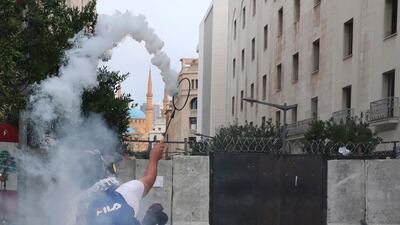
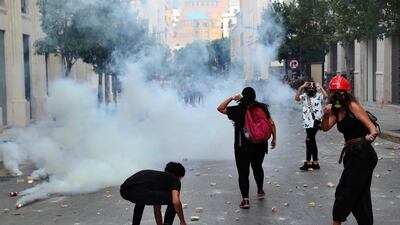
  • An anti-government protester uses a tennis racket to return a tear gas canister towards riot police near Parliament Square in Beirut on September 1. AP
    An anti-government protester uses a tennis racket to return a tear gas canister towards riot police near Parliament Square in Beirut on September 1. AP
  • An anti-government protester throws a stone towards riot police during a protest near Parliament Square. AP
    An anti-government protester throws a stone towards riot police during a protest near Parliament Square. AP
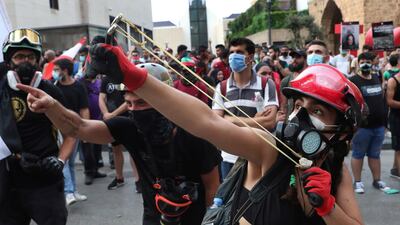
  • An anti-government protester uses a slingshot to launch a stone towards Lebanese riot police. AP
    An anti-government protester uses a slingshot to launch a stone towards Lebanese riot police. AP
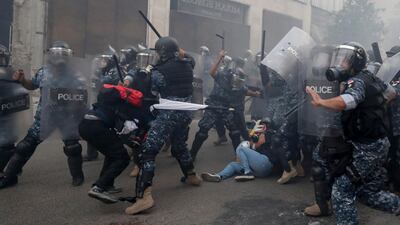
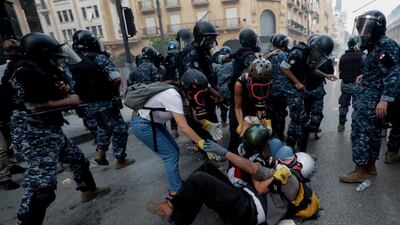
  • Riot policemen beat anti-government protesters near Parliament Square. AP
    Riot policemen beat anti-government protesters near Parliament Square. AP
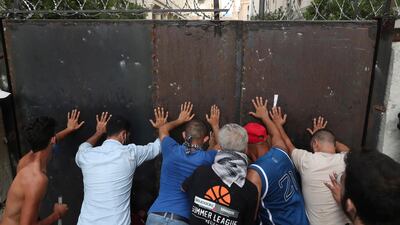
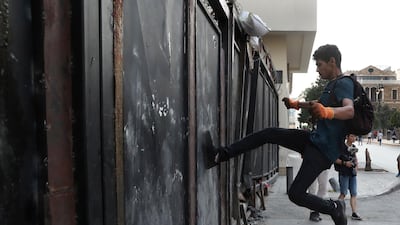
  • Anti-government protesters try to break open a metal barrier blocking the road to parliament on Sept 1, 2020. AP
    Anti-government protesters try to break open a metal barrier blocking the road to parliament on Sept 1, 2020. AP
  • Anti-government protesters try to break open a metal barrier blocking the road to parliament on Sept 1, 2020. AP
    Anti-government protesters try to break open a metal barrier blocking the road to parliament on Sept 1, 2020. AP
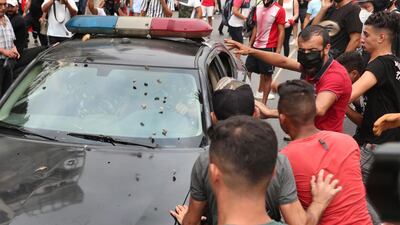
  • Anti-government protesters throw stones at a police car near Parliament Square on Sept 1. AP
    Anti-government protesters throw stones at a police car near Parliament Square on Sept 1. AP
  • Activists help anti-government protesters after being beaten by riot policemen near Parliament Square. AP
    Activists help anti-government protesters after being beaten by riot policemen near Parliament Square. AP
  • Riot policemen beat anti-government protesters during a protest near Parliament Square. AP
    Riot policemen beat anti-government protesters during a protest near Parliament Square. AP
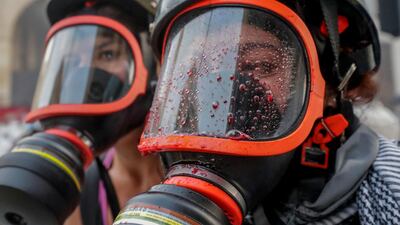
  • Activists help an anti-government protester with her tear gas mask covered in blood after being beaten by riot policemen near Parliament Square. AP
    Activists help an anti-government protester with her tear gas mask covered in blood after being beaten by riot policemen near Parliament Square. AP
  • An anti-government protester throws a stone towards riot police during a protest near Parliament Square. AP
    An anti-government protester throws a stone towards riot police during a protest near Parliament Square. AP
  • Anti-government protesters throw stones towards police near Parliament Square. AP
    Anti-government protesters throw stones towards police near Parliament Square. AP
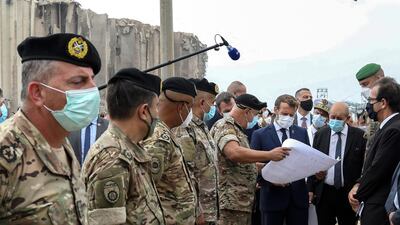
  • French President Emmanuel Macron and French Foreign Minister Jean-Yves Le Drain meet the military mobilised to help to rebuild the port of Beirut. AP via pool
    French President Emmanuel Macron and French Foreign Minister Jean-Yves Le Drain meet the military mobilised to help to rebuild the port of Beirut. AP via pool
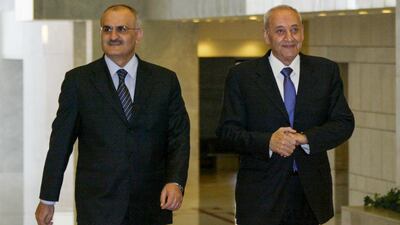
  • Lebanese Parliament Speaker Nabih Berri (R) arrives with Lebanese MP Ali Hassan Khalil to meet with Syrian President Bashar Al Assad at Al Shaab Palace in Damascus in 2008. AFP, File
    Lebanese Parliament Speaker Nabih Berri (R) arrives with Lebanese MP Ali Hassan Khalil to meet with Syrian President Bashar Al Assad at Al Shaab Palace in Damascus in 2008. AFP, File
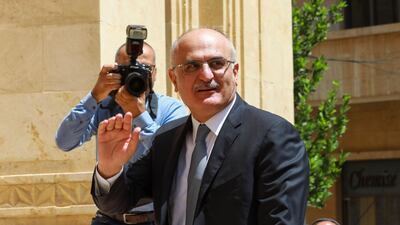
  • Then Finance Minister Ali Hassan Khalil arriving at the parliament in the Lebanese capital Beirut in 2018. AFP, file
    Then Finance Minister Ali Hassan Khalil arriving at the parliament in the Lebanese capital Beirut in 2018. AFP, file
  • Then Labour Minister Youssef Fenianos arriving at the parliament in the Lebanese capital Beirut in 2018. AFP, File
    Then Labour Minister Youssef Fenianos arriving at the parliament in the Lebanese capital Beirut in 2018. AFP, File

Forming a government can drag on for months in multi-confessional Lebanon, where a sectarian power-sharing arrangement seeks to maintain a fragile balance between all sides.

But Mr Hariri said all political sides had agreed with Mr Macron, who visited Beirut twice in the wake of the blast, to set aside their differences for six months to save the country from further deterioration.

"Every political side can invent a problem to government formation," Mr Hariri said.

"But if the political parties really want to stem the collapse and rebuild Beirut, they must follow the French initiative."

Mr Hariri, a western ally traditionally aligned with Gulf states, also said Lebanon had no way out of the crisis other than a programme with the International Monetary Fund.

IMF talks stalled earlier this year over disputes among Lebanese government officials, bankers and political parties about the scale of the country's vast financial losses.

Foreign donors have made clear there will be no fresh aid unless the heavily indebted state begins reforms it has long ignored to tackle waste and corruption.

A donor conference being organised by France was pushed back from the end of October to next month as the deadlock over a new government continues.


RESULTS

Bantamweight: Jalal Al Daaja (JOR) beat Hamza Bougamza (MAR)

Catchweight 67kg: Mohamed El Mesbahi (MAR) beat Fouad Mesdari (ALG)

Lightweight: Abdullah Mohammed Ali (UAE) beat Abdelhak Amhidra (MAR)

Catchweight 73kg: Mosatafa Ibrahim Radi (PAL) beat Yazid Chouchane (ALG)

Middleweight: Yousri Belgaroui (TUN) beat Badreddine Diani (MAR)

Catchweight 78KG: Rashed Dawood (UAE) beat Adnan Bushashy (ALG)

Middleweight: Sallah-Eddine Dekhissi (MAR) beat Abdel Enam (EGY)

Catchweight 65kg: Yanis Ghemmouri (ALG) beat Rachid Hazoume (MAR)

Lightweight: Mohammed Yahya (UAE) beat Azouz Anwar (EGY)

Catchweight 79kg: Souhil Tahiri (ALG) beat Omar Hussein (PAL)

Middleweight: Tarek Suleiman (SYR) beat Laid Zerhouni (ALG)

Company%20Profile
%3Cp%3E%3Cstrong%3ECompany%20name%3A%3C%2Fstrong%3E%20Hoopla%3Cbr%3E%3Cstrong%3EDate%20started%3A%20%3C%2Fstrong%3EMarch%202023%3Cbr%3E%3Cstrong%3EFounder%3A%3C%2Fstrong%3E%20Jacqueline%20Perrottet%3Cbr%3E%3Cstrong%3EBased%3A%3C%2Fstrong%3E%20Dubai%3Cbr%3E%3Cstrong%3ENumber%20of%20staff%3A%3C%2Fstrong%3E%2010%3Cbr%3E%3Cstrong%3EInvestment%20stage%3A%20%3C%2Fstrong%3EPre-seed%3Cbr%3E%3Cstrong%3EInvestment%20required%3A%3C%2Fstrong%3E%20%24500%2C000%3C%2Fp%3E%0A
The specs

Engine: 1.5-litre 4-cyl turbo

Power: 194hp at 5,600rpm

Torque: 275Nm from 2,000-4,000rpm

Transmission: 6-speed auto

Price: from Dh155,000

On sale: now

Desert Warrior

Starring: Anthony Mackie, Aiysha Hart, Ben Kingsley

Director: Rupert Wyatt

Rating: 3/5

Ten tax points to be aware of in 2026

1. Domestic VAT refund amendments: request your refund within five years

If a business does not apply for the refund on time, they lose their credit.

2. E-invoicing in the UAE

Businesses should continue preparing for the implementation of e-invoicing in the UAE, with 2026 a preparation and transition period ahead of phased mandatory adoption. 

3. More tax audits

Tax authorities are increasingly using data already available across multiple filings to identify audit risks. 

4. More beneficial VAT and excise tax penalty regime

Tax disputes are expected to become more frequent and more structured, with clearer administrative objection and appeal processes. The UAE has adopted a new penalty regime for VAT and excise disputes, which now mirrors the penalty regime for corporate tax.

5. Greater emphasis on statutory audit

There is a greater need for the accuracy of financial statements. The International Financial Reporting Standards standards need to be strictly adhered to and, as a result, the quality of the audits will need to increase.

6. Further transfer pricing enforcement

Transfer pricing enforcement, which refers to the practice of establishing prices for internal transactions between related entities, is expected to broaden in scope. The UAE will shortly open the possibility to negotiate advance pricing agreements, or essentially rulings for transfer pricing purposes. 

7. Limited time periods for audits

Recent amendments also introduce a default five-year limitation period for tax audits and assessments, subject to specific statutory exceptions. While the standard audit and assessment period is five years, this may be extended to up to 15 years in cases involving fraud or tax evasion. 

8. Pillar 2 implementation 

Many multinational groups will begin to feel the practical effect of the Domestic Minimum Top-Up Tax (DMTT), the UAE's implementation of the OECD’s global minimum tax under Pillar 2. While the rules apply for financial years starting on or after January 1, 2025, it is 2026 that marks the transition to an operational phase.

9. Reduced compliance obligations for imported goods and services

Businesses that apply the reverse-charge mechanism for VAT purposes in the UAE may benefit from reduced compliance obligations. 

10. Substance and CbC reporting focus

Tax authorities are expected to continue strengthening the enforcement of economic substance and Country-by-Country (CbC) reporting frameworks. In the UAE, these regimes are increasingly being used as risk-assessment tools, providing tax authorities with a comprehensive view of multinational groups’ global footprints and enabling them to assess whether profits are aligned with real economic activity. 

Contributed by Thomas Vanhee and Hend Rashwan, Aurifer

COMPANY%20PROFILE
%3Cp%3E%3Cstrong%3EName%3A%3C%2Fstrong%3E%20Floward%0D%3Cbr%3E%3Cstrong%3EBased%3A%20%3C%2Fstrong%3ERiyadh%2C%20Saudi%20Arabia%0D%3Cbr%3E%3Cstrong%3EFounders%3A%20%3C%2Fstrong%3EAbdulaziz%20Al%20Loughani%20and%20Mohamed%20Al%20Arifi%0D%3Cbr%3E%3Cstrong%3ESector%3A%20%3C%2Fstrong%3EE-commerce%0D%3Cbr%3E%3Cstrong%3ETotal%20funding%3A%20%3C%2Fstrong%3EAbout%20%24200%20million%0D%3Cbr%3E%3Cstrong%3EInvestors%3A%20%3C%2Fstrong%3EAljazira%20Capital%2C%20Rainwater%20Partners%2C%20STV%20and%20Impact46%0D%3Cbr%3E%3Cstrong%3ENumber%20of%20employees%3A%20%3C%2Fstrong%3E1%2C200%3C%2Fp%3E%0A