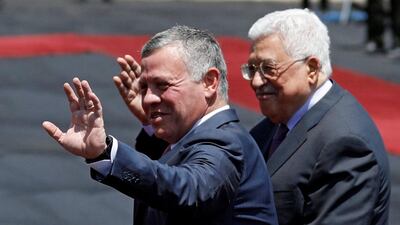
Jordan's King Abdullah II and Palestinian President Mahmoud Abbas wave during a reception ceremony in the West Bank city of Ramallah, August 7, 2017. REUTERS

Jordan's King Abdullah supports Palestinian rights at meeting with Abbas


Khaled Yacoub Oweis
  • English
  • Arabic

Jordan’s King Abdullah II reaffirmed his support for Palestinian rights at a meeting with President Mahmoud Abbas on Sunday, days after he discussed the issue with incoming US president Joe Biden.

The two men are hoping for a shift in American policy under Mr Biden to revive prospects for a two-state solution they regard as having been compromised by Mr Trump’s plan for Middle East peace.

The plan, unveiled in January, ignored Palestinian claims to East Jerusalem and other land, and the illegality of Israeli settlements in territory occupied since the 1967 war.

A Jordanian military helicopter took Mr Abbas from Ramallah to meet the king at his palace resort in Aqaba on the Red Sea, before the Palestinian leader travels to Cairo to meet Egyptian President Abdel Fattah El Sisi on Monday.

Official Jordanian media said King Abdullah told Mr Abbas that Jordan stood “with all of its capacity and abilities” behind realising a “sovereign and viable” Palestinian state on land Israel occupied in 1967, with East Jerusalem as its capital.

“The king affirmed the existing legal and historic status of Jerusalem, emphasising the kingdom’s rejection of all unilateral arrangements that aim at changing the identity of the city and its holy places,” the Petra government news agency said.

The Trump peace plan left the old heart of East Jerusalem under Israeli occupation.

This includes Al Aqsa Mosque, one of the holiest sites in Islam, and other religious sites under Jordanian custody.

A large part of the kingdom’s 10 million population is of Palestinian origin, with relatives in the occupied West Bank and Gaza, and in Israel.

Excluding East Jerusalem from the narrow path to Palestinian statehood that Mr Trump offered has been followed by US moves privately seen by Jordanian officials as provocative.

The latest was 10 days ago when US Secretary of State Mike Pompeo became the first American foreign minister to visit an Israeli settlement in the occupied West Bank.

A joint statement after the meeting in Aqaba said King Abdullah and Mr Abbas “affirmed the need to stop Israeli unilateral moves that compromise the chances for peace and intensify the conflict, such as settlements and annexation of any Palestinian land”.

The Royal Palace said the meeting was attended by Jordanian and Palestinian intelligence chiefs Ahmad Husni and Majid Faraj.

The Palestinian Authority this month resumed security co-operation with Israel, after halting it to protest against Israeli plans to annex Palestinian territory.

The meeting was the first between King Abdullah and Mr Abbas since Washington brokered landmark accords in August between Israel, the UAE and Bahrain.

The Palestinian Authority opposed the deals while Jordan said they could revive Palestinian-Israeli peace talks.

Last week the king spoke with Mr Biden by phone, becoming the first Arab head of state to do so since the Democrat was elected.

A statement by Mr Biden's office said he looked forward "to working closely with King Abdullah on the many interests shared by our countries".

They include counter-terrorism and “addressing other regional security challenges, and supporting a two-state solution to the Israeli-Palestinian conflict".

Jordanian Prof Hassan Al Momani said it appeared that Mr Abbas wanted to hear from the king his views about the “new reality” in Washington and how to deal with the Biden administration, having hoped for the Democrats winning the November 3 elections.

Prof Al Momani, who teaches international studies at the University of Jordan, told The National  that Mr Abbas's strategic position could improve with a "return to the traditional US narrative regarding the Palestinian issue".

But he said Washington had wider interests in the Middle East, which Mr Abbas might not regard as to his advantage.

“There are steps taken by Trump that Biden will aim to further, such as the establishment of relations between Israel and Gulf states,” Prof Al Momani said.


2019 ASIA CUP POTS

Pot 1
UAE, Iran, Australia, Japan, South Korea, Saudi Arabia

Pot 2
China, Syria, Uzbekistan, Iraq, Qatar, Thailand

Pot 3
Kyrgyzstan, Lebanon, Palestine, Oman, India, Vietnam

Pot 4
North Korea, Philippines, Bahrain, Jordan, Yemen, Turkmenistan

Classification of skills

A worker is categorised as skilled by the MOHRE based on nine levels given in the International Standard Classification of Occupations (ISCO) issued by the International Labour Organisation. 

A skilled worker would be someone at a professional level (levels 1 – 5) which includes managers, professionals, technicians and associate professionals, clerical support workers, and service and sales workers.

The worker must also have an attested educational certificate higher than secondary or an equivalent certification, and earn a monthly salary of at least Dh4,000. 

The burning issue

The internal combustion engine is facing a watershed moment – major manufacturer Volvo is to stop producing petroleum-powered vehicles by 2021 and countries in Europe, including the UK, have vowed to ban their sale before 2040. The National takes a look at the story of one of the most successful technologies of the last 100 years and how it has impacted life in the UAE. 

Read part four: an affection for classic cars lives on

Read part three: the age of the electric vehicle begins

Read part two: how climate change drove the race for an alternative 

COMPANY PROFILE
Name: Mamo 

 Year it started: 2019 Founders: Imad Gharazeddine, Asim Janjua

 Based: Dubai, UAE

 Number of employees: 28

 Sector: Financial services

 Investment: $9.5m

 Funding stage: Pre-Series A Investors: Global Ventures, GFC, 4DX Ventures, AlRajhi Partners, Olive Tree Capital, and prominent Silicon Valley investors. 

 
Explainer: Tanween Design Programme

Non-profit arts studio Tashkeel launched this annual initiative with the intention of supporting budding designers in the UAE. This year, three talents were chosen from hundreds of applicants to be a part of the sixth creative development programme. These are architect Abdulla Al Mulla, interior designer Lana El Samman and graphic designer Yara Habib.

The trio have been guided by experts from the industry over the course of nine months, as they developed their own products that merge their unique styles with traditional elements of Emirati design. This includes laboratory sessions, experimental and collaborative practice, investigation of new business models and evaluation.

It is led by British contemporary design project specialist Helen Voce and mentor Kevin Badni, and offers participants access to experts from across the world, including the likes of UK designer Gareth Neal and multidisciplinary designer and entrepreneur, Sheikh Salem Al Qassimi.

The final pieces are being revealed in a worldwide limited-edition release on the first day of Downtown Designs at Dubai Design Week 2019. Tashkeel will be at stand E31 at the exhibition.

Lisa Ball-Lechgar, deputy director of Tashkeel, said: “The diversity and calibre of the applicants this year … is reflective of the dynamic change that the UAE art and design industry is witnessing, with young creators resolute in making their bold design ideas a reality.”